
5 Developmental Benefits of Childcare (Scientifically Proven)
5 Developmental Benefits of Childcare (Scientifically Proven)
Placing your child in a daycare, playgroup, or with a childminder — for many parents, that feels difficult at first. Perhaps you know the feeling: you want the best for your child, but at the same time the question gnaws at you whether it's too early, whether your child will miss you, whether external care might even be harmful.
These worries are completely understandable. And they deserve an honest answer — not blanket reassurance, but a look at what the research actually shows.
The good news: the body of evidence has grown enormously over the past twenty years. Large longitudinal studies such as the NICHD Study of Early Child Care and Youth Development (USA), the EPPE Study (England), and Swiss research in the field of ECEC (Early Childhood Education and Care) — including work funded by the Jacobs Foundation — paint a nuanced picture. And that picture is predominantly positive, when certain quality conditions are met.
In this article you'll learn:
- Which five developmental benefits are well-supported by research
- When childcare is not ideal
- Which quality factors are decisive
- How Switzerland compares internationally
- What all this means concretely for your decision
Important: This article does not replace individual advice. Every child is different. But it gives you a well-founded basis for making the right decision for your family.
The 5 Scientifically Proven Benefits
1. Language Development: Larger Vocabulary, Better Grammar
Language is the key to almost everything — to learning, to social interaction, to expressing feelings. And this is precisely where research shows one of the strongest positive effects of external childcare.
What the studies show:
The NICHD Study, which followed over 1,300 children from birth into adolescence, found a clear link between high-quality care and better language skills — in both vocabulary and grammar. Children who attended a good daycare showed measurably better language competencies at age 4.5 than comparable children without external care.
The British EPPE Study (Effective Pre-School, Primary and Secondary Education) confirmed these findings and showed that the positive effect was still detectable into school age. The advantage was particularly pronounced for children from disadvantaged families.
Why is this so?
In a daycare or playgroup, your child constantly hears language in different contexts: at shared meals, during story time, in conflicts with other children, in explanations from the carer. They experience language not just as a communication tool with Mum and Dad, but as a universal tool.
On top of that, in a group there are children of different ages and different stages of language development. Your child hears more complex sentence structures from older children while practising expressing themselves clearly.
Particularly relevant for Switzerland:
Swiss research in the field of ECEC — supported among others by the Jacobs Foundation — has shown that children with a migration background benefit particularly strongly from early childcare. For a child who speaks a different language at home, daycare is often the first and most important place to experience German (or French, Italian) in everyday life. Early immersion in the local language lays the foundation for school success.
A study by the University of Fribourg showed that children with a migration background who attended daycare from the age of two spoke significantly better German at school entry than comparable children without daycare experience. The difference was large enough to substantially ease the start of school.
What this means for you as a parent: If you're worried about whether your child gets enough language support — especially in a multilingual environment — a good daycare or playgroup can be a real advantage.
2. Social Competence: Sharing, Resolving Conflicts, Developing Empathy
Social skills are among the most important competencies a child can develop in the preschool years. And here the group setting has a decisive advantage over individual care at home.
What the studies show:
The EPPE Study found that children with daycare experience were better able at age 5 to cooperate with other children, resolve conflicts verbally rather than physically, and take the perspective of others. The NICHD Study showed similar effects: children in high-quality care displayed more prosocial behaviour — that is, behaviours such as helping, comforting, and sharing.
Why can't the family achieve this alone?
This isn't to say that families do a poor job — quite the contrary. But certain social learning experiences require a group of peers.
At home, your child is (often) the only child. Or they have one or two siblings. In a daycare, they are one of eight, ten, twelve children. That means:
- Learning to share: Not every toy is immediately available. Waiting, taking turns, negotiating — these are skills that can only be practised to a limited extent in family life.
- Resolving conflicts: When two three-year-olds want the same tricycle, a conflict arises. And precisely this conflict is a learning opportunity that rarely occurs in this form at home.
- Developing empathy: Your child sees that another child is crying because they fell over. They learn to respond to this — at first perhaps uncertainly, then with increasing sensitivity.
The role of the carer:
What matters is how the professional handles conflicts. A good carer doesn't solve the conflict for the children but accompanies them in finding their own solution. In technical terms, this is called scaffolding — a kind of framework that the professional builds so the child can climb on their own.
Practical tip: When you visit a daycare, pay attention to how the carers handle conflicts between children. Are conflicts quickly shut down ("Stop arguing!") or accompanied ("What happened? What could you do?")? That tells you a lot about the pedagogical quality. More on this in our article Recognising Daycare Quality: What to Look For.
3. Cognitive Development: Structured Learning, Curiosity, School Readiness
Children are constantly learning — at home too. But a good daycare offers something that most families find difficult to replicate in everyday life: a thoughtfully designed, structured learning environment tailored to the child's developmental stage.
What the studies show:
The EPPE Study found that children who attended a high-quality preschool setting from the age of three showed better cognitive abilities at school entry — regardless of the parents' educational background. The effect was particularly strong for children from educationally disadvantaged families.
Research in the field of ECEC in Switzerland — including studies conducted within the National Research Programme NRP 60 — supports these findings. Children who attended high-quality care showed better performance in mathematical precursor skills (counting, understanding quantities, recognising patterns) and in logical thinking.
What does "structured learning" mean in daycare?
This doesn't mean classroom teaching. Preschool children learn best through play — but not every type of play promotes development equally. A good daycare offers:
- Guided play: The carer provides materials, asks questions, encourages experimentation — without giving the child the solution.
- Everyday maths: Counting while setting the table, measuring while baking, recognising patterns while sorting.
- Scientific discovery: What happens when you pour water on sand? Why does the leaf fall from the tree? Such everyday observations are taken up and explored further at daycare.
- Creative activities: Painting, crafting, building — this promotes not only fine motor skills but also spatial thinking and problem-solving ability.
School readiness — not school before school:
A common misunderstanding: daycare children are not better prepared for school because they learn letters and numbers earlier. They are better prepared because they have learned to concentrate, follow instructions, work in a group, and experience curiosity as a positive feeling.
Research clearly shows: academic drilling in the preschool years brings no lasting advantage. What counts are the so-called executive functions — working memory, impulse control, cognitive flexibility. And these are precisely what a good daycare promotes through everyday activities.
4. Independence: Eating Alone, Getting Dressed, Making Decisions
Independence is a developmental area that parents often underestimate — and where daycare makes a surprisingly large contribution.
What the research shows:
Studies consistently show that children with daycare experience are earlier in becoming independent in everyday tasks: getting dressed, tying shoes, eating independently, going to the toilet, tidying up. This isn't because daycare children are better brought up — but because the group situation naturally promotes independence.
Why does the group promote independence?
At home, as a parent you often have the reflex to help your child — do up the jacket, hold the plate, tie the shoes. This is lovingly meant but takes away opportunities for practice.
At daycare, the carer is responsible for several children. That means: your child has to do certain things themselves — not because nobody helps, but because the situation naturally requires it. And that is precisely the best learning environment for independence.
Concretely, this means:
| Everyday skill | At home | At daycare |
|---|---|---|
| Putting on jacket | Parents usually help | Child tries alone, carer helps if needed |
| Eating | Parents clear up, hold plate | Child eats independently, clears their dishes |
| Tidying toys | Parents often tidy up themselves | Fixed tidying-up rituals for all children |
| Making decisions | Parents choose clothes, food | Child chooses between options |
| Conflicts | Parents intervene immediately | Child tries to find a solution first |
Montessori principle "Help me to do it myself":
Many Swiss daycares work — whether explicitly or implicitly — with this principle. The environment is designed so that children can do as much as possible themselves: low coat hooks, child-friendly crockery, accessible materials. This strengthens not only practical skills but also self-confidence.
From practice: Many parents report that after a few weeks at daycare, their child can suddenly do things they never attempted at home — close a zip, cut an apple themselves, set the table. This isn't magic; it's the environment.
5. Resilience: Mastering Transitions, Regulating Emotions, Building Frustration Tolerance
Resilience — the ability to cope with challenges, setbacks, and changes — is perhaps the most important but least visible benefit of early childcare.
What the research shows:
Developmental psychology shows that children don't develop resilience through the absence of stress, but through the experience of successfully coping with moderate stress — so-called positive stress. And this is exactly what a good daycare offers in measured doses.
The NICHD Study found that children who experienced high-quality care were better able to cope with transitions and new situations at school age. They showed better emotional regulation — the ability to recognise and constructively deal with strong feelings such as anger, sadness, or frustration.
What resilience experiences does daycare offer?
- Daily transition: Every morning your child says goodbye to you and enters a different environment. This is hard at first — but with a good settling-in process, it becomes a positive experience: "I can do this. Mum/Dad comes back."
- Multiple caregivers: Your child learns that not only Mum and Dad are trustworthy, but that they are also safe with other adults. This expands the trust network.
- Frustration tolerance: The tower falls down. Another child takes the toy. The favourite pudding is all gone. Small frustrations that your child learns to endure.
- Emotional language: Good carers help children name their feelings: "You're angry because Lisa has the ball. I understand that. What could you do?" This verbalisation of emotions is a central building block of resilience development.
The difference from overwhelming stress:
The distinction is important: positive stress is measured, predictable, and accompanied by a trusted caregiver. If a child spends the entire day in an overcrowded daycare without a stable caregiver, that's not positive stress — it's overload. The quality of care makes the crucial difference here.
When Is Daycare NOT Ideal? Important Nuances
Research clearly shows: childcare can have great benefits. But it equally clearly shows that these benefits don't arise automatically. There are situations where external care isn't the best choice — or should at least be adapted.
Your Child's Temperament Plays a Role
Not every child responds the same way to group situations. Some children thrive in a group — they are extroverted, seek contact, get bored quickly alone. Other children are naturally more introverted, sensory-sensitive, or need more retreat space.
Research shows that children with a so-called difficult temperament (high sensory sensitivity, strong emotional reactions) are more sensitive to the quality of care. For these children, good care is particularly important — and poor care is particularly harmful. If your child is very sensitive, you should look especially carefully at whether the facility suits them.
Quality Is the Decisive Factor
This is perhaps the most important insight of all the research: It's not whether a child is cared for that matters — but how.
The NICHD Study and the EPPE Study both reach the same conclusion: high-quality care promotes development. Low-quality care can hinder development — or even have negative effects, particularly in the area of behaviour.
What "quality" concretely means is explained in detail below.
Too Many Hours Can Be Burdensome
The NICHD Study found a correlation between the number of care hours and behavioural issues: children who spent an average of more than 30 hours per week in a facility during the first 4.5 years of life showed slightly more externalising behaviour (e.g. aggression, disobedience) — though still within the normal range.
What does this mean concretely? Not that daycare is fundamentally bad if your child is in full-time care. But it means that with long care hours, you should pay particular attention to quality — and to ensuring your child has enough rest phases and unstructured time.
For infants and very young children (under 12 months), many developmental psychologists recommend starting with shorter care hours and gradually increasing. More on this in our article What Age to Start Daycare?.
Quality Factors: What Must Be Right for the Benefits to Materialise?
Research agrees: the positive effects of childcare depend directly on quality. But what exactly does quality mean in this context? Here are the four most important factors:
Staff-to-Child Ratio
The staff-to-child ratio is the strongest predictor of care quality. The fewer children a professional has to look after, the better they can respond to each individual child.
Recommended benchmarks:
| Age of children | Recommended ratio | Reality in many Swiss daycares |
|---|---|---|
| 0–18 months | 1:3 | Often 1:4 or worse |
| 18–36 months | 1:5 | Often 1:6 |
| 3–5 years | 1:8 | Often 1:10 or more |
These benchmarks are based on international research and recommendations from kibesuisse (the Swiss Childcare Association). Unfortunately, they are not always met in practice — a quality feature you should definitely ask about.
Training of Care Professionals
The qualifications of the professionals have a direct impact on the quality of pedagogical interactions. In Switzerland, there are various training levels:
- FaBe (Childcare Specialist): Three-year vocational training (EFZ). The standard in most daycares.
- HF (Higher Professional School): Advanced training as an Early Childhood Educator HF. In-depth pedagogical knowledge.
- Interns and apprentices: In many daycares, they make up a large part of the team. This isn't inherently bad, but the ratio of trained to untrained staff needs to be right.
The EPPE Study found that facilities with better-trained staff (particularly those with university-level pedagogical education) provided higher-quality care — and that this directly affected children's cognitive and social development.
Consistent Caregivers (Low Turnover)
Children need stable relationships. If carers constantly change, your child cannot build a secure attachment — and precisely this attachment is the foundation for all positive effects.
Ask about staff turnover when visiting a daycare. High turnover is often a sign of poor working conditions — and poor working conditions almost always mean poorer care quality.
Age-Appropriate Pedagogy
A two-year-old needs something different from a four-year-old. Good daycares differentiate their offerings by age group and follow recognised pedagogical frameworks (such as the Swiss Framework for Early Childhood Education and Care).
Tip: Unsure which form of care is right for you? Our Childcare Finder Quiz helps you find the right option — in less than 3 minutes.
A detailed guide to all quality features can be found in our article Recognising Daycare Quality: What to Look For.
Switzerland in International Comparison: Catching Up on ECEC
Switzerland is one of the wealthiest countries in the world — but in early childhood education and care (ECEC), it lags far behind internationally.
Some facts:
- According to the OECD, Switzerland invests only around 0.4% of GDP in pre-school education. The OECD average is around 0.8%, and Scandinavian countries invest over 1.5% in some cases.
- There is no national legal entitlement to a daycare place. Availability and costs vary enormously by canton and municipality.
- Daycare places in Switzerland are extremely expensive: full-time care costs between CHF 2,000 and 3,000 per month depending on the region — before subsidies. Many families cannot afford this.
- Wages for care professionals are low compared with other professions carrying similar responsibility. This leads to high turnover and a skills shortage.
The Jacobs Foundation, with its "Primokiz" initiative and various research projects, has helped raise awareness of the importance of ECEC in Switzerland. The federal government has also taken steps in the right direction with start-up financing and the parliamentary initiative to reduce care costs.
But much remains to be done. If we know that high-quality childcare promotes development, improves equality of opportunity, and pays off economically in the long run, the current underinvestment is hard to justify.
What Does All This Mean for You as a Parent?
Let's translate the research into concrete recommendations for action:
1. Childcare Can Be a Great Asset for Your Child
The evidence is clear: high-quality care promotes language, social competence, cognitive development, independence, and resilience. You're not doing your child a favour by forgoing care out of guilt.
2. Quality Over Quantity
Better three days in an excellent daycare than five days in a mediocre one. Pay attention to the staff-to-child ratio, the training of the staff, the stability of the team, and the pedagogical approach.
3. The Settling-In Process Is Crucial
A good settling-in period — ideally following the Berlin or Munich model — lays the foundation for everything that follows. Take enough time for this. More in our article Daycare Settling In: How to Make the Start a Success.
4. Observe Your Child
Research provides averages — your child is an individual. Observe how they respond to care. Are they happy in the morning? Do they tell you about their experiences? Or do they withdraw, cry a lot, sleep badly? Your child gives you the most important clues.
5. It Doesn't Have to Be Daycare
Daycare is the best-known form — but not the only one. A loving childminder, a well-run playgroup, or a day-care family association can deliver equally good outcomes if the quality is right. Compare the options in our article Daycare, Playgroup, or Childminder: What Suits You?.
6. Find Out About Subsidies
Many municipalities and cantons offer childcare vouchers or income-dependent contributions. It's worth checking the options in your municipality.
Frequently Asked Questions
Does it harm my child to go to daycare early?
No — provided the care is high-quality and the settling-in process is done carefully. Research shows that children from about 12 to 18 months can benefit well from group care. For younger children, many professionals recommend individual care (e.g. a childminder) or shorter care hours. The quality of the relationship with the carer is always what matters most. More on this: What Age to Start Daycare?
How many days per week are beneficial?
That depends on your child's age and your family situation. Research shows that as few as two to three days per week are enough to achieve the developmental benefits described. For children under two, two to three days are often ideal. For children aged three and above, four to five days can also work well if the daycare quality is right and the child feels comfortable.
Are children who are cared for at home disadvantaged?
No, not fundamentally. Children who are cared for at home by engaged parents who read to them often, play with them, and facilitate social contacts also develop excellently. The advantage of daycare lies primarily in providing a complementary learning environment — not in replacing the family. However, children from educationally disadvantaged families or families with a migration background benefit more strongly from early external care, because daycare can offer stimulation that may be lacking at home.
How do I recognise a good daycare?
The most important features are: a good staff-to-child ratio, trained and stable staff, a warm and respectful atmosphere, a well-thought-out pedagogical concept, and open communication with parents. Also trust your gut feeling: if you visit the daycare and feel welcome and respected as a parent, that's a good sign. A detailed guide can be found here: Recognising Daycare Quality.
Conclusion
The science is clear: high-quality childcare offers children real developmental benefits — linguistically, socially, cognitively, in terms of independence, and in terms of resilience. These benefits are particularly significant for children from disadvantaged backgrounds, but they apply to all children.
At the same time, "daycare" is no guarantee. The quality must be right. And your child is unique — what is ideal for one child may not suit another.
Take the time to compare different options. Ask questions. Observe your child. And don't let guilt guide you — because good care is not a replacement for the family, but a valuable complement.
Next step: Not sure which form of care suits you best? Take our Childcare Finder Quiz — in less than 3 minutes you'll get a personal recommendation.
This article is based on current research and was prepared with care. It does not replace individual advice. Sources: NICHD Study of Early Child Care and Youth Development; EPPE/EPPSE Study (Effective Pre-School, Primary and Secondary Education); Jacobs Foundation / Primokiz; National Research Programme NRP 60; kibesuisse; OECD Family Database; Swiss Framework for Early Childhood Education and Care.
More articles

What Age for Daycare? What Research Says
When is your child ready for daycare? Research-based guide on developmental stages, settling-in, and quality criteria fo...
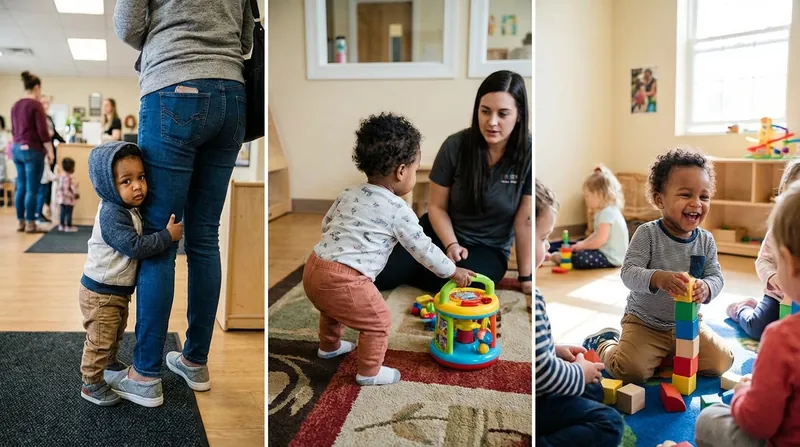
Settling-In by Age: Baby, Toddler, Preschool
Settling-in varies greatly by age. Learn which models work at which age and how to best support your child through the t...

Social Skills: What Kids Learn in Daycare
Children develop important social skills in daycare. Learn how group life and role play strengthen your child's emotiona...

Language Development: How Daycare Helps
Growing up multilingual in Switzerland: how daycare supports your child's language development and what you can do as a ...

Daycare Costs Switzerland 2026: Real Prices
How much does a daycare place cost in Switzerland? Current prices by canton, subsidies, tax deductions, and practical mo...
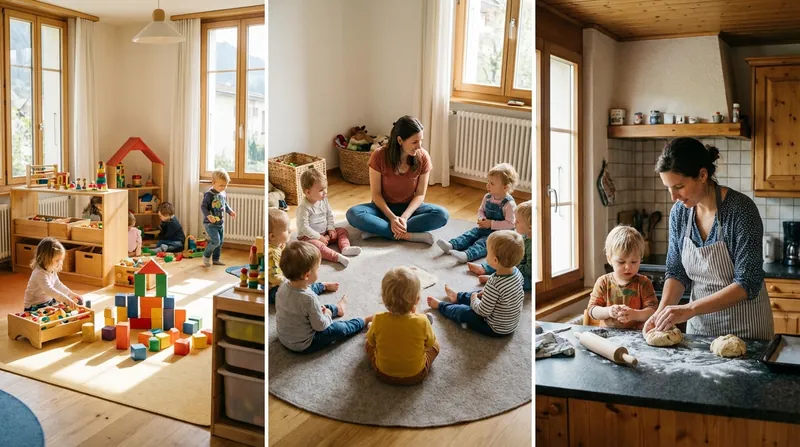
Daycare, Playgroup, or Childminder? The Complete Comparison
Which type of childcare is right for your family? Daycare, playgroup, and childminder compared side by side: age, costs,...