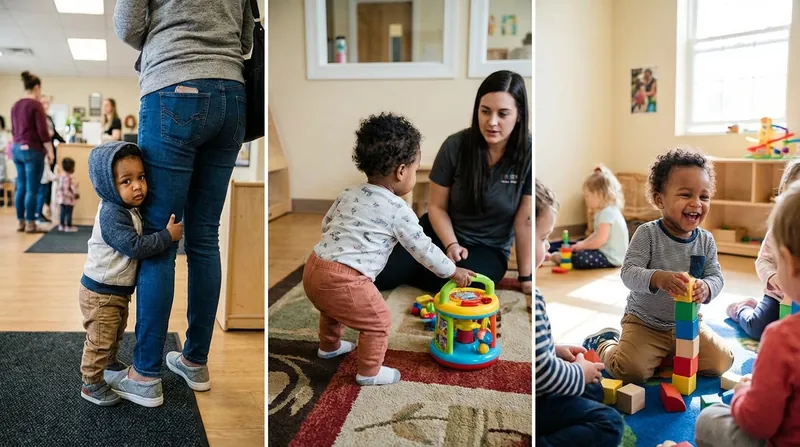
Settling In by Age: Baby, Toddler, Preschooler
Settling In by Age: Baby, Toddler, Preschooler
Settling into daycare is one of the most emotional phases for parents and children alike. But settling in at 4 months looks completely different from settling in at 3 years. Babies primarily need physical closeness and familiarity with a caregiver. Toddlers are in the middle of the autonomy phase, oscillating between curiosity and separation anxiety. And preschoolers already bring enormous understanding, but at the same time have their own unique fears.
This guide shows you how the settling-in process works depending on the child's age, which models exist, and what you as a parent can specifically do to make the transition smooth. If you're looking for a general overview of settling in, we recommend our introductory article Daycare Settling In: How to Make the Start a Success.
The Two Best-Known Settling-In Models
Before we look at the age groups, a brief overview of the two models most commonly used in Switzerland.
The Berlin Model
The Berlin settling-in model was developed in the 1980s and is the most widely used model in Swiss daycares. It is based on attachment theory and follows a clear process:
| Phase | Duration | What happens |
|---|---|---|
| Foundation phase | 3 days | Parent accompanies the child to daycare, stays the entire time, is passively present |
| First separation attempt | Day 4 | Parent says a short goodbye (a few minutes) and leaves the room |
| Stabilisation phase | Days 5–14 | Separation times are gradually extended |
| Final phase | From day 14 | Child is cared for on a regular basis, parent is reachable by phone |
Important: The time indications are guidelines. Some children only need a week, others six weeks or more. The child sets the pace — not the calendar.
The Munich Model
The Munich model is more extensive and participatory than the Berlin model. It typically lasts 4 to 6 weeks and involves the parents more actively:
| Phase | Duration | What happens |
|---|---|---|
| Preparation phase | Before entry | Detailed intake meeting, parents get to know the daycare and team |
| Getting-to-know phase | Weeks 1–2 | Parent participates in daycare life with the child, takes part in activities |
| Security phase | Weeks 2–3 | First short separations, carer takes over care tasks |
| Trust phase | Weeks 3–4 | Separation times are extended, child builds trust with the carer |
| Evaluation phase | Weeks 5–6 | Reflection meeting between parents and care professionals |
Which Model Is Better?
Both models have their merits. The Berlin model is more structured and works well for daycares managing many settling-in processes simultaneously. The Munich model is more individualised and involves parents more closely. In practice, many Swiss daycares use a hybrid form combining elements of both models.
Settling In by Age: 0 to 12 Months (Babies)
What Your Baby Needs at This Age
Babies in their first year of life are completely dependent on their attachment figures. They cannot yet understand why Mum or Dad is suddenly gone. Their sense of time is not yet developed — every separation feels final.
At the same time, babies at this age are comparatively flexible when it comes to new caregivers. If the settling-in process is carried out sensitively, they can build a secure bond with a daycare professional relatively quickly.
Special Aspects of Baby Settling-In
- Care as a bonding moment: Nappy changing, feeding, and sleep accompaniment are the most important moments for building attachment. The carer takes over these tasks step by step.
- Sleep rituals: Every baby has their own falling-asleep habits. The daycare should be willing to adopt these as far as possible.
- Scent transfer: A worn T-shirt from Mum or a cuddly toy from home gives the baby security.
- Maintaining rhythm: The baby's sleep and feeding rhythm should be maintained as far as possible at the daycare.
- Non-verbal signals: Babies communicate through facial expressions, gestures, and crying. The carer must learn to read these signals correctly.
Typical Process (Adapted Berlin Model)
| Day | Duration | Process |
|---|---|---|
| Days 1–3 | 1–2 hrs | You are with the baby at the daycare, the carer approaches slowly, observes |
| Day 4 | 30–60 min separation | Short goodbye, you leave the room, stay nearby |
| Days 5–10 | Gradual extension | Separation is extended depending on the baby's reaction |
| Days 11–21 | Half/full days | Baby is fully integrated into the daycare routine |
Tips for Parents
- Allow at least 3 to 4 weeks for settling in — for babies under 6 months, rather more
- Be patient if the carer needs time to read your baby's signals
- Breastfeeding/bottle: discuss with the daycare how meals will work
- At what age daycare can make sense is explained in our article What Age to Start Daycare?
Settling In by Age: 12 to 24 Months (Toddlers)
What Your Toddler Needs at This Age
The phase between 12 and 24 months is often the most challenging for settling in. Children at this age have developed a strong bond with their primary attachment figures and frequently go through a phase of stranger anxiety. At the same time, they are becoming increasingly mobile and curious about their surroundings.
This means: your toddler wants to explore the daycare but simultaneously needs the reassurance that you're there. They literally go back and forth between the carer and you — and that's a good sign, because it shows they are using their secure base.
Special Aspects of Toddler Settling-In
- Separation protest is normal: At this age, crying at goodbye is not just normal but a healthy sign — it shows that your child has a secure attachment.
- Transitional objects: A comfort toy, a dummy, or a cloth from home are enormously important. They provide security in the new environment.
- Create rituals: A consistent goodbye ritual provides predictability and thus security.
- Language development: Many children at this age cannot yet express what they feel. Watch for physical signals such as sleep disturbances, appetite changes, or clinging.
- Autonomy phase: "No!" and "Do it myself!" are typical expressions at this age. This can make settling in harder but is developmentally normal.
Typical Process
| Day | Duration | Process |
|---|---|---|
| Days 1–3 | 1–2 hrs | You are present, child explores the room, carer offers play activities |
| Days 4–5 | First separation 10–30 min | Short goodbye, you go out, return reliably |
| Days 6–14 | Separation gradually extended | From 30 min to 1–2 hours, then to half days |
| Days 15–28 | Full day | Child stays the whole day, including lunch and nap |
Tips for Parents
- Always say goodbye — never sneak away. That destroys trust.
- Keep the goodbye short and loving: "I'll come back after the afternoon snack."
- If you cry, cry quietly. Your emotions transfer to your child.
- Call after 30 minutes and ask how things are going — most children calm down quickly.
Settling In by Age: 2 to 3 Years
What Your Child Needs at This Age
Children between 2 and 3 are little personalities with a strong will, a growing vocabulary, and the ability to understand routines. They can already grasp that you'll come back — but the feeling of separation is still intense.
At this age it helps enormously if you portray the daycare and the care professionals positively and actively prepare your child for starting daycare.
Special Aspects
- Preparation is possible: You can talk with your child about daycare, read picture books on the topic, and even make a visit in advance.
- Friendships emerge: Children at this age begin to form friendships. This is a strong motivator for attending daycare.
- Toilet training: Many children at this age are in the middle of the potty-training process. Discuss with the daycare how this will be handled.
- Understanding rules: Children understand simple rules and benefit from clear structures.
Tips for Parents
- Visit the daycare with your child beforehand on a trial day
- Read picture books about daycare life
- Let your child choose their own rucksack and indoor shoes — involvement strengthens motivation
- Speak positively about the daycare without creating unrealistic expectations
Settling In by Age: 3 Years and Older (Preschoolers)
What Your Child Needs at This Age
Children aged 3 and older already bring extensive understanding of social situations. They can cognitively process the separation from their parents and understand that Mum or Dad will come back after work. Nevertheless, starting daycare can still be challenging at this age — especially for children who have been primarily cared for at home.
Special Aspects
- Fostering independence: Preschoolers want to do many things themselves. Let your child dress themselves, carry the rucksack, and say goodbye on their own.
- Social anxieties: At this age, children can be afraid of not fitting in or being excluded. Talk about this.
- Comparison with others: Children at this age compare themselves with peers and may become insecure when other children can do something better.
- Cognitive understanding: You can talk with your child about feelings and expectations.
Typical Process
Settling in from age 3 is often shorter than for younger children but can vary depending on personality:
| Phase | Duration | Process |
|---|---|---|
| Trial visits | 1–2 visits | Child visits the daycare with parent, gets to know the rooms and other children |
| Accompanied start | 1–3 days | Parent stays one to two hours at the daycare |
| First separations | Days 3–5 | Half days without parent |
| Full care | From week 2 | Child stays the whole day |
Tips for Parents
- Tell your child about all the exciting things that happen at daycare — crafting, gymnastics, singing, playing
- Arrange playdates with other daycare children so that friendships can develop
- Take your child's fears seriously, even if they seem small to you
- Celebrate the daycare start as a positive event — your child is growing up!
Signs of a Successful Settling-In
How do you recognise that settling in has worked? Here are the most important signs:
Positive Signs
- Your child lets the carer comfort them when they are sad
- They show joy when being taken to daycare (even if they cry briefly at goodbye)
- They talk about daycare experiences at home and name other children by name
- They eat and sleep well at daycare
- The carer knows your child's preferences and quirks
- Your child brings home crafts or drawings and is proud of them
Warning Signs
- Your child still cries excessively at goodbye after 4 to 6 weeks and cannot be calmed
- They completely withdraw at daycare and don't play
- They show noticeable behavioural changes at home (sleep problems, bedwetting, extreme clinginess)
- They refuse to eat at daycare for weeks
- The carer cannot build a relationship with the child
Important: If settling in hasn't worked after 6 weeks, it doesn't mean your child isn't suited for daycare. It can help to change the carer, adapt the model, or take a break and try again later.
Parent Behaviour: What Helps, What Harms
Your behaviour as a parent has a major influence on how the settling-in process goes. Here is an honest overview:
What Helps
- Trust the daycare: If you're uncertain, your child will sense it. Choose a daycare you trust, and then actually trust it.
- Be reliable: Always arrive on time for pick-up. Keep to agreements.
- Be emotionally available: When you're there, be truly present — not on your phone.
- Stay calm: Even when your child cries, remain composed and loving.
- Communicate openly: Share important information with the daycare (bad night, doctor's visit, changes at home).
What Harms
- Sneaking away: Your child will notice and lose trust
- Coming back: Once you've said goodbye, go. Coming back again prolongs the pain.
- Crying in front of the child: Your tears signal to the child: the situation is dangerous.
- Comparing: "But Leon doesn't cry either!" — such comparisons put your child under pressure.
- Threatening: "If you don't stop crying, I'll leave!" — that worsens the fear.
Conclusion: Every Age Has Its Own Path
Settling in is a process that is as individual as your child. Whether baby, toddler, or preschooler — each age group brings its own challenges and opportunities. The most important thing is that you allow enough time, see the care professionals as partners, and give your child the security that you'll always come back.
Further helpful information can also be found in our article A Day at Daycare: What Your Child Experiences — for a concrete insight into what awaits your child after settling in.
Further reading:
More articles

What Age for Daycare? What Research Says
When is your child ready for daycare? Research-based guide on developmental stages, settling-in, and quality criteria fo...

5 Developmental Benefits of Childcare
What does research say? 5 scientifically proven benefits of external childcare for your child's development — and what t...

Social Skills: What Kids Learn in Daycare
Children develop important social skills in daycare. Learn how group life and role play strengthen your child's emotiona...

Language Development: How Daycare Helps
Growing up multilingual in Switzerland: how daycare supports your child's language development and what you can do as a ...

Daycare Costs Switzerland 2026: Real Prices
How much does a daycare place cost in Switzerland? Current prices by canton, subsidies, tax deductions, and practical mo...

Daycare, Playgroup, or Childminder? The Complete Comparison
Which type of childcare is right for your family? Daycare, playgroup, and childminder compared side by side: age, costs,...