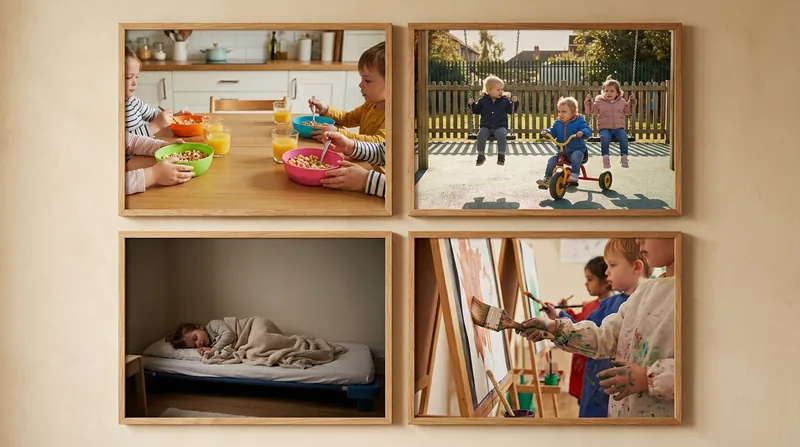
A day in daycare: What your child experiences
A day in daycare: What your child experiences
Your child is about to start daycare — or is already there — and you're wondering: What actually happens all day? What does a typical daily schedule look like? What does my child eat? Do they go outside even when it rains? And what do I need to pack in the daycare backpack? This guide takes you through a complete daycare day in Switzerland, explains the pedagogical concepts behind it and shows you how daily life differs depending on your child's age.
The typical daily schedule in a Swiss daycare
Most daycares in Switzerland follow a similar basic rhythm, even if the details differ depending on the facility, pedagogical concept and canton. Here is an example daily plan:
| Time | Activity | Description |
|---|---|---|
| 07:00–09:00 | Arrival & free play | The children are dropped off, greeted and play freely |
| 09:00–09:30 | Morning circle | Shared ritual: song, greeting, plan for the day |
| 09:30–10:00 | Morning snack | Shared snack (fruit, bread, water) |
| 10:00–11:30 | Guided activity / outdoors | Crafts, painting, gymnastics, forest trip or garden play |
| 11:30–12:00 | Tidying up & hand washing | Tidying up together, preparation for lunch |
| 12:00–12:45 | Lunch | Hot meal, eaten together at the table |
| 12:45–14:30 | Rest phase / nap | Sleeping, reading aloud, quiet play |
| 14:30–15:00 | Afternoon snack | Afternoon snack (fruit, yoghurt, crackers) |
| 15:00–17:00 | Free play / afternoon activity | Indoors or outdoors, depending on the weather |
| 17:00–18:30 | Pick-up phase | Children are collected, quiet play until pick-up |
Note: This plan is a guideline. Every daycare has its own rhythm, adapted to the needs of the group of children. Some daycares only open at 7:30, others have extended care hours until 19:00.
The individual daily elements in detail
Arrival and free play (07:00–09:00)
The morning begins with arrival. The carer greets each child individually — this is important for the transition from family to daycare. Many daycares have a farewell ritual: a waving window, a short phrase like "Bye Mummy, see you tonight" or a sticker on the hand.
During free play time, the children choose what they want to do: build with Lego, play in the dolls' corner, look at books or paint. Free play is not a "filler" — it is a central element of early childhood education, in which children develop creativity, social skills and problem-solving abilities.
Morning circle (09:00–09:30)
The morning circle is a ritual that gives children orientation. Everyone sits in a circle and:
- Greeting: Each child is greeted by name, often with a song
- Plan for the day: The carer explains what is coming up today
- Weather and season: What day of the week is it today? What's the weather like?
- Conversation: The children are allowed to share what they have experienced
- Action song or singing game: Singing and moving together
The morning circle lasts between 10 and 30 minutes depending on the age of the group. Babies and toddlers under 2 years often don't participate yet.
Guided activities (10:00–11:30)
After the morning snack comes the "guided sequence" — an activity planned by the carer. This is based on the daycare's pedagogical concept and the children's age:
- Creative work: Painting with finger paints, crafting with natural materials, modelling
- Movement: Gymnastics, dancing, rhythmics, obstacle courses in the garden
- Nature and environment: Gardening, forest trips, observing animals
- Language and music: Stories, finger games, instruments
- Experiments: Pouring water, sieving sand, mixing colours
The activities change daily and are often based on a weekly theme (e.g. "Autumn", "Animals on the farm", "Colours").
Lunch (12:00–12:45)
Mealtimes in daycare are far more than food intake — they are a social event. The children eat together at the table, learn table manners, try new foods and practise independence (serving themselves, holding a cup, using cutlery).
Rest time (12:45–14:30)
After lunch, children need a break. Depending on age, rest time looks different:
- Babies and toddlers (0–2 years): Sleep in their own cot or on a mat. Sleep duration: 1–2 hours
- Children 2–3 years: Nap or rest period with reading aloud and quiet play
- Children 3–5 years: Often no longer sleeping, but a "quiet hour" with books, audio stories or puzzles
Important: Good daycares don't force any child to sleep. If your child doesn't want to sleep, they are guided to a quiet activity.
Afternoon snack and afternoon (14:30–18:30)
The afternoon is more freely structured in many daycares than the morning. After the afternoon snack (a light snack), the children usually play outside — in the garden, at the playground or in the neighbourhood. From about 16:30, the pick-up phase begins. The carer briefly informs you about the day when you collect your child: What did your child eat? How did they sleep? Were there any special experiences?
Differences by age group
Daily daycare life differs considerably depending on your child's age. Here is an overview:
Baby group (0–18 months)
| Feature | Details |
|---|---|
| Staff-to-child ratio | 1 carer per 3–4 babies |
| Daily structure | Very individual, oriented around the baby's sleeping and eating rhythm |
| Activities | Sensory experiences (touch mats, rattles), movement support, singing, lots of physical contact |
| Eating | Bottle / puree, later finger food. You bring milk powder/breast milk |
| Sleep | 2–3 naps per day, individually as needed |
| Nappies | Regular changing (every 2–3 hours), nappies often brought by parents |
Toddler group (18–36 months)
| Feature | Details |
|---|---|
| Staff-to-child ratio | 1 carer per 4–6 toddlers |
| Daily structure | Fixed rhythm with morning circle, activities and shared meals |
| Activities | Free play, simple crafts, sandpit, movement games, first role play |
| Eating | At the table with cutlery, increasingly independent, same meal as the older children |
| Sleep | 1 nap (1–2 hours) |
| Development | Toilet training (in consultation with you), language explosion, "I do it myself!" phase |
Preschool group (3–5 years)
| Feature | Details |
|---|---|
| Staff-to-child ratio | 1 carer per 6–8 children |
| Daily structure | Clearly structured day with morning circle, guided activities and lots of outdoor time |
| Activities | Projects (over several days), excursions, first "school preparation" (numbers, letters, concentration), cooking, theatre |
| Eating | Independent, helps with setting and clearing the table |
| Sleep | Usually no more nap, but a quiet break instead |
| Development | Social competence, friendships, conflict resolution, preparation for kindergarten |
Pedagogical concepts in Swiss daycares
Not every daycare works the same way. Most Swiss daycares are guided by one or more pedagogical approaches. Here are the most important ones:
Reggio Emilia
The Reggio approach originates from northern Italy and sees the child as a competent, curious researcher. Central elements:
- 100 languages of the child: Children express themselves in diverse ways — painting, building, dancing, speaking
- Project work: Children pursue their own topics over days or weeks
- The room as third educator: Bright, aesthetic rooms with diverse materials
- Documentation: The carers document learning processes and make them visible to parents
In Switzerland, particularly many urban daycares work with the Reggio approach.
Montessori
Maria Montessori coined the phrase "Help me do it myself". Central elements:
- Prepared environment: Everything is at child height, materials are freely accessible
- Independence: Children choose their own activities and work at their own pace
- Montessori materials: Special learning materials (sandpaper letters, pink tower, golden bead material)
- Mixed-age groups: Younger children learn from older ones
Montessori daycares exist in almost every canton in Switzerland, both as private and subsidised facilities. They are often somewhat more expensive than regular daycares.
Waldorf
Waldorf pedagogy according to Rudolf Steiner emphasises rhythm, creativity and nature experience:
- Rhythm: A clear, recurring daily, weekly and annual rhythm
- Natural materials: Wooden toys, beeswax clay, wool instead of plastic
- Creativity: Lots of painting, singing, eurythmy, crafts
- Free play: Unscheduled time for free play has a high priority
- Seasonal festivals: Harvest festival, lantern festival, St John's — the annual cycle is celebrated
Waldorf daycares (also called Waldorf nurseries) can be found mainly in larger Swiss cities. The approach suits families who want a nature-oriented, low-stimulus daily life for their children.
Situational approach and open work
Many Swiss daycares work with the situational approach: The carers pick up topics that currently occupy the children and create learning opportunities from them. Additionally, more and more daycares use open work: Instead of fixed groups, the children move freely between different function rooms (building room, atelier, movement room, role play corner).
If you would like to know which quality features make a good daycare — regardless of the pedagogical concept — our guide Daycare visit: 50 questions for the first visit will help you.
Nutrition in daycare: What's on the menu?
Meal structure
Most daycares in Switzerland offer three meals:
| Meal | Time | Typical contents |
|---|---|---|
| Morning snack | 09:30 | Seasonal fruit, wholegrain bread, vegetable sticks, water |
| Lunch | 12:00 | Hot meal: vegetables, protein (meat/fish/tofu), starch (rice/pasta/potatoes) |
| Afternoon snack | 15:00 | Fruit, yoghurt, crackers, rice cakes, water |
Organic and regional
More and more daycares are opting for organic and regional foods. Particularly in the cantons of Zurich, Bern and Basel, there is a strong trend towards sustainable food in daycares. Some daycares cook freshly on site every day, others are supplied by a catering service.
Allergies and intolerances
Good daycares take allergies and intolerances very seriously. You should provide all relevant information in writing when registering:
- Allergies: Nuts, milk, eggs, gluten, soy etc.
- Intolerances: Lactose, fructose etc.
- Religious or cultural dietary requirements: No pork, vegetarian, vegan etc.
- Emergency plan: For severe allergies (e.g. anaphylaxis), an emergency plan with medication (e.g. EpiPen) must be in place
Tip: When visiting the daycare, ask specifically about how they handle allergies. How are meals adapted? Who is responsible? Is there an allergy protocol? More on this in our guide Daycare contract: What you should look out for.
Outdoors in any weather
"There's no bad weather, only bad clothing"
This saying is taken literally in Swiss daycares. Most daycares go outside every day — in sunshine, rain, snow and cold. There are good reasons for this:
- Health: Fresh air strengthens the immune system and prevents infections
- Movement: Outside, children can run, climb, jump — live out their urge to move
- Experiencing nature: Seasons, animals, plants — nature experience is a central area of education
- Mood: Children (and carers) are more balanced after outdoor time
Limits of outdoor time
Naturally, there are limits. Most daycares have guidelines:
- Heat: From about 33–35 °C, children stay in the shade or indoors. Drinking plenty of water, sunscreen and a sun hat are mandatory
- Cold: From about –10 °C, outdoor time is shortened. Warm clothing in layers is crucial
- Thunderstorms and storms: During thunderstorms, children go inside immediately. Storm warnings are taken seriously
- Heavy rain/hail: In extreme weather, they stay indoors
What does my child need? The daycare backpack packing list
Every daycare has its own list, but you will need this basic equipment almost everywhere:
Daily daycare backpack
| Item | Details |
|---|---|
| Spare clothing | At least 1 complete set (underwear, T-shirt, trousers, socks) |
| Rain gear | Rain jacket and rain trousers (leave at daycare) |
| Wellington boots | Leave at daycare, for wet days |
| Indoor shoes / slippers | Non-slip, comfortable |
| Sun hat | Mandatory in summer |
| Sunscreen | Applied at home, tube for the daycare |
| Nappies | If needed: supply at daycare (bring or included in the rate, depending on daycare) |
| Dummy / cuddly toy | If your child needs one (only for rest time) |
| Drinking bottle | Labelled with your child's name |
| Toothbrush | Some daycares brush teeth after lunch |
Seasonal additions
| Season | Additional items to pack |
|---|---|
| Spring | Mud trousers, light jacket, cap |
| Summer | Sun hat, sunscreen (SPF 50+), swimsuit, towel |
| Autumn | Rain jacket, rain trousers, wellington boots, warm layer |
| Winter | Ski suit / winter jacket + snow trousers, winter boots, gloves, hat, scarf |
Tip: Label all clothing items with your child's name. In a daycare with 30 children, blue rain jackets all look the same. Name stickers or a waterproof pen will save you a lot of searching.
What often surprises parents
Settling-in takes longer than expected
Many parents expect 1–2 weeks of settling-in. In practice, many children need 3–6 weeks before they truly feel comfortable. Patience is key. More on this in our guide Daycare settling-in: How to make the start a success.
Children eat differently at daycare than at home
Your child won't eat vegetables at home, but suddenly eats broccoli and carrots at daycare? This is normal. The group effect is powerful — when the other children eat, your child joins in. Conversely, your child may eat less at daycare than usual because they are excited or tired. Neither is cause for concern.
The "daycare cold" is real
In the first months, your child will probably be ill more frequently. This is normal and even important for building the immune system. Expect 8–12 infections in the first daycare year. That sounds like a lot but is medically harmless. If you're wondering when your child can no longer attend daycare, speak to the daycare management directly — most have clear rules (fever above 38 °C, diarrhoea, conjunctivitis etc.).
The costs are higher than expected
Daycare costs in Switzerland are among the highest in Europe. Depending on the canton, income and care volume, you pay between CHF 400 and CHF 2,500 per month for one day per week. Use our cost calculator to calculate your individual budget, and find out about subsidies in your canton via our canton pages.
Frequently asked questions (FAQ)
How long does a daycare day normally last?
Most daycares in Switzerland offer full-day care from about 7:00 to 18:00 or 18:30. You don't have to leave your child there all day though. Many parents drop their child off between 7:30 and 9:00 and pick up between 16:30 and 18:00. Some daycares also offer half-day care (e.g. until 13:30 including lunch).
What happens if my child cries at daycare?
Crying at drop-off is completely normal in the first weeks — especially during settling-in. The carers are trained for this and comfort your child. In the vast majority of cases, the child calms down a few minutes after you leave. If the crying persists over several weeks, the daycare will seek a conversation with you and look for solutions together.
Can I visit the daycare during the day?
That depends on the daycare. Some daycares have an open-door policy and allow visits by arrangement. Others recommend not visiting the children during the day because it disrupts the routine and can trigger renewed separation distress in some children. Ask the daycare management.
My child is in a forest playgroup. Is the daily schedule different there?
Yes, in a forest playgroup or farm playgroup, the schedule is naturally different — the children are outside almost the entire time, the morning snack is prepared over a fire and the activities revolve around nature experience. Read our separate guide Forest and farm playgroup: Adventures for little explorers for more.
How do I find the right daycare near me?
Most easily through the search function on kizi.ch. You can filter by location, care type, availability and pedagogical concept. Compare several daycares and visit at least 2–3 in person before you decide.
Conclusion: Daily life in daycare — structured, varied, child-friendly
A good daycare day is an interplay of structure and freedom, activity and rest, indoors and outdoors. Your child doesn't just learn crafts and singing — they learn to navigate a group, resolve conflicts, become independent and make friends. These are skills that have an impact far beyond the daycare years.
Your next steps
- Ask your daycare about the exact daily schedule — every facility has its own rhythm
- Pack the daycare backpack with our checklist
- Talk to the carer about your child's needs (sleep, food, allergies)
- Compare daycares near you on kizi.ch
Find suitable care now on kizi.ch
Sources: kibesuisse recommendations, Orientation framework for early childhood education, care and upbringing in Switzerland (Marie Meierhofer Institute), cantonal guidelines for quality assurance in daycares, Swiss Society for Nutrition (SGE). As of: February 2026.
More articles
Daycare Tour: The Ultimate Checklist
What to look for during a daycare tour? The most important questions about organization, education, rooms, and costs....
Daycare Settling-In: A Successful Start
Everything about the daycare settling-in period: the Berlin Model explained, typical process, what to do when your child...
Finding Daycare in Switzerland: Step by Step
How to find the right daycare place: when to register, what to look for, which questions to ask. A practical guide with ...
Child Sick: Can They Go to Daycare? Rules
Child sick — daycare yes or no? Clear rules, waiting periods, your rights as an employee, and emergency solutions for wo...

Daycare Change or Move: Smooth Transition
Planning a move or unhappy with the daycare? How to make the change stress-free — incl. checklist and settling-in tips....

Daycare Costs Switzerland 2026: Real Prices
How much does a daycare place cost in Switzerland? Current prices by canton, subsidies, tax deductions, and practical mo...