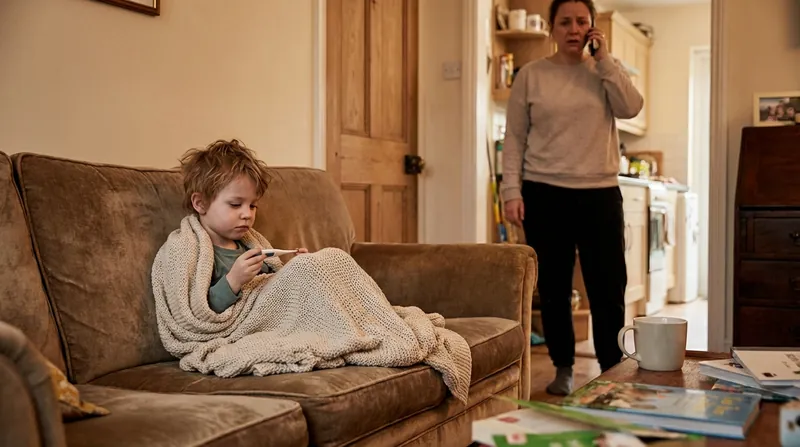
When must your child stay home?
It happens in every family — and usually at the worst possible moment: your child wakes up in the morning, forehead hot, nose running, eyes glazed. You feel their forehead, grab the thermometer and see: 38.7 °C. At the same time, you have a meeting at 9 am that you can't reschedule. What now?
The question "child sick — daycare yes or no?" comes up regularly for working parents. Studies show that children go through six to ten infections per year in their first daycare years. This is normal and even important for building the immune system — but it throws everyday life into disarray each time.
This guide gives you a complete overview: When must your child stay home? How long is the quarantine period for the most common illnesses? What are your rights towards your employer? And what can you do when simply no one can step in?
When must your child stay home?
Most daycares in Switzerland have clear guidelines that are set out in the care contract or parent regulations. Even though the details vary slightly from daycare to daycare, the following basic rules apply practically everywhere:
Fever above 38.5 °C
From a body temperature of 38.5 °C (measured rectally), a child is considered feverish and may not attend daycare. Some facilities set the threshold as low as 38.0 °C. Important: what counts is the temperature without fever-reducing medication. Making a child "fit" with paracetamol in the morning and sending them to daycare is not a solution — the child needs rest, and the daycare will turn them away if the fever returns during the day.
Vomiting or diarrhoea
If your child has vomited or had diarrhoea in the past 24 hours, they must stay home. Gastrointestinal infections are extremely contagious and can make the rounds through a daycare group within a few days. Most daycares require that the child be symptom-free for at least 48 hours before they can return.
Contagious illnesses
With the following illnesses, your child must absolutely not attend daycare:
- Hand, foot and mouth disease: Highly contagious, with typical blisters on hands, feet and in the mouth. One of the most common reasons for absence in daycares.
- Scarlet fever: Bacterial infection with fever, sore throat and a characteristic skin rash. Must be treated with antibiotics.
- Chickenpox (varicella): Very contagious, with typical itchy blisters all over the body. Contagious as early as 1–2 days before the rash appears.
- Gastroenteritis (norovirus, rotavirus): Severe vomiting and diarrhoea, very contagious. Spreads extremely fast in communal settings.
- Conjunctivitis: Red, sticky eyes with discharge. The bacterial form is highly contagious and is spread through contact and shared objects.
- Head lice: Not an illness in the strict sense, but a common reason for daycare exclusion. Transmission through direct head-to-head contact.
General malaise
Even without a clear diagnosis, the rule is: if your child is obviously ill — lethargic, tearful, not eating, just wanting to lie down — they don't belong in daycare. The caregivers cannot give an ill child the individual attention it needs. Besides, the risk of infecting other children is high.
After antibiotic treatment
If your child is receiving an antibiotic, they should generally stay home for the first 24 to 48 hours after starting treatment. During this time, the child is often still contagious, and the medication needs time to take effect. Your paediatrician can tell you when returning to daycare makes sense.
Quarantine periods: When can your child go back to daycare?
One of the most common questions: "How long does my child need to stay home?" Here is an overview of typical quarantine periods:
| Illness | Quarantine period (typical) |
|---|---|
| Fever (>38.5 °C) | 24 hrs fever-free without medication |
| Vomiting / diarrhoea | 48 hrs symptom-free |
| Hand, foot and mouth disease | Until blisters are crusted over (approx. 5–7 days) |
| Chickenpox | Until all blisters are crusted over |
| Scarlet fever | 24 hrs after starting antibiotics |
| Conjunctivitis | 24 hrs after starting treatment |
| Head lice | After first treatment (+ proof) |
Important: These are guideline values. Your daycare may have stricter rules. When in doubt: ask the daycare management and consult with your paediatrician. Your child should return in a condition where they can cope well with the daycare routine — not just "no longer contagious."
Reporting obligations: Which illnesses must be reported?
In Switzerland, certain illnesses are subject to mandatory medical reporting to the Federal Office of Public Health (BAG). For you as a parent, this means: your doctor must make the report, not you. But you should inform the daycare so they can take appropriate measures.
Reportable illnesses that occur in children include:
- Measles
- Whooping cough (pertussis)
- Meningococcal infections
- Tuberculosis
- Hepatitis A
- COVID-19 (depending on current BAG regulations)
For head lice, hand foot and mouth disease or gastroenteritis, there is no mandatory medical reporting to the BAG — but the daycare should inform the other parents in the group so they can watch for symptoms. This is usually done by the daycare management itself.
Your rights as an employee
When your child is ill, you have clear legal rights as an employee in Switzerland. Many parents are unaware of these rights or are afraid to assert them. Here are the most important facts:
Art. 36 para. 3 ArG: Up to 3 days per illness
The Swiss Employment Act (ArG) gives you the right to stay away from work when your child is ill, provided you can present a medical certificate. Standard practice and case law provide for up to 3 paid working days per illness.
Important — and many parents don't know this:
- These 3 days apply per illness event, not per year. If your child has six colds during the year, you are theoretically entitled to up to 3 days six times.
- There is no statutory upper limit on the total number of sick days per year that you may take because of your child.
- Both parents can claim these days — not just mothers.
- Single parents have the same rights. The law does not discriminate based on family constellation.
- A medical certificate is required. So call the paediatrician early — many practices issue a certificate after a telephone consultation.
Collective labour agreements (GAV) and company regulations
Many industry-level collective agreements and company-specific regulations offer more generous provisions than the statutory minimum. Check your employment contract and your industry's collective agreement. Some employers grant up to 5 days per illness or offer additional "family days."
Tip: Ask your HR department about the specific regulation in your company. There is often a staff regulation that goes beyond the statutory minimum.
Continued pay: What applies when you stay home because of your child?
Continued salary payment when absent due to a sick child is governed by Art. 324a OR (Code of Obligations). The employer is obliged to continue paying your salary for a "limited period" — just as with your own illness.
Duration of continued pay
The duration depends on the number of years of service. In practice, courts use so-called scales:
| Years of service | Bern Scale | Basel Scale | Zurich Scale |
|---|---|---|---|
| 1st year | 3 weeks | 3 weeks | 3 weeks |
| 2nd year | 1 month | 2 months | 8 weeks |
| 3rd year | 2 months | 2 months | 9 weeks |
| 4th year | 2 months | 3 months | 10 weeks |
| 5th–9th year | 3 months | 3 months | +1 week/year each |
| 10th+ year | +1 month/5 years each | +1 month/5 years each | +1 week/year each |
Note: These scales apply to all absences under Art. 324a OR combined — i.e. your own illness, sick child, military service etc. are cumulated within one year of service.
Daily sickness benefit insurance (KTG)
Many employers have daily sickness benefit insurance (KTG) that replaces the statutory continued pay obligation. Typical benefit: 80% of salary for 720 days, usually after a waiting period of 30–90 days. Absences due to sick children are also processed through this. Whether you are covered by KTG can be found in your employment contract or by asking your HR department.
Seriously ill child: Care compensation (EO)
If your child doesn't just have the flu but is seriously ill — for example with cancer, a severe injury or another grave health impairment — a special protection has been in place since July 2021:
Care compensation through the Income Replacement Scheme (EO)
Parents of seriously ill or injured children are entitled to care leave of up to 14 weeks (98 days). These days can be taken within a framework period of 18 months — consecutively or split up.
Requirements:
- The child is under 18 years old
- There is a serious health impairment (medically confirmed)
- At least one parent must interrupt or reduce employment to care for the child
- The compensation amounts to 80% of salary (as with maternity compensation), maximum CHF 220 per day
Both parents can divide the 14 weeks between them. The entitlement also exists for foster parents who have a formal foster relationship.
Important: This regulation applies to serious illnesses, not normal childhood illnesses. Your paediatrician must confirm that the impairment is serious.
Emergency care: What to do when both parents have to work?
There are situations where neither you nor your partner can stay home. An important business appointment, an exam, an operational assignment — sometimes there is no other way. For these cases, you should have a Plan B.
Grandparents and family network
The first port of call for most Swiss families is the grandparents. According to the Federal Statistical Office, grandparents in Switzerland regularly look after around 160,000 children — and even more in emergencies. Talk early on with your parents or in-laws about whether they could step in when a child is sick.
SRK home childcare
The Swiss Red Cross (SRK) offers the "home childcare" service in many cantons. Trained caregivers come to your home and look after your sick child while you go to work. The costs are around CHF 5–12 per hour depending on the canton — significantly cheaper than lost wages. Booking is often possible at short notice, ideally the evening before.
Private emergency nanny services
Various agencies arrange emergency nannies at short notice. The costs are higher (CHF 30–50 per hour), but you typically get an experienced caregiver within a few hours. Some agencies also offer subscription models where you pay an annual fee and get priority placement in emergencies.
Employers with emergency childcare
Some larger employers in Switzerland offer their own emergency childcare or have agreements with external providers. Ask your HR department whether your company has such an offering. It is also worth raising this topic at your next employee review — the more parents ask, the more likely such an offering will be created.
Practical tips for working parents
A sick child is never plannable. But you can prepare so that the stress level is a little lower when it happens:
- Always have a Plan B ready: Clarify in advance with grandparents, neighbours or friends who could step in during an emergency. Create a list of phone numbers — not only when the time comes.
- Communicate openly with your employer: Parents who speak openly about their care situation generally encounter understanding. Those who always "muddle through" risk losing trust. Let them know early and offer to work from home if possible.
- Keep the paediatrician's number handy: Save your paediatrician's practice number in your phone. Many practices have morning telephone hours during which you can get advice and, if needed, a medical certificate.
- Emergency medicine cabinet at home: Fever suppositories (paracetamol or ibuprofen, age-appropriately dosed), electrolyte solution for diarrhoea, thermometer, nasal drops (saline solution) and a cool pack should always be in stock.
- Clarify home office arrangements: Discuss with your employer whether and under what conditions you can work from home when your child is sick. This is not an ideal solution (a sick child needs attention), but it can help when your child is on the mend.
- Take turns with your partner: Share the care days fairly. This not only relieves the individual, but also signals to both employers that the responsibility is shared.
What happens when your child falls ill at daycare?
Not every sick child is noticeable in the morning. Sometimes symptoms only appear during the daycare day. In this case, most daycares follow a standardised procedure:
The typical process
- Recognising symptoms: The caregiver notices that your child has a fever, is vomiting or is obviously unwell.
- Separating the child: Your child is separated from the group and looked after in a quiet area — for their wellbeing and to protect the other children.
- Contacting parents: You are informed by phone. The daycare usually expects you to collect your child within 1 to 2 hours. Some daycares also contact the emergency contact person if you are unreachable.
- Documentation: The incident is documented in the daily report or the daycare's digital system. If a reportable illness is suspected, the daycare management may inform the cantonal medical service.
What you should do
- Always be reachable: Make sure the daycare can reach you or an emergency contact person at all times.
- Keep emergency contacts up to date: Register grandparents, neighbours or other trusted persons as secondary contacts — with their consent.
- React quickly: Daycares have limited capacity to individually care for a sick child. Try to come as quickly as possible.
- No discussion on site: When the daycare decides that your child needs to be collected, accept it. The caregivers are acting in the best interest of all children in the group.
Frequently asked questions (FAQ)
Can I bring my child to daycare with a mild cold?
Yes, generally you can. A mild cold without fever and without significant impairment is not a reason to stay home — otherwise hardly any child would be in daycare during the winter months. However, make sure your child is fit enough to participate in the daily routine, and inform the caregiver about the symptoms.
Does my employer have to believe that my child is sick?
From the first day, your employer can request a medical certificate. In practice, it is often not necessary for a single day, but to be on the safe side, a medical certificate is recommended — especially with repeated absences. The certificate does not need to contain your child's diagnosis, only confirm that you are needed for care.
What if my employer puts pressure on me because I'm absent due to my child?
The right to absence when your child is ill is enshrined in law. Your employer may not cause you any disadvantage as a result — neither dismissal nor a warning solely because of exercising this right are permissible. If you experience pressure, contact your trade union, a legal advisory service or the cantonal conciliation authority.
Can I work from home instead of taking time off?
That depends on your employer and the nature of your work. There is no legal entitlement to home office. However, if your child is on the mend and your employer agrees, working from home can be a pragmatic solution. Bear in mind though: when your child is truly sick, you cannot simultaneously work productively and care for them. In this case, a day off is the more honest — and better for everyone — solution.
As a father, do I have to take holiday when my child is sick?
No. The right to paid absence expressly applies to both parents, regardless of gender. You do not have to sacrifice holiday days when your child is sick. This right applies to you as a father just as much as to a mother.
Further guides
Here you can find further helpful articles about childcare and family life:
- Daycare settling-in: How to make the start a success
- Recognising a good daycare: Quality criteria and checklist
- Work-life balance: Models, tips and rights
- Single parenting: Organising childcare
A sick child turns everyday life upside down — but you are better prepared than you think. Know your rights, talk openly with your employer and have an emergency plan in your pocket. And don't forget: this phase will pass. With every infection overcome, your child's immune system grows stronger.
Sources: Employment Act (ArG), Code of Obligations (OR), Federal Office of Public Health (BAG), Federal Social Insurance Office (BSV), kibesuisse, Swiss Red Cross (SRK). Last updated: February 2026.
More articles

Daycare Tour: The Ultimate Checklist
What to look for during a daycare tour? The most important questions about organization, education, rooms, and costs....
Daycare Settling-In: A Successful Start
Everything about the daycare settling-in period: the Berlin Model explained, typical process, what to do when your child...

Finding Daycare in Switzerland: Step by Step
How to find the right daycare place: when to register, what to look for, which questions to ask. A practical guide with ...
A Day at Daycare: What Your Child Experiences
From morning circle to snack time: what a typical daycare day looks like in Switzerland — with schedule, packing list, a...

Daycare Change or Move: Smooth Transition
Planning a move or unhappy with the daycare? How to make the change stress-free — incl. checklist and settling-in tips....

Daycare Costs Switzerland 2026: Real Prices
How much does a daycare place cost in Switzerland? Current prices by canton, subsidies, tax deductions, and practical mo...