Why daycare quality is so important
Not all daycares are equal. Some are excellent — caring, professional, with a clear pedagogical concept. Others are chaotic, understaffed or simply not the right fit for your child. The problem: Quality is hard to recognise from the outside. Attractive rooms and a professional website say little about the daily care experience.
This guide gives you ten concrete criteria with which you can objectively assess the quality of a daycare — scientifically grounded and proven in practice. At the end, you will find a checklist to print out that you can take along to every visit.
Tip: This article complements our daycare visit checklist. The visit checklist helps you with the practical execution; this article explains what really matters in terms of content.
Why daycare quality is so important
The first years of life are crucial for your child's development. During this phase, foundations are laid for language, social competence, emotional security and cognitive abilities. A high-quality daycare can significantly promote this development — a poor daycare can slow it down.
Studies show: It is not whether a child attends daycare that determines the impact, but how good the daycare is. Quality beats everything — the age at entry, the number of days, the type of care. So if you are faced with a choice, invest your energy not in the question "daycare yes or no?" but in the question "which daycare is good enough for my child?".
Also read: Developmental benefits of childcare and From what age to daycare?
The 10 quality criteria
1. Staff-to-child ratio
The staff-to-child ratio is the single most important quality indicator. It shows how many children one carer looks after simultaneously. The younger the children, the more individual attention they need — and the lower the ratio must be.
Recommended staff-to-child ratios by age:
| Age | Recommended ratio | Warning sign |
|---|---|---|
| 0–18 months | 1:3 to 1:4 | More than 1:5 |
| 18 months – 3 years | 1:5 to 1:6 | More than 1:8 |
| 3–6 years | 1:7 to 1:8 | More than 1:10 |
Why is this so crucial? Babies and toddlers need a reliable carer who reads their signals and responds sensitively. If a carer has to look after six babies at the same time, she simply cannot do this. The child learns: "My needs are not heard." That is the opposite of what we want.
How to ask about it:
- "How many children does one carer look after in the baby group / toddler group / older group?"
- "What is the ratio during staff illness or during the early morning and late afternoon hours?"
- "Do trainees and interns count towards the ratio?"
Caution: Some daycares state the ratio including trainees and interns. This distorts the picture. Ask specifically about the ratio of qualified staff to children.
2. Staff qualifications
Not every person who works in a daycare is equally trained. In a good daycare, various qualification levels work together — but the foundation is formed by trained professionals.
The most important qualifications in Switzerland:
- Childcare Worker EFZ (FaBe): Three-year basic vocational training with a federal certificate of competence. The standard training in the daycare sector. FaBe professionals know developmental psychology, pedagogical concepts and observation methods.
- Early Childhood Educator HF: Diploma from a Higher Education College. In-depth pedagogical competences, group leadership, parent work, concept development. Often employed as group leader or daycare manager.
- Social Pedagogue FH/HF: University of Applied Sciences or HF qualification focusing on social pedagogy. Broad knowledge of development, integration and special needs.
- FaBe trainees and interns: Persons in training. They complement the team but may not bear sole responsibility for a group.
How to ask about it:
- "What qualifications do the carers in my child's group have?"
- "What is the proportion of qualified staff?"
- "Are there regular continuing education opportunities?"
A good daycare has at least 60 % qualified staff (FaBe EFZ or higher). The remainder can consist of trainees and interns — but they are supervised and never left alone.
3. Pedagogical concept
Every serious daycare has a written pedagogical concept. This describes how children are guided, what values drive the work and how daily life is structured.
Well-known approaches:
- Montessori: "Help me do it myself." Free choice of activity, prepared environment, mixed-age groups.
- Waldorf: Rhythm, imitation, sensory experiences. Lots of nature, little plastic toys, artistic activities.
- Reggio Emilia: The child as researcher. Project work, creative expression, documentation of learning processes.
- Situational approach: Learning from everyday life. Picking up and deepening the children's topics.
- No specific label: Many daycares work with their own concept that combines elements of various approaches.
What counts: It is less important which approach a daycare follows. What matters is that it has one — and that the team knows it, lives it and can explain it. If you ask about the concept during a visit and the management can explain in their own words how daily life is structured and why, that is an excellent sign.
Warning sign: If nobody can explain the concept or the answer is "We just do what the children need" — without substance behind it — caution is advised. Without a concept, there is no shared direction in the team, and quality is left to chance.
4. Room design and equipment
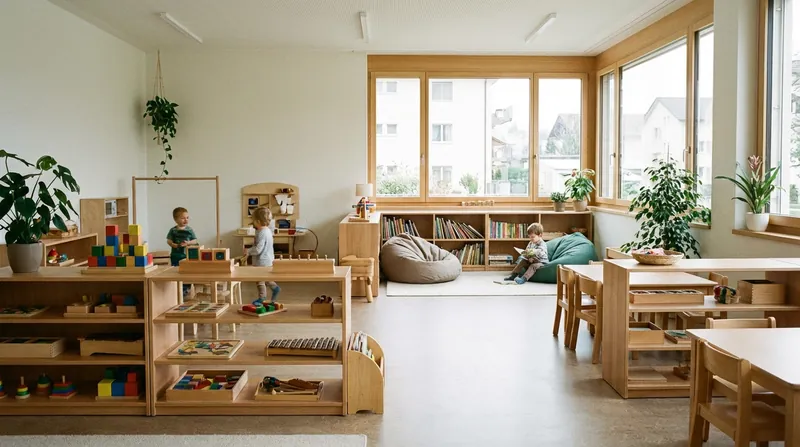
Rooms are the "third educator" — they shape how children play, learn and feel. A good daycare offers rooms that invite discovery, enable retreat and allow movement.
What to look for:
- Natural light: Large windows, bright rooms. Children need daylight for their wellbeing and sleep rhythm.
- Age-appropriate play materials: Not just plastic toys, but also natural materials, building blocks, books, painting supplies, dressing-up boxes. Materials should be freely accessible so children can choose independently.
- Creative area: A space for painting, crafting, modelling — with aprons, washable surfaces and plenty of materials.
- Quiet area: A place where children can retreat when everything gets too much. Cushions, blankets, picture books, perhaps a small tent or den.
- Movement area: Space to run, climb, romp. Ideally indoors (movement room, climbing wall) and outdoors.
- Outdoor area: Own garden or playground? Or regular excursions to nearby parks and forests? Children need outdoor time daily — in (almost) any weather.
How to ask about it:
- "May I see all the rooms — including the sleep rooms and the garden?"
- "How often do the children go outside?"
- "How are the rooms divided into different areas?"
Tip: During the visit, also let your gut feeling speak. Do the rooms feel inviting? Would you feel comfortable here? Children sense this just the same.
5. Nutrition concept
Children in full-day care eat up to three meals per day at the daycare. What they eat, how it is prepared and how mealtimes are structured has a direct influence on health, wellbeing and eating behaviour.
What to look for:
- Freshly cooked or catering? Daycares with their own kitchen often cook fresh and can respond more flexibly to needs. Catering doesn't have to be bad — but ask where the food comes from and how fresh it is.
- Allergies and intolerances: How does the daycare handle allergies? Are there separate meals? Is the kitchen staff informed? Is there an emergency plan for allergic reactions?
- Organic and quality: Does the daycare use organic products? Seasonal and regional ingredients? This is not a must — but a sign that the daycare has thought about nutrition.
- Mealtime atmosphere: Do the children sit together at the table? Are they allowed to serve themselves (self-service promotes independence)? Is the table cleared together? Is there a table grace or ritual? All of this conveys food culture and community.
- Drinking: Do the children have access to water at all times?
How to ask about it:
- "Is the food freshly cooked or delivered?"
- "How do you handle allergies?"
- "May I see the weekly menu?"
- "Are the children allowed to serve themselves?"
6. Settling-in model
Settling-in is the most sensitive moment at the start of daycare. How a daycare shapes this transition says a lot about its pedagogical approach. Research clearly shows: Children who are settled in without a parent's accompaniment have up to seven times more sick days in the following months than children with accompanied settling-in. The stress of an abrupt separation measurably burdens the immune system.
The most common models:
- Berlin model: The most widespread model in Switzerland. Usually lasts 2–4 weeks. In the first days, a parent stays. Then there are short separation phases that are slowly extended. The carer observes when the child is ready. The child sets the pace.
- Munich model: Even more child-oriented. Lasts 4–6 weeks. The parent initially actively participates in daycare life (plays, eats, sleeps alongside). Only when a stable relationship with the carer has been built do separations begin.
Warning signs during settling-in:
- "Two to three days are enough for most children." — No, that is almost never enough.
- "Parents should ideally say goodbye quickly and leave." — That is an outdated concept.
- "We do it by feel." — Lack of structure during such an important transition is risky.
How to ask about it:
- "Which settling-in model do you use?"
- "How long does settling-in typically take?"
- "What happens if my child needs more time?"
- "Who is my child's primary carer during settling-in?"
Also read: Daycare settling-in: How to make the start a success
7. Parent communication
A good daycare maintains open, transparent communication with parents. You should know at all times how your child is doing, what they experienced and how their development is progressing.
Characteristics of good parent communication:
- Daily brief reports: Verbally at pick-up or via a digital app. What did the child eat? How long did they sleep? Were there any special experiences?
- Regular parent meetings: At least twice a year, a detailed conversation about the child's development. In good daycares, observations and documentation are shared.
- Parent evenings: Information evenings on pedagogical topics, the annual programme or current topics such as settling-in, sleep, nutrition.
- Transparency about problems: If something has happened — a conflict between children, an accident, a difficult phase — you are informed promptly and openly. No daycare is perfect. But a good daycare communicates openly when things aren't going smoothly.
- Accessibility: Can you call with urgent questions? Is there a contact person?
Warning signs:
- You only learn weeks later that your child is regularly involved in conflicts.
- Your questions are answered evasively.
- There are no structured parent meetings.
- The daycare only informs you about organisational matters (closures, holidays), never about content.
8. Safety and hygiene
Children explore the world with their hands, mouths and full physical engagement. That's why a daycare needs clear safety and hygiene standards — without wrapping children in cotton wool.
Safety — what to look for:
- Sockets secured, stair gates, window locks
- Poisonous plants removed (indoors and outdoors)
- Cleaning products locked away safely
- Outdoor play equipment regularly inspected
- Clear duty of supervision — especially outdoors, during swimming or on excursions
- Emergency plan (for accidents, natural events, fire)
Hygiene:
- Regular hand washing (practised and ritualised with the children)
- Clear rules for contagious illnesses (when must a child stay home? When can they return?)
- Clean changing areas with gloves
- Regular cleaning of rooms and play materials
First aid:
- All carers should regularly complete a first aid course for children (recommendation: refresher every two years).
- A first aid kit should be readily accessible at all times.
How to ask about it:
- "Do all staff have a current first aid course?"
- "What is the rule for contagious illnesses?"
- "What does the emergency plan look like?"
9. Staff turnover
This point is often overlooked — yet it is perhaps the most important warning sign of all. High staff turnover means: Children regularly lose their primary carers. And for young children, that is one of the most distressing experiences.
Why is this so serious?
Children under three build intense attachments to their carers. This attachment is the basis for everything: for the feeling of security, for the willingness to learn, for emotional development. If the trusted carer leaves after six months and the next one leaves after eight months too, the child learns: "It's not worth building a relationship — the person leaves anyway." That is a devastating lesson.
What high turnover says about the daycare:
If staff don't stay, something is wrong. Common reasons: poor pay, overwork from too high staff-to-child ratios, lack of appreciation from management, insufficient continuing education opportunities or a toxic working climate. All of this directly affects care quality.
How to ask about it:
- "How long have the carers been working here?"
- "Were there staff changes in the group in the last year?"
- "What is the average length of stay of employees?"
Good signs: Staff who have been there for several years. A management that speaks proudly about their stable team. Family photos of staff on the wall.
Bad signs: If the daycare gives no clear answer to the question. If you see new faces on every visit. If management says: "In this industry, turnover is just normal."
Remember: Yes, the skilled worker shortage is real. But good daycares still manage to retain their staff. High turnover is always a sign that something in the operation is not right.
10. QualiKita label and other certifications
In Switzerland, there is no state quality ranking for daycares. But there are voluntary quality labels — and the best known is QualiKita.
What is QualiKita? QualiKita is a scientifically based quality label for daycares in Switzerland, supported by kibesuisse (the Swiss Childcare Association) and the Jacobs Foundation. It was developed based on international quality research.
What is assessed? QualiKita evaluates eight quality areas:
- Pedagogical work with the children
- Cooperation with parents
- Staff and teamwork
- Leadership and management
- Premises and infrastructure
- Safety and health
- Catering
- Administration and organisation
How does the certification work? The daycare goes through a comprehensive self-assessment process, followed by an external evaluation by trained professionals. The label is valid for four years and must then be renewed.
Is QualiKita a must? No. Many excellent daycares do not have a QualiKita label — often for cost reasons or because the process is time-consuming. But if a daycare has the label, it is a strong signal: The daycare has voluntarily undergone an external assessment and met the standards. This shows quality awareness and transparency.
Other quality indicators:
- Membership of kibesuisse (the industry association)
- Recognised continuing education certificates of staff
- ISO certifications (rare in daycares, but a sign of professional management)
- Subsidy agreement with the municipality (municipalities review quality before subsidising)
Warning signs: When you should pay close attention
Besides the ten quality criteria, there are some alarm signals where you should remove the daycare from your list:
During the visit
- Children appear unhappy, apathetic or unoccupied. Children in a good daycare are usually busy, happy and engaged. Naturally, a child cries sometimes — that's normal. But if the overall mood is subdued, something is wrong.
- Staff appear stressed, overwhelmed or impatient. Pay attention to the tone in which carers speak to the children. Is communication friendly and at eye level? Or are children spoken to harshly?
- High noise level without recognisable structure. It is never quiet in a daycare — but there is a difference between cheerful children's noise and uncontrolled chaos.
- No clear concept. If you ask "What is your pedagogical concept?" and the answer is vague, uncertain or evasive — exercise caution.
- Rooms are not shown. If the daycare does not want to show you all rooms — sleep rooms, kitchen, outdoor area — that is a clear warning sign.
- Short settling-in as standard. "With us, two to three days are enough" — that contradicts everything we know about child attachment.
During ongoing operation
- Frequent staff changes. If you see several new faces within a few months, turnover is too high.
- Many temporary staff or substitutes. This means the daycare has difficulty finding and retaining staff.
- Lack of communication. You don't know what your child did all day. Questions are answered evasively.
- Your child changes negatively. If your child suddenly cries more, sleeps worse, becomes more aggressive or no longer wants to go to daycare — take this seriously. There can be many reasons, but daycare quality is one of the first you should check.
Checklist: Assessing daycare quality
Use this checklist at every daycare visit. You can also save it directly in our interactive checklist and compare.
Staff-to-child ratio
- Ratio for baby group (0–18 months) enquired: _____
- Ratio for toddler group (18 months – 3 years) enquired: _____
- Ratio for older children (3–6 years) enquired: _____
- Clarified whether trainees/interns are counted
- Ratio during off-peak hours and staff illness enquired
Staff
- Qualifications of carers enquired
- Proportion of qualified staff enquired (target: at least 60 %)
- Asked about continuing education
- Asked about staff turnover ("How long have the carers been working here?")
Pedagogical concept
- Written concept received or viewed
- Team can explain the concept in their own words
- Daily schedule is structured and comprehensible
Rooms and equipment
- All rooms visited (including sleep rooms, kitchen, outdoor area)
- Natural light present
- Creative area, movement area and quiet area present
- Play materials age-appropriate and varied
- Outdoor area or regular outdoor time available
Nutrition
- Freshly cooked or catering?
- Handling of allergies clarified
- Menu plan viewed
- Mealtime atmosphere observed or enquired about
Settling-in
- Settling-in model enquired (Berlin / Munich / own)
- Typical duration enquired (minimum: 2 weeks)
- Flexibility for longer needs clarified
- Dedicated primary carer during settling-in
Parent communication
- Daily reports (verbal or digital)
- Regular parent meetings (at least 2x/year)
- Parent evenings
- Transparency about problems and incidents
Safety and hygiene
- Safety measures visible (sockets, stair gates, window locks)
- First aid training of staff
- Clear rules for contagious illnesses
- Emergency plan in place
Certifications
- QualiKita label present? (Not mandatory, but a plus)
- kibesuisse membership?
- Subsidy agreement with municipality?
Overall impression
- Children appear happy and occupied
- Staff appear relaxed and attentive
- Atmosphere feels warm and inviting
- My gut feeling is positive
How to use these criteria correctly
Perfect does not exist
No daycare will achieve top marks in all ten criteria. That is not necessary either. Perhaps a daycare has no garden of its own, but a fantastic team that goes to the park with the children every day. Or the food comes from a caterer, but the settling-in is exemplary. It's not about perfection, but about overall quality.
Prioritise for your child
Which criteria are most important for your child? A child with allergies needs a daycare with a well-thought-out nutrition concept. A shy child benefits from a particularly good staff-to-child ratio and a long settling-in. An active child needs space to run around.
Before the visit, consider: What are my three most important criteria? And: What are my absolute deal-breakers?
Compare at least two to three daycares
Don't visit just one daycare. Only through comparison will you notice how different the quality can be. Use our daycare search to find daycares near you, and our checklist to record and compare your impressions.
Trust your gut feeling — but check the facts
Your first impression is important. If you feel uncomfortable in a daycare, there are often good reasons, even if you can't name them immediately. But supplement the gut feeling with the hard facts: staff-to-child ratio, staff turnover, concept. Sometimes the first impression is deceiving — positively or negatively.
Frequently asked questions
Does a good daycare have to be expensive?
No. The price of a daycare says little about quality. Subsidised daycares with a service agreement are monitored by the municipality and must meet minimum standards — that can be a quality advantage. Expensive private daycares may have nicer furniture, but the team and the staff-to-child ratio are more important than the furnishings. Focus on the substantive criteria, not the price.
How do I find out whether a daycare is QualiKita-certified?
On the official QualiKita website, you will find a list of all certified facilities. You can also ask the daycare directly. But remember: Daycares without the label can also be excellent. The label is a positive signal, but not a must.
What do I do if I am dissatisfied after starting?
First, speak openly with the daycare management. Name specifically what bothers you and give the daycare the chance to improve. If nothing changes after a reasonable period, don't hesitate to switch daycares. Your child senses when you are unsure — and they deserve care where you have a good feeling.
Can I visit the daycare again after registering?
Yes, and you should. Ask whether you can come on a normal daycare day — not on the organised visiting day, but unannounced or at short notice. A daycare that has nothing to hide will welcome this. If not, that is a warning sign.
Conclusion: Quality is recognised by those who look closely
The search for the right daycare can be overwhelming. But with the right questions and a trained eye, you can assess quality well. The ten criteria in this article give you a solid framework for that.
Remember: You know your child best. No quality label and no staff-to-child ratio can replace your parental instinct. But they can support it — and help you make an informed decision.
Your next steps:
- Find daycares near you
- Use our interactive checklist for the visit
- Read our daycare visit checklist for the practical procedure
- Learn more about daycare settling-in
Sources: QualiKita/kibesuisse, Jacobs Foundation, Berlin settling-in study, NICHD Study of Early Child Care. Last updated: February 2026.
More articles
Daycare, Playgroup, or Childminder? The Complete Comparison
Which type of childcare is right for your family? Daycare, playgroup, and childminder compared side by side: age, costs,...
Finding a Childminder: The Complete Guide
How to find the right childminder. About associations, costs, contracts, and what you should look for....

Playgroup: Everything Parents Need to Know
Playgroup from what age? Costs, types, and why playgroups are so important for kindergarten preparation....

Au Pair in Switzerland: Requirements & Costs
Au pair costs, legal rules, and the difference from a nanny: everything Swiss host families need to know....

Hiring a Nanny in Switzerland: Cost & Contract
Want to hire a nanny? Everything about wages, social insurance, contracts, nanny-sharing, and tax deductions as a privat...
Day Family or Daycare? An Honest Comparison
Day family or daycare: costs, flexibility, staff ratios, and quality compared directly — plus tips for combination model...