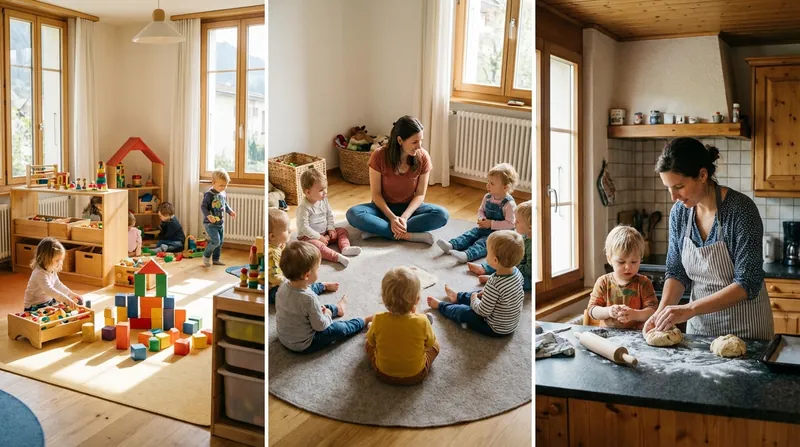
Daycare, Playgroup, or Childminder? The Complete Comparison
Daycare, playgroup, childminder — three forms of childcare that are fundamentally different. Which one suits your child, your daily routine, and your budget? This comparison helps you decide.
Comparison at a Glance
| Daycare (Kita) | Playgroup | Childminder (family daycare) | |
|---|---|---|---|
| Age | From 3 months | From approx. 2.5 years | From 0 years |
| Care hours | Full-day (up to 12 hrs) | Half-day (2–3 hrs) | Flexible (individual) |
| Frequency | 1–5 days/week | 1–3 half-days/week | 1–5 days/week |
| Group size | 12–22 children | 8–12 children | 1–5 children |
| Caregivers | Team (FaBe, HF diploma) | 1–2 group leaders | 1 person |
| Costs | CHF 100–150/day | CHF 14–25/half-day | CHF 5–12/hour |
| Subsidies | Often yes (municipality) | Rarely | Yes, through associations |
| Tax deduction | Yes | Yes | Yes |
| License required | Yes (cantonal) | No | Above a certain size |
| Meals | Yes (incl. or separate) | Usually a snack | Yes |
| Ideal for | Working parents | Kindergarten preparation | Flexible needs |
The Daycare Center (Kita)
What is it?
A daycare center offers professional full-day care for children from approx. 3 months until they start school. Children are cared for in mixed-age or same-age groups by trained staff. Daycare centers have fixed opening hours (usually 07:00–18:30) and are generally open year-round, with a few weeks of operational holidays.
Advantages
- Professional care by qualified staff (Fachperson Betreuung EFZ, dipl. Kindererzieher/in HF)
- Structured daily routine with an educational program
- Social contact with many children of the same age
- Reliable and predictable — fixed days and times
- Often subsidized — income-based rates
- Supervised and licensed — guaranteed minimum standards
Disadvantages
- Higher costs than other forms of childcare
- Waiting lists, especially in cities (6–12 months lead time needed)
- Less flexible for short-notice changes
- Larger groups — not ideal for every child
- Children get sick more often (risk of infection in large groups)
- Operational holidays — parents must organize holiday care themselves
Who is it ideal for?
The daycare center is particularly suitable for working parents who need regular full-day care on fixed days. Children who enjoy being with many peers feel comfortable here.
The Playgroup
What is it?
In a playgroup, children from approx. 2.5 years until kindergarten entry meet one to three times a week for half a day (2–3 hours). The focus is on free play: crafting, painting, singing, movement games, and social interaction. The playgroup is not full-day care but rather an educational offering to prepare children for kindergarten.
There are various types of playgroups: classic indoor playgroups, forest and nature playgroups, farm playgroups, music playgroups, and inclusive playgroups for children with special needs.
Advantages
- Affordable: CHF 14–25 per half-day
- Ideal for first experiences of separation from home
- Small groups (max. 8–12 children)
- Preparation for kindergarten (routines, rules, social behavior)
- Language development — especially important for non-German-speaking children
- Parent contact and advice as part of the offering
- Wide variety of concepts (forest, farm, music, etc.)
Disadvantages
- No full-day care — does not meet the needs of working parents
- Only available from approx. 2.5 years
- Not licensed — quality can vary
- Usually no subsidies (except in some municipalities)
- Some playgroups have long waiting lists
Who is it ideal for?
The playgroup is suitable for families who do not need full-day external care but want to prepare their child socially and linguistically for kindergarten. Particularly popular with families where one parent works part-time or is at home.
Good to know: In Basel-Stadt, children with little or no German language skills must attend a German-speaking playgroup, daycare, or family daycare for at least 3 half-days per week in the year before kindergarten.
The Childminder (Family Daycare)
What is it?
A childminder cares for children in their own home — individually or in a small group of up to 5 children. The care is more flexible than in a daycare center and can be individually tailored. Many childminders are employed by a family daycare association, which ensures quality assurance, training, and insurance.
Advantages
- Home-like environment — one or two consistent caregivers
- Flexible care hours, often also mornings, evenings, or on weekends
- Ideal for babies and very young children
- Small group — individual attention
- Often cheaper than daycare for part-time
- Care can start from birth (no minimum age)
- Children experience a normal family routine
Disadvantages
- Fewer social contacts with children of the same age
- Quality depends heavily on the individual person
- No substitute when the childminder is sick
- No mandatory training requirement (without association membership)
- Less structure than in a daycare center
Who is it ideal for?
A childminder is particularly suitable for babies and very young children who benefit from a small, home-like environment. It is also often the better solution for families with irregular working hours or the need for special flexibility.
Licensing rules for childminders: In Switzerland, a childminder does not need a license as long as they care for a maximum of 5 children at a time and no more than 2.5 days per week. Beyond that, a cantonal license is required. We recommend looking for a childminder through a recognized family daycare association — training, insurance, and quality control are guaranteed there.
Decision Guide: 5 Questions for You
How many days per week do you need care? Full-day on 3–5 days → daycare or childminder. Half-day 1–2x per week → playgroup.
How old is your child? Under 2.5 years → daycare or childminder. From 2.5 years → all three options.
What is your budget? Subsidized daycare is often the cheapest. Otherwise: childminder for a few days, playgroup as a supplement.
Does your child need a lot of one-on-one attention? Yes → childminder. No, enjoys large groups → daycare.
Is it primarily about care or kindergarten preparation? Care → daycare or childminder. Kindergarten preparation → playgroup.
Tip: Many families combine forms of childcare — e.g., 2 days daycare + 1 day childminder + 1 half-day playgroup. This is perfectly common and often the best solution.
More articles
Finding a Childminder: The Complete Guide
How to find the right childminder. About associations, costs, contracts, and what you should look for....

Playgroup: Everything Parents Need to Know
Playgroup from what age? Costs, types, and why playgroups are so important for kindergarten preparation....

Au Pair in Switzerland: Requirements & Costs
Au pair costs, legal rules, and the difference from a nanny: everything Swiss host families need to know....
Good Daycare: 10 Quality Criteria for Parents
How to recognise a good daycare? 10 evidence-based quality criteria, warning signs, and a printable checklist for parent...

Hiring a Nanny in Switzerland: Cost & Contract
Want to hire a nanny? Everything about wages, social insurance, contracts, nanny-sharing, and tax deductions as a privat...
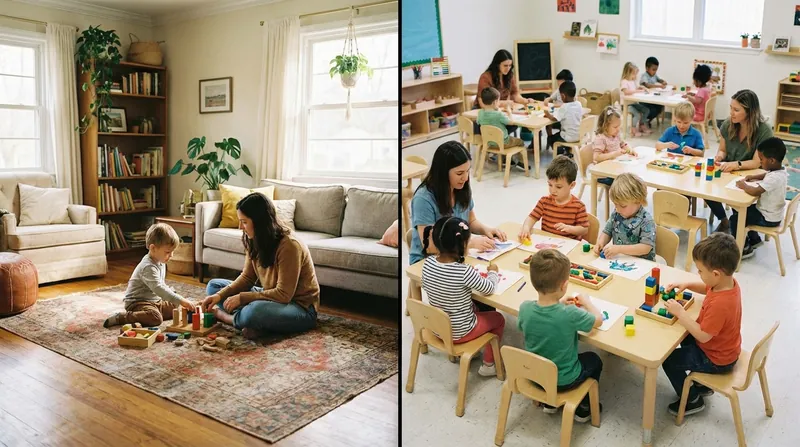
Day Family or Daycare? An Honest Comparison
Day family or daycare: costs, flexibility, staff ratios, and quality compared directly — plus tips for combination model...