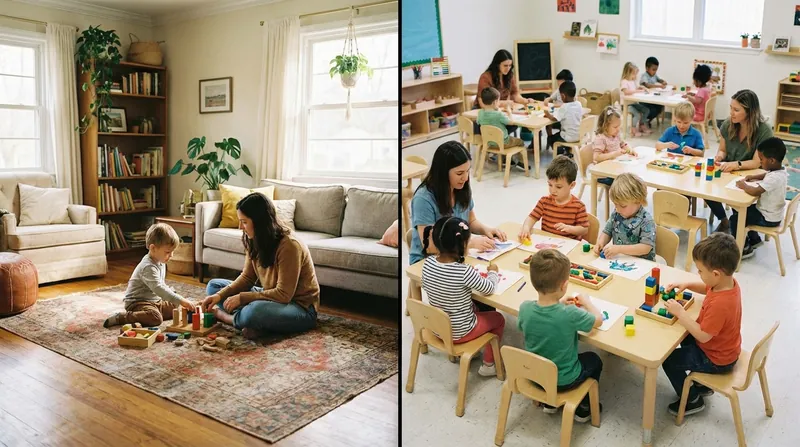
Childminder Family or Daycare? The Honest Comparison
Childminder Family or Daycare? The Honest Comparison
Daycare or childminder family? Thousands of Swiss parents ask themselves this question every year. Both forms of care have clear strengths — and honest weaknesses. In most guides you read diplomatic phrases like "it depends on the individual needs". That is of course true — but this article goes a step further and names the specific advantages and disadvantages from the parents' perspective. With cost tables, daily routine comparison and an honest assessment of which form of care suits which child best.
At a Glance: Childminder Family vs. Daycare
| Criterion | Childminder Family | Daycare |
|---|---|---|
| Staff-to-child ratio | 1:3 to 1:5 | 1:5 to 1:8 (age-dependent) |
| Group size | 3–5 children (mixed) | 8–20 children per group |
| Opening hours | Often more flexible (6:30–18:30) | Mostly 7:00–18:00 |
| Costs | CHF 8–12/hr | CHF 90–150/day |
| Pedagogical concept | Everyday-oriented, family-like | Structured programme |
| Supervisory authority | Cantonally licensed | Cantonally licensed |
| Location | Carer's private household | Dedicated premises |
| Settling in | Often more individualised and quicker | Standardised settling-in process |
| Social contacts | Small, mixed-age group | Larger, mostly same-age group |
| Meals | Freshly cooked, family-style | Professional kitchen or catering |
Daily Routine: What a Typical Day Looks Like
Childminder Family
| Time | Activity |
|---|---|
| 7:00 | Arrival, free play |
| 8:30 | Shared morning snack |
| 9:00 | Going out: playground, forest, shopping |
| 11:30 | Shared lunch (freshly cooked) |
| 12:30 | Afternoon nap / quiet time |
| 14:00 | Crafts, reading aloud, free play |
| 15:30 | Afternoon snack |
| 16:00 | Playing indoors or outdoors |
| 17:30–18:00 | Pick-up |
Everyday life in a childminder family follows normal family life. The children experience everyday situations — shopping, cooking, walking the dog — and learn practical life skills along the way.
Daycare
| Time | Activity |
|---|---|
| 7:00 | Arrival time, free play |
| 9:00 | Morning circle (greeting, songs, topic of the day) |
| 9:30 | Guided activity (crafts, painting, music, gymnastics) |
| 10:30 | Morning snack |
| 11:00 | Free play or garden time |
| 11:30 | Lunch |
| 12:30 | Afternoon nap / quiet time |
| 14:00 | Afternoon activity (project, outing, experiment) |
| 15:30 | Afternoon snack |
| 16:00 | Free play, staggered pick-up |
| 18:00 | Daycare closes |
The daycare daily routine is more structured, with a pedagogical programme tailored to children's development. There are guided activities, projects and often a thematic weekly plan.
Cost Comparison
Childminder Family
Childminder family costs are generally calculated per hour:
| Canton/Region | Cost per hour | Cost per day (10 hrs) | Cost per month (2 days/week) |
|---|---|---|---|
| German-speaking Switzerland | CHF 8–10 | CHF 80–100 | CHF 700–870 |
| Western Switzerland | CHF 7–9 | CHF 70–90 | CHF 610–780 |
| Major cities | CHF 9–12 | CHF 90–120 | CHF 780–1,040 |
These costs are before subsidies. Many municipalities subsidise childminder family places just like daycare places.
Daycare
Daycare costs are mostly calculated per day or half-day:
| Canton/Region | Cost per day (private) | Cost per day (subsidised) | Cost per month 2 days/week (private) |
|---|---|---|---|
| German-speaking Switzerland | CHF 100–140 | CHF 20–80 | CHF 870–1,220 |
| Western Switzerland | CHF 90–130 | CHF 15–70 | CHF 780–1,130 |
| Major cities | CHF 120–160 | CHF 25–90 | CHF 1,040–1,390 |
Cost Comparison: What Is Cheaper?
| Care extent | Childminder family (average) | Daycare private (average) | Daycare subsidised (average) |
|---|---|---|---|
| 2 days/week | CHF 740/mo. | CHF 1,000/mo. | CHF 500/mo. |
| 3 days/week | CHF 1,110/mo. | CHF 1,500/mo. | CHF 750/mo. |
| 5 days/week | CHF 1,850/mo. | CHF 2,500/mo. | CHF 1,250/mo. |
Cost conclusion: Childminder families are generally 20–30% cheaper than daycare centres with private funding. However, with subsidised daycare places, daycare can be cheaper — depending on income and municipality. More on daycare costs at Daycare Costs in Switzerland.
Flexibility: Opening Hours, Illness, Holidays
Opening Hours
| Childminder Family | Daycare | |
|---|---|---|
| Earliest opening | Often from 6:30 | Mostly from 7:00 |
| Latest closing | Often until 18:30–19:00 | Mostly until 18:00–18:30 |
| Saturday | Individually negotiable | Rarely |
| Overnight | Possible (by arrangement) | No |
| Spontaneous changes | Often possible | Mostly not possible |
Child Illness
| Childminder Family | Daycare | |
|---|---|---|
| Mild cold | Often not a problem | Mostly allowed |
| Fever | Individual — some accept children with mild fever | Usually not allowed above 38.5 °C |
| Stomach bug | Mostly not | Not allowed (24–48 hrs symptom-free) |
| Individual carer ill | No substitute — child stays home | Internal cover |
Childminder family advantage: Many childminder families are more accommodating with minor illnesses than daycare centres. This can be a decisive factor for working parents.
Daycare advantage: When a carer at daycare is absent, there is cover. If the childminder family is ill, care drops out entirely — a disadvantage you need to plan for.
Holidays
| Childminder Family | Daycare | |
|---|---|---|
| Operational closures | Individual (often 2–4 weeks) | Mostly 2–3 weeks (summer + Christmas) |
| Holiday care | Some also offer holiday care | Mostly reduced operation during holidays |
Which Child Suits Which Option?
Childminder family is particularly suitable for:
- Babies and toddlers (0–2 years): The small setting and close attachment figure provide security. The staff-to-child ratio of 1:3 to 1:5 allows for plenty of individual attention.
- Shy or sensitive children: Children who feel uncomfortable in large groups often flourish in the small childminder family.
- Children who miss siblings: In the mixed-age group of a childminder family, they experience sibling-like dynamics.
- Families with irregular working hours: If you work shifts or need early/late care.
- Families in rural areas: Where there is no daycare nearby.
Daycare is particularly suitable for:
- Children from 2–3 years: At this age, children actively seek contact with peers and benefit from the larger group.
- Sociable, curious children: Children who need many playmates and variety.
- Children who need structure: The pedagogical programme provides support and orientation.
- Children with language needs: The larger group promotes language development — especially for children with a different mother tongue.
- Families who need reliability: Daycare centres are less likely to cancel because there are multiple carers.
Staff-to-Child Ratio: What Does It Mean in Practice?
The staff-to-child ratio describes the relationship between carers and children. According to kibesuisse, the following benchmarks apply:
Daycare
| Children's age | Recommended ratio |
|---|---|
| 0–18 months (infants) | 1:3 to 1:4 |
| 18 months – 3 years | 1:5 to 1:6 |
| 3–5 years (preschool) | 1:6 to 1:8 |
Childminder Family
| Setting | Typical ratio |
|---|---|
| Childminder family (incl. own children) | 1:3 to 1:5 |
| Childminder family (max. per licence) | 1:5 (depending on canton) |
What does this mean? In a childminder family, a toddler generally receives more individual attention than in a daycare group. At the same time, daycare offers more diversity in activities and more same-age playmates. A detailed comparison of all forms of care can be found in our guide Daycare, Playgroup or Childminder: The Comparison.
Quality: How Do I Recognise a Good Childminder Family or Daycare?
Quality Features of a Good Childminder Family
- Licence: The childminder family has a valid licence from the responsible cantonal authority
- Training: The carer has completed a first aid course for children and ideally further pedagogical training
- Premises: Child-safe, clean household with sufficient space to play (indoors and outdoors)
- Criminal record extract: The carer has provided a current criminal record extract and special private extract
- Network: The childminder family is affiliated with a childminder association (e.g. kibesuisse member), which offers professional advice and further training
- Observation: Visit the childminder family unannounced or for a trial session — how does the carer interact with the children?
More tips can be found in our guide Finding a Childminder: How to Go About It.
Quality Features of a Good Daycare
- Licence: Valid cantonal operating licence
- Pedagogical concept: Written concept addressing children's development
- Staff-to-child ratio: Compliance with recommended benchmarks
- Qualified staff: At least 50% trained professionals (FaBe, diploma level)
- Parent meetings: Regular development discussions
- Transparency: Open communication, parents are always welcome
- QualiKita label: Daycare centres with the quality label from kibesuisse meet particularly high standards
A detailed guide can be found in our article Recognising Daycare Quality.
Combination Models: The Best of Both Worlds
More and more families are choosing a combination model — and for good reason. The advantages of both forms of care can be combined:
Example: 2 Days Daycare + 1 Day Childminder Family
- Monday + Wednesday: Child at daycare (social contacts, pedagogical programme)
- Friday: Child at childminder family (family atmosphere, flexibility)
- Tuesday + Thursday: Child with parents
Advantages of this combination:
- Child has peers at daycare and a close attachment figure at the childminder family
- When daycare is closed (operational holidays), the childminder family can step in
- The childminder family may be more accommodating with minor illness
Disadvantages:
- Two settling-in periods needed
- More coordination for parents
- Child must adapt to two different environments
Tip: With a combination model, it is important that daycare and childminder family are on different days — not split within the same day. This way the child has a clear attachment figure and a clear place each day.
Frequently Asked Questions (FAQ)
Does a childminder family need a licence?
Yes. In most cantons, a childminder family needs a licence as soon as they regularly care for other people's children. The licence requirement varies by canton but usually starts from one child. The licence is granted by the municipality or canton.
Can childminder family places be subsidised?
Yes, in many municipalities childminder family places are subsidised just like daycare places — provided the childminder family is affiliated with a recognised association and has a valid licence.
What if the childminder family falls ill?
This is the biggest disadvantage of the childminder family: if the carer is unavailable, there is no substitute. Some childminder associations organise replacement care, but this is not guaranteed. Plan a back-up for this situation (grandparents, neighbours, emergency nanny).
Can I switch from childminder family to daycare over time?
Yes, many families start with a childminder family (for the baby phase) and switch to daycare at around 2–3 years when the child benefits from the larger group. This is a very common and proven model.
Are childminder families less professional than daycare centres?
Not necessarily. Childminder families that are affiliated with an association receive regular professional advice and further training. The care is different — more family-oriented and everyday-focused — but no less valuable. What counts is the quality of the relationship between the carer and the child.
Conclusion
Childminder family or daycare — both forms of care have their place. The childminder family offers more closeness, smaller groups and greater flexibility. Daycare scores with its pedagogical programme, larger children's groups and reliability. For many families, a combination of both forms is the ideal solution. In the end, it is not the form of care that determines quality, but the people who look after your child.
Find the right daycare or childminder family near you now on kizi.ch — and compare options that suit your family.
Sources: kibesuisse — Swiss Childcare Association, Swiss Association of Childminder Family Organisations, Federal Social Insurance Office (BSV), cantonal guidelines for supplementary childcare. As of: February 2026.
More articles
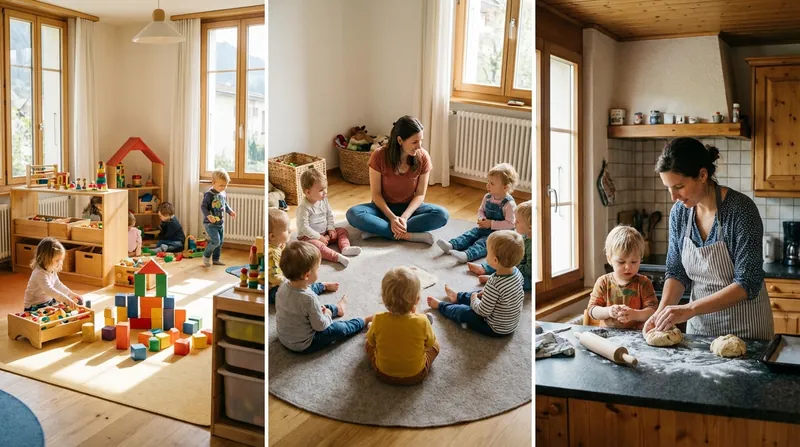
Daycare, Playgroup, or Childminder? The Complete Comparison
Which type of childcare is right for your family? Daycare, playgroup, and childminder compared side by side: age, costs,...
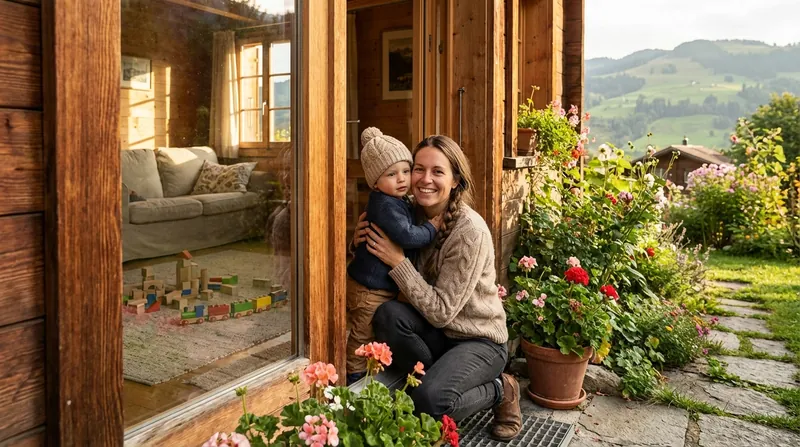
Finding a Childminder: The Complete Guide
How to find the right childminder. About associations, costs, contracts, and what you should look for....
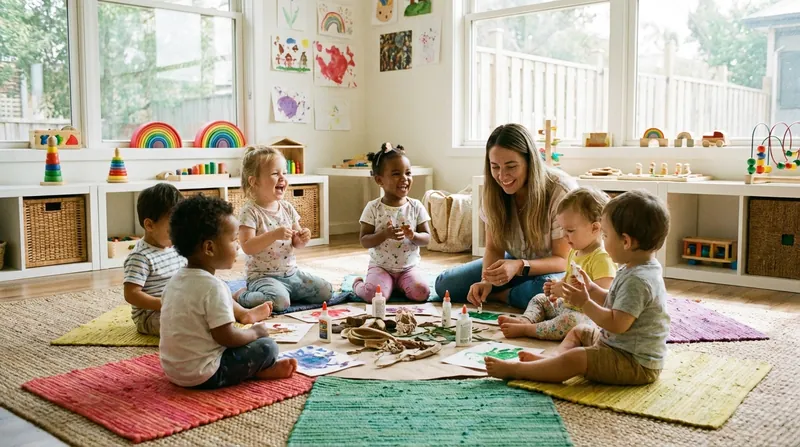
Playgroup: Everything Parents Need to Know
Playgroup from what age? Costs, types, and why playgroups are so important for kindergarten preparation....
Au Pair in Switzerland: Requirements & Costs
Au pair costs, legal rules, and the difference from a nanny: everything Swiss host families need to know....
Good Daycare: 10 Quality Criteria for Parents
How to recognise a good daycare? 10 evidence-based quality criteria, warning signs, and a printable checklist for parent...
Hiring a Nanny in Switzerland: Cost & Contract
Want to hire a nanny? Everything about wages, social insurance, contracts, nanny-sharing, and tax deductions as a privat...