
What Age Should My Child Start Daycare? What the Research Says
What Age Should My Child Start Daycare? What the Research Says
The question of the right time for a child to start daycare concerns almost every parent. Is my baby too young at six months? Is three years too late? And what does science actually say about it? In this guide, we take a close look at the research, examine the perspective of developmental psychology, and give you concrete decision-making tools.
Key takeaways: There is no universally "right" age to start daycare. The quality of care is demonstrably more important than the timing. Children from around 24 months benefit especially strongly from group settings — but younger children can also thrive perfectly well in a high-quality daycare centre.
The Legal Situation in Switzerland
In Switzerland, there is no legally prescribed minimum age for starting daycare. Most daycare centres accept children from 3 months, i.e. after the end of maternity leave. In practice, many children start with non-family childcare between 4 and 18 months.
Cantonal regulations vary considerably in some areas. In some cantons, the staff-to-child ratio for infants is more strictly regulated than for older children, which is meant to ensure the quality of care for the youngest. Typical staff-to-child ratios in Switzerland:
| Child's age | Recommended staff-to-child ratio |
|---|---|
| 0–18 months | 1 carer per 3 children |
| 18–36 months | 1 carer per 5 children |
| 3–5 years | 1 carer per 8 children |
These ratios vary by canton. Find out about the regulations in your canton — on our canton overview you'll find the relevant information for your area.
Important: The fact that daycare centres accept infants from 3 months is a legal possibility — not a developmental psychology recommendation. The decision is yours as a parent.
What Developmental Psychology Says About Each Age Group
0–12 Months: The Attachment-Building Phase
The first year of life is a particularly sensitive phase from a developmental psychology perspective. British psychiatrist John Bowlby, the founder of attachment theory, demonstrated as early as the 1960s how crucial a secure attachment to at least one primary caregiver is for healthy emotional development.
What happens during this phase:
- Your baby learns that it can rely on caregivers
- It develops a basic sense of security and trust
- Stress regulation matures — your baby learns to calm down with help
- Towards the end of the first year, so-called "specific attachment" develops
What this means for the daycare decision:
Starting daycare in the first 12 months is fundamentally possible but requires special conditions. The key is that your baby also has a consistent caregiver in the daycare — not constantly changing staff. Research shows that infants can indeed build multiple secure attachments (to mum, dad, grandparents, and also to the daycare carer), as long as the relationship is stable and responsive.
Research finding: The NICHD Study (National Institute of Child Health and Human Development), one of the largest longitudinal studies on non-family care with over 1,300 children, shows: Children who enter high-quality care in their first year show no negative attachment effects — provided the quality of care is high and the mother-child relationship remains responsive.
Practical recommendation for this age group:
- If possible, start with just a few hours per week
- Look for a consistent, regular caregiver at the daycare
- Plan a particularly gentle and extended settling-in period (at least 4–6 weeks)
- Critically check the daycare's staff-to-child ratio — for infants it should be no more than 1:3
12–18 Months: Stranger Anxiety as a Sign of Healthy Development
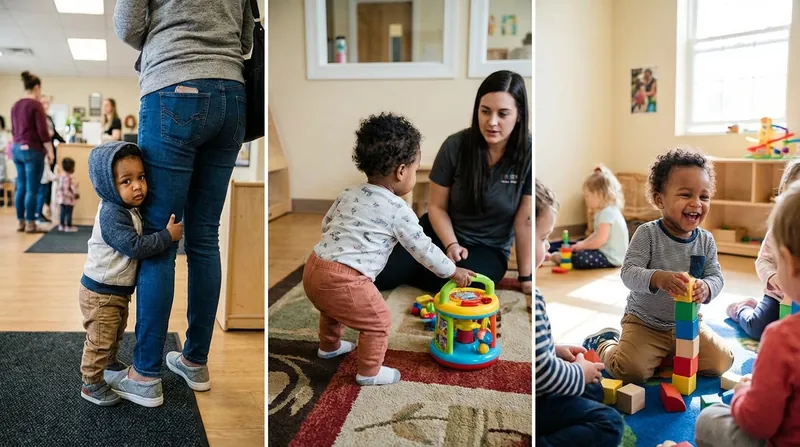
Between the 8th and 18th months, most children experience a phase of so-called "stranger anxiety" (technically: separation anxiety or stranger anxiety). Your child suddenly reacts fearfully or with rejection towards unfamiliar people and protests intensely when you leave the room.
Why this is normal and even positive:
- Stranger anxiety shows that your child has built a secure attachment
- It can now distinguish between familiar and unfamiliar people
- Cognitive development has reached a point where your child understands that you exist even when it can't see you (object permanence)
What this means for the daycare decision:
Many parents interpret stranger anxiety as a sign that their child is "not yet ready" for daycare. This is understandable but not necessarily correct. What matters is the type of settling-in process. The Berlin Settling-In Model (more on that below) is specifically designed for this developmental phase and demonstrably works well.
Practical recommendation for this age group:
- Choose a settling-in process based on the Berlin Model or the Munich Model
- Allow enough time — during this phase, settling in often takes longer
- Don't interpret protest at drop-off as failure, but as a normal developmental step
- The reaction after separation is more telling than the goodbye distress: if your child can be comforted by the key carer within minutes, that's a good sign
More about settling in can be found in our detailed article: Daycare Settling-In: How to Make a Gentle Start.
18–24 Months: The Beginnings of Autonomy
From around 18 months, your child's world changes fundamentally. It begins to perceive itself as an independent person, actively explores its environment, and shows the first conscious social interactions with peers — though still predominantly in "parallel play" (alongside each other rather than together).
What happens during this phase:
- Language develops rapidly (vocabulary explosion around the 18th month)
- Your child begins to express its own wishes and ideas
- First forms of empathy become visible
- Interest in other children grows significantly
- The "autonomy phase" (formerly: defiance phase) begins
What this means for the daycare decision:
This age group already benefits noticeably from a structured group setting. Daycare offers stimulation that is difficult to replicate at home in this way: other children to observe and imitate, age-appropriate play materials, and trained staff who specifically support autonomy development.
Practical recommendation for this age group:
- A good time to start daycare if the family situation requires it
- Children at this age still need plenty of closeness and emotional security
- One to three daycare days per week is a good start
- The settling-in period should last at least 2–4 weeks
24–36 Months: Growing Social Readiness
From the second birthday, children make an enormous leap in their social development. They begin to play cooperatively, understand rules, and fit into simple group structures. Many experts consider this phase as particularly favourable for starting non-family childcare.
What happens during this phase:
- Cooperative play increasingly replaces parallel play
- Your child learns to share, wait, and resolve conflicts (with help)
- Language development increasingly enables verbal communication with peers
- The capacity for self-regulation grows
- Imaginative and role play begins
What this means for the daycare decision:
Children at this age are developmentally particularly well-suited to benefit from a group setting. The Zurich Longitudinal Study (more on that below) shows that children who regularly attend daycare from this age develop measurable advantages in their social competence.
If you're not yet sure whether a daycare, a playgroup, or a childminder is the right form of care, our comparison of childcare types can help you decide.
From Age 3: The Consensus Among Many Experts
Many developmental psychologists and educators describe the age of 3 and above as particularly suitable for starting daycare. In many European countries — such as Germany, Austria, and France — there is a legal entitlement to a childcare place from this age.
Why this age in particular?
- Attachment security is generally well established
- Language development allows for differentiated communication
- The child can verbally express its needs (hunger, tiredness, toilet)
- Emotional self-regulation has matured significantly
- The child shows active interest in peers and group games
- Imagination, creativity, and motivation to learn are high
But note: "Ideal" does not mean "the only right choice". Research clearly shows that children who enter high-quality care earlier suffer no disadvantages. The "from age 3" point is a statistical average — your child is an individual with its own developmental pace.
What the Research Says: Key Studies at a Glance
The NICHD Study (USA, since 1991)
The NICHD Study of Early Child Care and Youth Development is arguably the most comprehensive longitudinal study on non-family childcare worldwide. Over 1,300 children were followed from birth into adolescence.
Key findings:
- The quality of the family relationship is the strongest predictor of child development — stronger than any childcare factor
- High-quality non-family care has a positive effect on cognitive and language development
- With low-quality care or very high care volumes (more than 30 hours per week over many years), slightly elevated behavioural problems were observed — however, these effects largely disappeared by school age
- Children from socioeconomically disadvantaged families benefited particularly strongly from high-quality care
The Berlin Settling-In Study (INFANS Model)
The Berlin Settling-In Study, conducted by the INFANS Institute in the 1980s and 1990s, produced the globally widespread "Berlin Settling-In Model". The study examined how children best manage the transition from family to non-family care.
Key findings:
- Children who experienced a parent-accompanied, gradual settling-in showed significantly fewer stress symptoms
- Cortisol levels (stress hormone) were significantly lower in gently settled-in children
- The study confirmed that attachment-theory-based settling-in demonstrably reduces children's stress levels
- The duration of settling in should be guided by the individual child, not rigid schedules
More on this: How to Make Daycare Settling-In a Success
The Zurich Longitudinal Study
Particularly relevant for Swiss parents: The Zurich Longitudinal Study by the University of Zurich (Department of Developmental Psychology) followed children in Switzerland over several years and examined the influence of different forms of care on development.
Key findings:
- Children in high-quality non-family care showed better social competence than children cared for exclusively within the family
- Language development was comparable or slightly better in daycare children
- What mattered was not the starting age, but the process quality (quality of interaction between carer and child)
- Children from families with a migration background benefited particularly strongly in language development
Jacobs Foundation: Research on Early Childhood Education in Switzerland
The Jacobs Foundation, one of Switzerland's most significant foundations in the field of child and youth development, has funded several studies and programmes on early childhood education quality. Their findings feed into Swiss education policy.
Key insights:
- Investments in early childhood education yield the highest societal return on investment
- The qualifications of care staff are the most important factor in care quality
- Early support demonstrably reduces inequality of opportunity
- Switzerland has catching up to do compared internationally when it comes to public funding of early childhood education, care, and development (ECEC)
By the way: You can find a summary of the developmental benefits that children gain from high-quality care in our article Developmental Benefits of Childcare.
Quality Trumps Timing: What Matters More Than Age
If there's one thing we can take away from thirty years of research, it's this: The quality of care is more important than the starting age. A child who enters an excellent daycare at 6 months develops better than a child who starts at age 3 in a daycare of poor quality.
What to Look for in Daycare Quality
Structural quality:
- Staff-to-child ratio: How many children does one professional care for? The younger the children, the more important a close ratio
- Staff training: Do the carers have a recognised pedagogical qualification (Fachperson Betreuung EFZ, HF degree)?
- Group size: Smaller groups enable more individualised care
- Premises: Are the rooms child-friendly, safe, and stimulatingly designed?
- Staff turnover: Frequent changes strain children's attachment relationships
Process quality (the even more important dimension):
- Responsiveness: Do the carers respond promptly and appropriately to children's signals?
- Language stimulation: Is there lots of talking, reading aloud, and singing with the children?
- Autonomy support: Are children allowed to co-determine and make their own decisions in age-appropriate ways?
- Emotional security: Are children's feelings acknowledged and supported?
- Individualised support: Is each child's developmental stage recognised and fostered?
You'll find a detailed criteria catalogue in our article Recognising Daycare Quality: What Parents Should Look For. And if you're planning a visit, our Daycare Visit Checklist is an indispensable tool.
Warning Signs: When Your Child May Not Be Ready Yet
Every child is different, and there is no one-size-fits-all approach. Nevertheless, there are some signs that may indicate your child is not (yet) ready for daycare — or that the chosen daycare is not the right fit:
Signs That Require Attention
- Persistent developmental regressions: Your child wets the bed again despite being dry, or loses already acquired language skills
- Lasting sleep disturbances: Nightmares, problems falling asleep, or night waking that persist for several weeks after settling in
- Persistent refusal: When your child regularly cries for extended periods even after 6–8 weeks and cannot be comforted by the key carer
- Changed eating behaviour: Your child consistently refuses food at daycare or shows an eating disorder
- Aggressive or severely withdrawn behaviour: When your child reacts very aggressively towards other children or completely withdraws for weeks
- Physical symptoms: Frequent stomach aches, headaches, or nausea without a medical cause that occur exclusively on daycare days
Important: Distinguish Between an Adjustment Phase and Genuine Warning Signs
A certain adjustment phase is completely normal. In the first weeks, tears at drop-off, slight sleep changes, and increased clinginess at home are to be expected. The rule of thumb:
- Normal: Brief protest at drop-off that subsides within 5–10 minutes. The child then plays happily and eats well.
- Monitor: Longer crying episodes (15–30 minutes) that improve within the first 4 weeks.
- Take action: Persistent, inconsolable distress lasting more than 6–8 weeks, combined with regressions in other areas of development.
If you observe warning signs, this is not a failure — neither yours nor your child's. It may mean that the timing doesn't suit yet, that the settling-in process should be structured differently, or that the specific daycare isn't the right one for your child.
Practical Tips for Your Decision
1. Listen to Your Gut — But Supplement It with Facts
Your parental instinct is valuable. But it can be distorted by guilt, social pressure, or fears. Combine your gut feeling with the research findings from this article and make an informed decision.
2. Start Searching Early
Good daycare places are scarce in many Swiss municipalities. Start searching 6–12 months before your desired start date. Our Childcare Finder Quiz helps you find the right type of care for your family.
3. Visit Multiple Daycares
Don't rely on websites and brochures alone. Visit at least 2–3 daycares in person and pay special attention to the interaction between carers and children. Our Daycare Visit Checklist helps you not forget anything important.
4. Allow Enough Time for Settling In
A good settling-in period lasts at least 2–4 weeks, for younger or more sensitive children even 6–8 weeks. Plan this period generously and avoid returning to work at the same time as settling in. Everything about the optimal settling-in process can be found in our article Daycare Settling-In: How to Make a Gentle Start.
5. Start with Few Days per Week
Especially with younger children (under 2), a gradual start has proven effective. Begin with 1–2 days per week and increase slowly. This allows your child to process the new environment in small doses.
6. Look for a Good Fit Between Child and Daycare
Not every good daycare is the right daycare for your child. A reserved child feels more comfortable in a small, quiet group than in a large, lively facility. An active child needs a daycare with plenty of outdoor space and opportunities for movement.
7. Talk Openly with the Daycare Management
Good daycares take your concerns seriously and respond individually to your child's needs. If you feel that your worries aren't being heard, that's a warning sign about the facility.
8. Trust the Process — But Stay Attentive
The vast majority of children settle in well, even if the first days and weeks are bumpy. Trust the process and the professionals — but keep an eye on your child's development and address any changes.
Frequently Asked Questions
At what age can my child start daycare?
In Switzerland, most daycares accept children from 3 months. There is no legal minimum age. However, this doesn't mean every child must start daycare at 3 months — the ideal timing depends on many individual factors, including the quality of the daycare, the family situation, and the child's temperament. Research shows that the quality of care is more important than the starting age.
Is it bad for my baby to start daycare so early?
No, provided the daycare is of high quality. The major NICHD longitudinal study with over 1,300 children shows: Children who enter good care early develop just as well as children cared for exclusively at home. Key factors are the staff-to-child ratio (ideally 1:3 for infants), a consistent caregiver at the daycare, and a gentle settling-in process. The family bond remains the strongest influence on child development.
What is the ideal age to start daycare?
Many experts cite the age of 2–3 years as particularly favourable, because children then benefit most from group care in social and language terms. But there is no universally "ideal" age. Children from 18 months already show growing interest in peers, and infants can also develop well in high-quality care. The quality of care, the settling-in process, and your child's individual development matter more than a specific age.
How do I know if my child is ready for daycare?
Signs of daycare readiness include: Your child shows interest in other children, can briefly separate from you without panicking, and can be comforted by other adults. But be careful: These signs are not prerequisites. Even children who initially show strong stranger anxiety can successfully settle in with a good settling-in process. Warning signs that argue against an immediate start, on the other hand, include persistent developmental regressions, lasting sleep disturbances, or chronic physical complaints without a medical cause.
How long should the settling-in process take?
The settling-in period should last at least 2–4 weeks, for infants and more sensitive children often 4–8 weeks. The Berlin Settling-In Model, used by most Swiss daycares, provides for a parent-accompanied, gradual settling-in process where the pace is determined by the child — not the calendar. Plan the settling in so that you are flexible during this time and not under time pressure. A good settling-in process is the best investment in a successful daycare start.
Conclusion: Your Child, Your Pace
The question "At what age should my child start daycare?" cannot be answered with a single number. But what research clearly shows:
- Quality over timing: An excellent daycare from 6 months is better than a mediocre one from age 3
- Settling in is crucial: Regardless of age — a gentle, attachment-oriented settling-in process makes the difference
- Your child is an individual: Statistics and studies provide guidance, but your child has its own developmental pace
- Complementing the family, not replacing it: Daycare complements your family — the primary attachment remains with you
Trust that you know your child best. Inform yourself, visit daycares, ask questions — and then make the decision that feels right for your family.
Further Reading
- Daycare Settling-In: How to Make a Gentle Start
- Daycare Visit Checklist: 50 Questions You Should Ask
- Recognising Daycare Quality: What Parents Should Look For
- Developmental Benefits of Childcare
- Daycare, Playgroup, or Childminder? The Big Comparison
Find the Right Daycare for Your Child
Are you ready to find the right care for your child? On kizi.ch you'll find quality-checked daycares, playgroups, day-care families, and nannies near you. Start your search now and compare offerings, prices, and available places — all in one place.
Find suitable childcare now on kizi.ch →
Still not sure which type of care is right? Our Childcare Finder Quiz helps you find the best option for your family in just a few minutes.
More articles
Settling-In by Age: Baby, Toddler, Preschool
Settling-in varies greatly by age. Learn which models work at which age and how to best support your child through the t...

5 Developmental Benefits of Childcare
What does research say? 5 scientifically proven benefits of external childcare for your child's development — and what t...

Social Skills: What Kids Learn in Daycare
Children develop important social skills in daycare. Learn how group life and role play strengthen your child's emotiona...

Language Development: How Daycare Helps
Growing up multilingual in Switzerland: how daycare supports your child's language development and what you can do as a ...

Daycare Costs Switzerland 2026: Real Prices
How much does a daycare place cost in Switzerland? Current prices by canton, subsidies, tax deductions, and practical mo...

Daycare, Playgroup, or Childminder? The Complete Comparison
Which type of childcare is right for your family? Daycare, playgroup, and childminder compared side by side: age, costs,...