Promoting Language Development: How Daycare Helps
Promoting Language Development: How Daycare Helps
Language is the key to the world. Through language, children express their needs, form friendships, understand connections and acquire new knowledge. In Switzerland, many children also grow up multilingual — whether through the national languages, dialect and Standard German, or through families with a migration background. Daycare plays a central role in language development: it offers a rich linguistic environment, professional language support and daily interaction with peers.
This guide explains how language develops in children, how daycare supports this process and what you as a parent can do.
Language Development: The Key Milestones
Every child develops language at their own pace. Nevertheless, there are typical milestones that can serve as a guide. Deviations of a few months are normal — especially for children growing up with multiple languages.
Overview of Language Development by Age
| Age | Milestone | Examples |
|---|---|---|
| 0–6 months | Babbling phase, cooing, first sounds | Aaah, Oooh, cooing in response to being spoken to |
| 6–12 months | Syllable doubling, first understanding | Mama, Papa, Dada; responds to own name |
| 12–18 months | First words (10–50 words) | No, there, ball, woof-woof; points at objects |
| 18–24 months | Vocabulary explosion (50–200 words) | Two-word sentences: Mummy come, ball gone |
| 2–3 years | Simple sentences (3–5 words) | I want milk, Daddy is gone; why-questions begin |
| 3–4 years | Complex sentences, narrative ability | Retelling stories, using tenses |
| 4–5 years | Grammar largely correct | Subordinate clauses, subjunctive, more abstract concepts |
| 5–6 years | School-ready language | Fluent narration, word games, understanding rhymes |
Important: These milestones refer to the first language. For children who learn a second language from daycare onwards, milestones in the second language may be delayed — this is no cause for concern.
Multilingualism in Switzerland: The Norm Rather Than the Exception
Switzerland is a multilingual country with four national languages: German, French, Italian and Romansh. In addition, German-speaking Switzerland has a diglossia situation — children speak Swiss German in everyday life and learn Standard German as effectively a second language. On top of this, there are families with other heritage languages.
Facts and Figures
- Around one third of all children in Swiss daycare centres grow up with more than one language
- In cities like Zurich, Basel or Geneva, the proportion is significantly higher
- Many cantons have introduced compulsory language support before kindergarten
- Basel-Stadt requires a German language assessment at age 3 and compulsory playgroup attendance where support is needed
Myths About Multilingualism
Unfortunately, persistent myths about multilingual children endure:
Myth 1: Multilingual children are linguistically delayed. Reality: Multilingual children have an overall vocabulary that is equal to or even larger than that of monolingual children — distributed across several languages. In the short term, the vocabulary in a single language may be smaller, but this evens out by school age.
Myth 2: You should only speak one language with the child, otherwise they will be confused. Reality: Children can learn multiple languages simultaneously from birth. Language mixing (code-switching) is not a sign of confusion but of linguistic competence.
Myth 3: The mother tongue must be perfect first before a second language is added. Reality: There is no critical time window during which only one language may be learned. The earlier children come into contact with a second language, the more naturally they learn it.
Myth 4: Only German should be spoken at daycare. Reality: The family language is the child's emotional home. If it is devalued, self-esteem suffers. Good daycare centres value all languages, even when the language of communication is German or Swiss German.
How Daycare Promotes Language Development
Professional daycare centres use various methods to promote the language development of all children — regardless of whether it concerns the first or second language.
Language Support Integrated into Daily Life
The most effective form of language support does not take place in special lessons but in everyday life. Professionals use every opportunity to engage children in conversation:
- Narrating actions: Now we are putting on our shoes. First the left foot, then the right.
- Asking open questions: What did you do at the weekend? instead of Did you have a nice weekend?
- Active listening: The professional gives the child their full attention and signals genuine interest
- Corrective feedback: Child says: I goed. Professional responds: Yes, you went! Where did you go?
- Vocabulary expansion: New words are introduced and explained in context
Reading Aloud and Storytelling
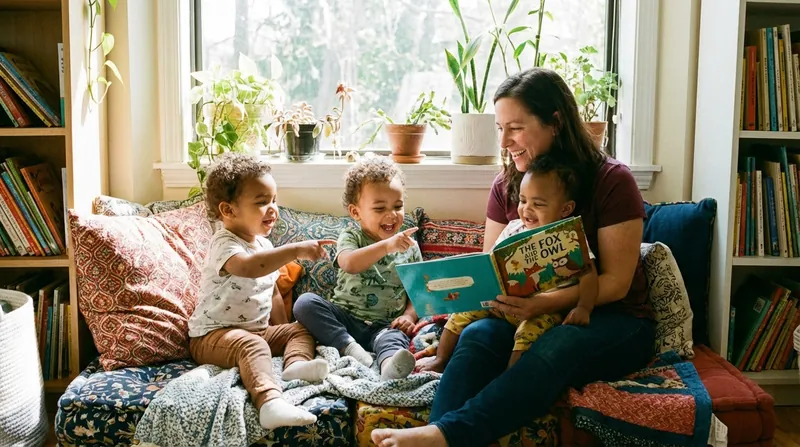
Regular reading aloud is one of the most effective methods for language support. At daycare, stories are read aloud daily — often in small groups so that all children can be actively involved.
Particularly effective is dialogic reading, where the professional does not simply read aloud but actively involves the child:
- What do you think happens next?
- Why do you think the bear is sad?
- Can you show me where the rabbit is hiding?
Songs, Rhymes and Language Games
Music and rhythm are gateways to language. At daycare, songs are sung, verses recited and language games played daily:
- Finger plays: Promote language and motor skills simultaneously
- Rhymes and counting-out verses: Train phonological awareness — an important prerequisite for later reading
- Clapping games: Combine language with rhythm and movement
- Tongue twisters: Train oral motor skills and are fun
- Word games: Promote creativity and vocabulary
Peer Group Effect: Learning from Peers
Children learn language not only from adults but also from each other. At daycare, natural language learning situations arise when children play, negotiate and tell stories together. This so-called peer group effect is particularly strong when children with different language levels are together — the linguistically stronger children become natural language role models.
Social motivation also plays a role: children want to be understood and to belong. This is a powerful drive to learn a new language. Further aspects of how children learn from each other can be found in our article Social Skills: What Children Learn in Daycare.
Bilingual and Immersive Programmes
Some daycare centres in Switzerland offer special bilingual programmes in which two languages are used equally in daily life — for example German/English, German/French or German/Spanish.
How Do Bilingual Daycare Centres Work?
Most bilingual daycare centres work according to the principle of one person — one language: certain professionals consistently speak Language A, others consistently speak Language B. This way, children experience both languages naturally in everyday life and associate them with different people.
Benefits of Bilingual Programmes
- Natural language acquisition without formal instruction
- Promotion of cognitive flexibility
- Intercultural competence from an early age
- Advantage in later foreign language learning
What You Should Consider
- Bilingual daycare centres are often private and more expensive than regular daycare centres
- The quality of language support depends on the qualifications of the professionals
- Not every child benefits equally — this depends on individual language level and the family language situation
- A bilingual programme does not replace nurturing the family language at home
What to look for when choosing a daycare centre in general can be found in our article Recognising Daycare Quality.
Dialect and Standard German in German-Speaking Swiss Daycare
A Swiss-specific issue is the question of whether dialect or Standard German should be spoken at daycare. Practice varies considerably:
- Dialect as everyday language: In many daycare centres, Swiss German is the everyday language — especially in rural areas
- Standard German as educational language: Some daycare centres deliberately use Standard German, as it is the language of schooling
- Mixed approach: Everyday communication in Swiss German, reading aloud and singing in Standard German
For children whose mother tongue is not German, dialect can be an additional hurdle, as they essentially have to learn two variants simultaneously. At the same time, Swiss German is the language of integration — speaking dialect means belonging.
Recommendation: Ask during the daycare visit how language is handled. There is no right or wrong, but there should be a deliberate approach in place.
When Is Speech Therapy Advisable?
Some children need additional support with language development. Speech therapy (logopedics) can help when a child falls significantly behind the typical milestones.
Warning Signs by Age
| Age | Possible need for support if ... |
|---|---|
| 18 months | Child speaks fewer than 10 words and rarely points at things |
| 24 months | Fewer than 50 words, no two-word sentences (so-called late talkers) |
| 3 years | Speech is barely understandable to outsiders, no sentences |
| 4 years | Major grammatical errors, very limited vocabulary, stuttering |
| 5 years | Difficulties with narration, many sounds are formed incorrectly |
How Does a Speech Therapy Assessment Work?
- The daycare or paediatrician recommends an assessment
- You register your child with the cantonal speech therapy service or a private practice
- The speech therapist conducts standardised tests
- If needed, therapy begins — usually once a week
- The daycare is often involved as well, so that support continues in daily life
Good to know: Pre-school speech therapy is funded through the school medical or special education service in many cantons and is free for parents. Enquire with your municipality.
10 Tips for Parents to Promote Language at Home
- Talk a lot with your child — and in your strongest language (family language). Quality over quantity.
- Read aloud daily — ideally as an evening ritual. Let your child turn pages and describe pictures.
- Ask open questions — What did you play at daycare today? instead of Was it nice at daycare?
- Correct indirectly — Repeat what was said in the correct form without correcting the child.
- Sing songs — Music and rhythm demonstrably support language acquisition.
- Narrate in everyday life — Shopping, cooking and walks offer countless opportunities for language.
- Limit screen time — Television and tablets do not replace real communication. Children learn language through dialogue, not passive listening.
- Value all languages — If your child is growing up multilingual, speak positively about all languages.
- Be patient — Do not interrupt your child and give them time to formulate their thoughts.
- Visit the library — Most Swiss libraries offer free events for young children (story time, rhymes and songs).
Conclusion: Language Grows Through Dialogue
Your child's language development is a fascinating process that is best promoted through a rich linguistic environment, genuine communication and patient support. Daycare offers ideal conditions for this: daily interaction with peers, professional language support in everyday life and diverse language stimulation through songs, stories and games.
Whether your child grows up monolingual or multilingual, whether they begin to speak early or late — the most important thing is that they grow up in an environment where language is valued and where they feel heard.
Further articles:
More articles
What Age for Daycare? What Research Says
When is your child ready for daycare? Research-based guide on developmental stages, settling-in, and quality criteria fo...
Settling-In by Age: Baby, Toddler, Preschool
Settling-in varies greatly by age. Learn which models work at which age and how to best support your child through the t...
5 Developmental Benefits of Childcare
What does research say? 5 scientifically proven benefits of external childcare for your child's development — and what t...
Social Skills: What Kids Learn in Daycare
Children develop important social skills in daycare. Learn how group life and role play strengthen your child's emotiona...
Daycare Costs Switzerland 2026: Real Prices
How much does a daycare place cost in Switzerland? Current prices by canton, subsidies, tax deductions, and practical mo...
Daycare, Playgroup, or Childminder? The Complete Comparison
Which type of childcare is right for your family? Daycare, playgroup, and childminder compared side by side: age, costs,...