Social Skills: What Children Learn in Daycare
Social Skills: What Children Learn in Daycare
When parents think about daycare, it is often first about care during working hours. But daycare is far more than a place to keep children — it is a unique learning environment for social skills. Nowhere else do children experience so early and so intensively what it means to be part of a group. They learn to share, assert themselves, find compromises and develop empathy. These skills are fundamental for their entire later life — at school, at work and in relationships.
In this guide, we show you which social skills children develop in daycare, how the professionals support this process and what you as a parent can contribute.
What Are Social Skills?
Social skills encompass all the abilities we need to successfully live together with other people. In children, these skills develop step by step and include various areas.
The Most Important Social Skills at a Glance
| Skill | Description | Typical Age |
|---|---|---|
| Sharing | Sharing toys and materials with others | From approx. 2–3 years |
| Waiting | Showing patience until it is one's turn | From approx. 2.5–3 years |
| Empathy | Recognising others' feelings and responding to them | From approx. 3–4 years |
| Cooperation | Working together towards a goal | From approx. 3–4 years |
| Conflict resolution | Resolving disputes with words rather than actions | From approx. 4–5 years |
| Perspective-taking | Understanding other people's viewpoints | From approx. 4–5 years |
| Following rules | Accepting and following group rules | From approx. 3 years |
| Maintaining friendships | Building stable relationships with peers | From approx. 4 years |
Important: These age ranges are guidelines. Every child develops at their own pace. Some children are ahead in certain areas, behind in others — this is entirely normal.
How Daycare Promotes Social Development
Daycare offers something that the family environment alone cannot provide: a constant group of peers. In this group, situations that enable social learning arise daily.
Group Daily Life as a Learning Environment
In daycare, children experience dozens of social interactions every day. During circle time they learn to listen and wait. At lunchtime they practise table manners and consideration. During play they negotiate rules and roles. These everyday situations are more valuable than any structured learning programme because they are authentic and meaningful to the children.
A typical daycare day offers countless opportunities for social learning. More about the daily routine can be found in our article A Day in Daycare: What Your Child Experiences.
The Role of Free Play
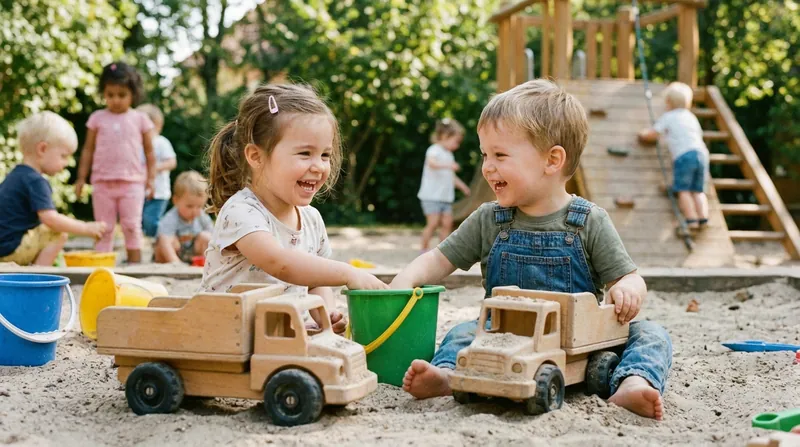
Free play is the most important phase for social development. Here, children decide for themselves who they play with, what they play and how they play. This naturally gives rise to conflicts and cooperation situations that are accompanied by the professionals but not controlled by them.
During free play, children learn among other things:
- Negotiating: Who gets to play which role? Who determines the rules?
- Finding compromises: Both want the red spade — how do we solve this?
- Leading and following: Sometimes one child sets the tone, sometimes they follow another's idea
- Setting boundaries: Saying no when they do not want something
- Accepting boundaries: Accepting when another child does not want to join in
Role Play and Its Significance
Role play is one of the most effective forms of social learning. When children play house, slip into the role of a doctor or act out a shop, a great deal happens simultaneously:
- Perspective-taking: The child puts themselves in another person's shoes
- Emotional regulation: They must appropriately portray emotions suited to the role
- Language development: They use new words and sentence structures
- Social rules: They understand how various social situations work
- Cooperation: Role play only works together
Did you know? Children who engage in a lot of role play show higher emotional intelligence and better conflict resolution skills in studies. Role play is essentially a training ground for real life.
Learning to Share — A Long Process
Sharing is one of the first social skills parents expect from their children — and at the same time one of the most difficult. For toddlers, the concept of ownership is closely linked to their own identity. When you tell a two-year-old to share their toy, it feels as though you are taking a part of themselves away.
How Sharing Develops
- 12–18 months: Child shows objects but rarely gives them away
- 18–24 months: Begins to offer objects but takes them back immediately
- 2–3 years: Can share with support but needs guidance
- 3–4 years: Understands the concept but shares selectively (with friends rather than strangers)
- 4–5 years: Can share consciously and voluntarily, understands fairness
How Daycare Supports Sharing
In daycare, there are proven strategies to encourage sharing:
- Time rules: Each child may play with the coveted toy for 5 minutes, then it is the next child's turn
- Communal materials: Many materials belong to everyone, not to individual children
- Role modelling: Professionals demonstratively share with the children
- Positive reinforcement: Sharing is praised, not-sharing is not punished
- Trading culture: Children learn that trading can be a win-win situation
Conflicts: The Underestimated Learning Opportunity
Many parents worry when their child gets into conflicts at daycare. But conflicts are not only normal — they are indispensable for social development. A child that never argues misses important learning opportunities.
Why Conflicts Are Valuable
Conflicts teach children:
- That other people have different wishes and needs
- That you do not always get your way
- That there are ways to solve problems without hitting or shouting
- That a relationship can survive an argument
- That compromises are possible and can feel good
Conflict Resolution in Daycare — Step by Step
Professional staff in daycare guide conflicts according to a proven approach:
- Stop: The situation is interrupted before anyone gets hurt
- Calm down: Both children are given time to calm down
- Listen: Each child may describe their perspective without being interrupted
- Name: The professional names both children's feelings: "You are angry because ... You are sad because ..."
- Seek a solution: Together, a solution is sought that works for both
- Agreement: The children agree and can continue playing
This process is repeated hundreds of times until the children can increasingly apply it independently. From around 4 to 5 years, many children manage to resolve simple conflicts without adult help.
Typical Daycare Conflicts by Age
| Age | Common Conflicts | Typical Resolution |
|---|---|---|
| 1–2 years | Taking toys, biting, pushing | Professional separates, offers alternative |
| 2–3 years | Not wanting to share, tantrums, competing for attention | Time rules, naming feelings |
| 3–4 years | Excluding, wanting to be in charge, rule-breaking | Discussing rules together, practising perspective-taking |
| 4–5 years | Friendship conflicts, jealousy, fairness discussions | Mediation conversations, independent problem-solving |
Empathy — The Heart of Social Competence
Empathy is the ability to recognise, understand and appropriately respond to other people's feelings. It is the foundation for almost all other social skills and develops over several years.
Stages of Empathy Development
- 0–1 year: Emotional contagion — baby cries when other babies cry
- 1–2 years: Egocentric empathy — child comforts others the way they want to be comforted themselves
- 2–3 years: Beginning cognitive empathy — child understands that others feel differently from them
- 3–5 years: Genuine empathy — child can put themselves in others' shoes and respond appropriately
How Daycare Promotes Empathy
In daycare, empathy is promoted in various ways:
- Naming feelings: Professionals use words for emotions so that children develop an emotional vocabulary
- Picture books: Stories about feelings and social situations are read and discussed
- Feelings barometer: Children show each morning how they are feeling — with smileys, colours or photos
- Encouraging comforting: When a child cries, others are encouraged to comfort them, but not forced
- Animal care: Some daycare centres have pets to practise responsibility and caring
Children who build a secure attachment to their carers in daycare generally also develop stronger empathic abilities. How this attachment forms depends significantly on the settling-in process.
Emotional Regulation: Learning to Manage Feelings
Emotional regulation is the ability to recognise strong feelings like anger, frustration, sadness or excitement and to manage them so that one is not overwhelmed by them. For toddlers, this is an enormous challenge, as the brain regions responsible (the prefrontal cortex) only mature during the course of childhood and adolescence.
What Emotional Regulation Involves
- Recognising feelings: Understanding what one is currently feeling
- Naming feelings: Finding words for emotions
- Expressing feelings: Showing how one feels in an acceptable way
- Regulating feelings: Applying strategies to calm down
- Controlling impulses: Not immediately reacting to every impulse
Regulation Strategies in Daycare
Professional daycare centres work with various strategies:
- Anger corner / quiet island: A place where children can retreat when feelings become too big
- Breathing exercises: Simple breathing techniques like the flower-candle exercise (smell the flower = breathe in, blow out the candle = breathe out)
- Movement: Stamping out anger, hitting cushions, running
- Creativity: Expressing feelings through painting, modelling clay or music
- Verbalisation: "I am angry because ..." instead of shouting or hitting
Tip for parents: Adopt the daycare's strategies at home too. Ask the professionals which methods work best for your child. Consistency between daycare and home enormously accelerates the learning process.
Group Dynamics: Leading, Following and Fitting In
In the daycare group, dynamic social structures develop. Some children tend to be leaders, others followers, and others mediators. These roles are not fixed — they can change depending on the situation, the play theme and the group composition.
Typical Roles in the Daycare Group
- The initiator: Brings in ideas, starts games, organises other children
- The co-creator: Takes up ideas and develops them further
- The mediator: Resolves conflicts, includes quieter children
- The observer: Watches first before joining in — learns through watching
- The loner: Enjoys playing alone, needs less group interaction
What Parents Should Know
None of these roles is better or worse than another. A child that enjoys playing alone does not necessarily have a social deficit. And a child that always plays the leader is not automatically socially competent.
What matters is flexibility: Can your child take on different roles? Can they both lead and follow? Can they hold back when needed or also step forward?
The professionals in daycare ensure that no child is permanently stuck in an unfavourable role. They promote this by:
- Regularly mixing up groups
- Offering various activities that appeal to different strengths
- Specifically including quieter children without overwhelming them
- Helping dominant children learn to also listen and wait
Further information about the developmental advantages daycare offers overall can be found in our article Developmental Advantages of Childcare.
Strengthening Social Skills — At Home Too
Daycare makes an enormous contribution to your child's social development. But you as a parent also play a decisive role.
10 Tips for Everyday Life
- Be a role model: Children learn through observation. Show in daily life how you resolve conflicts, apologise and show consideration for others.
- Name feelings: "I can see you are angry" and "I understand that makes you sad" — this helps your child build an emotional vocabulary.
- Read stories: Picture books about friendship, arguments and feelings are ideal for discussing social situations.
- Invite playmates: Regular play dates provide protected practice grounds for social skills.
- Allow conflicts: Do not immediately intervene when your child argues with another child. Give both the chance to find a solution.
- Praise prosocial behaviour: "That was great how you helped your friend" — positive reinforcement works more strongly than criticism.
- Set clear boundaries: Children need rules to feel safe. Explain the reasons behind the rules.
- Practise patience: Social skills develop over years, not overnight. Setbacks are normal.
- Cooperate with the daycare: Regularly talk to the professionals about how your child behaves in the group.
- Do not compare: Every child has their own pace. Comparisons with other children create pressure and help nobody.
When Should You Take Notice?
In most cases, social development is a natural process that proceeds at its own pace. However, there are signs where you should speak to the professionals or your paediatrician:
- Your child still has great difficulty with separation after several months at daycare
- They consistently show aggressive behaviour without improvement
- They have no interest in other children at all and consistently withdraw
- They are regularly excluded by other children and visibly suffer from it
- They show extreme anxiety in social situations
In such cases, early childhood special education may be helpful — this is organised cantonally in Switzerland and is generally free for families.
Long-term Impact: Why Social Skills from Daycare Help for a Lifetime
Numerous studies demonstrate that children who develop social skills early benefit in the long term. Research shows that good social skills at pre-school age are a better predictor of later school success than cognitive abilities such as arithmetic or reading. Children with strong social skills show fewer behavioural problems at school, have more stable friendships, are more cooperative in class and can better cope with frustration and setbacks.
Social skills are also decisive in later working life — teamwork, communication, empathy and conflict management are among the most sought-after skills in the job market. Those who have already trained these skills in daycare are building on a stable foundation.
Conclusion: Daycare as a Social School of Life
Daycare is far more than a place of care. It is a unique learning environment in which children develop fundamental social skills that accompany them for a lifetime. Sharing, arguing, making up, showing empathy, accepting rules, maintaining friendships — children learn all of this in daily interaction with peers.
As a parent, you can support this process by adopting the daycare's strategies at home, not putting your child under pressure and trusting the professionals. Social development takes time — but daycare provides the ideal framework for it.
Further articles:
More articles

What Age for Daycare? What Research Says
When is your child ready for daycare? Research-based guide on developmental stages, settling-in, and quality criteria fo...
Settling-In by Age: Baby, Toddler, Preschool
Settling-in varies greatly by age. Learn which models work at which age and how to best support your child through the t...
5 Developmental Benefits of Childcare
What does research say? 5 scientifically proven benefits of external childcare for your child's development — and what t...
Language Development: How Daycare Helps
Growing up multilingual in Switzerland: how daycare supports your child's language development and what you can do as a ...

Daycare Costs Switzerland 2026: Real Prices
How much does a daycare place cost in Switzerland? Current prices by canton, subsidies, tax deductions, and practical mo...
Daycare, Playgroup, or Childminder? The Complete Comparison
Which type of childcare is right for your family? Daycare, playgroup, and childminder compared side by side: age, costs,...