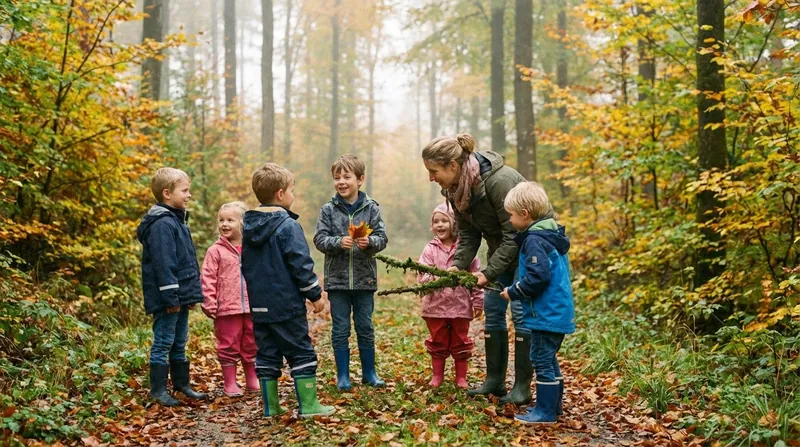
Forest and Farm Playgroups: Adventures for Little Explorers
Forest and Farm Playgroups: Adventures for Little Explorers
Does your child love being outdoors? Collecting stones, watching beetles, splashing in puddles and wanting to spend the whole day in the forest? Then a forest playgroup or farm playgroup could be just the right thing. In Switzerland, there is a growing number of nature education playgroups that offer children a setting in which they experience nature as a playground and learning space. This guide explains everything you need to know — from the educational philosophy and typical daily routine to the right equipment and costs.
What Is a Forest Playgroup?
Definition
A forest playgroup is a form of childcare for children from around 3 years of age (sometimes from 2.5), which spends the majority of care time in the forest. There is no fixed room — the forest is the room. A woodland area with a designated forest site, a fire pit and a shelter (tipi, tarpaulin or simple forest hut) serves as a base. The children play with what nature provides: sticks, stones, leaves, mud, water, pine cones.
What Is a Farm Playgroup?
A farm playgroup works on the same principle, except that the learning environment is a farm. The children experience everyday farm life: feeding animals, collecting eggs, harvesting vegetables, smelling hay. There is often a combination of outdoor time (field, forest, barn) and a simple indoor space (barn, farmhouse room).
Comparison with Regular Playgroups
| Criterion | Regular Playgroup | Forest Playgroup | Farm Playgroup |
|---|---|---|---|
| Location | Fixed room (community centre, daycare) | Forest (with forest site) | Farm (barn, field, forest) |
| Indoor/Outdoor | Predominantly indoor | Almost exclusively outdoor | Mixed (indoor + outdoor) |
| Materials | Craft materials, toys, furniture | Natural materials | Nature + farm (animals, tools) |
| Age | From approx. 3 years | From approx. 3 years | From approx. 3 years |
| Duration | 2–3 hours per half-day | 3–4 hours per half-day | 3–4 hours per half-day |
| Group size | 8–12 children | 8–12 children | 8–12 children |
| Costs | CHF 20–30 per half-day | CHF 20–30 per half-day | CHF 20–35 per half-day |
You can find a comprehensive comparison of all care types in our guide Daycare, Playgroup or Childminder: Which Care Fits?.
Educational Concept: Why Nature Is So Valuable
Forest Education and Nature Education
Forest playgroups and farm playgroups are based on the principles of forest education (also nature education or experiential education). The core idea: children learn best through their own experience in a natural environment.
What Children Learn in the Forest and on the Farm
Nature offers endless learning opportunities — without needing to buy toys or order craft kits:
- Motor skills: Climbing over roots, balancing on tree trunks, carrying stones, digging with sticks. The uneven forest floor trains balance and coordination better than any gym equipment
- Sensory perception: Smelling (moss, earth, fire), touching (bark, stones, water), hearing (birds, wind, brook), seeing (light play in the forest, animals, seasons)
- Creativity and imagination: A stick becomes a sword, a root becomes a ship, a hole in the ground becomes an animal castle. Natural materials are the best open-ended play material
- Nature knowledge: What tree is this? Which bird is singing? What does an earthworm eat? Children develop a natural understanding of ecology and connections
- Social skills: In the forest, there are no toys to own — everything is shared. Children learn cooperation, negotiation and empathy
- Resilience and self-confidence: Being outdoors in all weather strengthens resistance. Children who play in the forest learn: "I can do this — even when it's cold, wet or difficult"
- Concentration and calm: Studies show that children who regularly play in nature demonstrate better concentration and fewer stress symptoms
Swiss Research and Recommendations
Nature education is increasingly recognised in Switzerland. The Marie Meierhofer Institute for the Child (MMI) in Zurich emphasises the importance of nature experiences for early childhood development. The framework for early childhood education, care and upbringing in Switzerland also recommends providing children with regular access to nature-rich play spaces.
Typical Routine of a Forest Playgroup
A half-day in a forest playgroup typically lasts 3–4 hours. Here is what a typical morning looks like:
| Time | Activity | Description |
|---|---|---|
| 09:00 | Meeting point | Children are brought to the agreed meeting point (edge of the forest, car park, bus stop) |
| 09:15 | Morning circle | Greeting, song, discussion: What are we doing today? |
| 09:30 | Walk to the forest site | Walking together to the forest site — discovering, collecting, observing along the way |
| 10:00 | Snack by the fire | Shared snack by the fire. Often the children bring their own snack, sometimes prepared together (stick bread, hot tea) |
| 10:30 | Free play | Children play freely: building dens, damming streams, searching for animals, climbing, digging |
| 11:15 | Guided activity / story | Themed activity: animal tracking, whittling practice, forest story, seasonal ritual |
| 11:45 | Tidy up and closing song | Tidying up the forest site together, farewell song |
| 12:00 | Return and pick-up | Walking back together, children are picked up at the meeting point |
Farm Playgroup Specifics
On a farm, specific activities are added:
- Caring for animals: Feeding chickens, stroking goats, grooming ponies, watching rabbits
- Garden and field: Harvesting vegetables, picking herbs, turning compost
- Seasonal work: Pressing apples in autumn, planting seeds in spring, bringing in hay in summer
- Simple processing: Churning butter, baking bread, pressing juice
Equipment: What Does My Child Need?
The right clothing is crucial in a forest playgroup. The children are outdoors for 3–4 hours — in all weather. Here is a seasonal overview:
Clothing List by Season
| Item | Spring | Summer | Autumn | Winter |
|---|---|---|---|---|
| Underwear | Normal | Normal | Performance base layer | Thermal underwear |
| Top | Long-sleeved shirt | T-shirt | Long-sleeve + fleece | Thermal top + fleece |
| Trousers | Hiking trousers | Light trousers | Hiking trousers | Thermal trousers / ski trousers |
| Jacket | Softshell jacket | Light windbreaker | Rain jacket + fleece | Winter jacket (waterproof) |
| Rain protection | Rain jacket + rain trousers | Rain jacket if needed | Rain jacket + rain trousers | Integrated in ski suit |
| Shoes | Hiking shoes, wellies | Sturdy shoes (closed!) | Hiking shoes, wellies | Winter boots (waterproof, warm) |
| Headwear | Hat in cold weather | Sun hat (mandatory!) | Hat | Warm hat + neck gaiter |
| Gloves | — | — | Thin gloves | Warm, waterproof gloves (2 pairs!) |
| Extras | Scarf | Sunscreen SPF 50+ | Scarf | Scarf / neck gaiter, hand warmers |
Important Equipment Tips
- Layering principle: Better several thin layers than one thick one. This way the carer can flexibly adjust to the temperature
- Waterproof and breathable: The outer layer must be waterproof. Cheap rain jackets usually don't last long
- No open shoes: In the forest, closed, sturdy shoes are mandatory — no sandals, no crocs
- Spare clothing: Always a complete set of spare clothing in the backpack (underwear, socks, trousers, top)
- Water bottle and snack: As a rule, children bring their own snack. Avoid sweets and packaging waste — fruit, bread, vegetable sticks, nuts are ideal
- No toys from home: In most forest playgroups, the rule is: nature provides enough play material. Toys from home stay at home
- Backpack: A small, comfortable children's backpack with a chest strap. The child carries their own backpack — this promotes independence
Budget tip: Good outdoor clothing for children doesn't have to be expensive. In Switzerland, there are children's clothing exchanges and online platforms for second-hand clothing in many places. Robust brands like Reima, Didriksons and Polarn O. Pyret last through several children.
Weather: What Happens in Extreme Conditions?
Rain
Rain is not a reason to cancel a forest playgroup — on the contrary. Playing in the rain is one of the most valuable experiences for children. Jumping in puddles, watching earthworms, seeking shelter under a tree — that's pure adventure. Prerequisite: the right clothing (see above).
Cold
At temperatures below freezing, most forest playgroups slightly shorten the outdoor time. The fire becomes the central element — children warm up, drink hot tea and have their snack by the fire. In extreme cold (below approx. –10 °C), a playgroup may be cancelled in consultation with the parents. Many forest playgroups have an alternative indoor space for emergencies (heated container, farmhouse, community hall).
Heat
In summer heat, the forest offers a natural advantage: in the forest it is always a few degrees cooler than in open fields. Nevertheless, precautions apply:
- Sun hat and sunscreen (SPF 50+) are mandatory
- Drink sufficient water (at least 0.5 litres per child)
- Move activities into the shade
- In extreme heat (over 35 °C), the playgroup may be shortened or cancelled
Thunderstorms and Storms
In thunderstorms and storms, the forest playgroup is cancelled. The playgroup leader usually informs parents in the morning (via SMS, WhatsApp or email). In some cases, the alternative indoor space is used. These rules are clearly communicated in most forest playgroups and documented in the contract.
Safety: How Is Supervision Ensured?
Carer-to-Child Ratio
In a forest playgroup — as in regular playgroups — a carer-to-child ratio of typically 1 carer per 6–8 children applies. Since children have more freedom of movement in the forest, there are often 2 carers per group on site (e.g. 1 trained playgroup leader + 1 assistant).
Forest Rules
Every forest playgroup has clear rules that are taught to children on the first day:
- Stay visible: Children may only go as far as they can still see (or hear) the carer
- Whistle signal: When the carer blows the whistle, all children come back immediately
- Nothing in the mouth: Berries, mushrooms and plants are not eaten (unless the carer explicitly allows it)
- Sticks and knives: Clear rules for handling pointed sticks and (for older children) pocket knives
- Fire rules: Safety distance from the fire, no running near the fire
Dealing with Natural Hazards
| Hazard | Measure |
|---|---|
| Ticks | Long trousers and sleeves, light-coloured clothing. After the playgroup: check the child's entire body. Tick removal by the carer if needed (with tick remover). Vaccination against TBE recommended from 6 years (in risk areas from 3 years). |
| Bees and wasps | Stay calm, don't swat. In case of known allergy: deposit emergency kit (EpiPen) at the playgroup. Inform carers about allergies. |
| Poisonous plants | The carer knows the poisonous plants in the forest area and points them out to the children (yew, deadly nightshade, laburnum, autumn crocus). Basic rule: don't touch or eat anything unknown. |
| Fox tapeworm | Don't eat ground-level berries (wild strawberries, blueberries), wash hands before eating. The risk is low, but hygiene is important. |
| Falls and injuries | First aid kit is always present. Carers have first aid certification. In case of serious injuries: emergency services 144. GPS coordinates of the forest site are documented. |
Which Children Are Forest/Farm Playgroups Suitable For?
Particularly suitable for children who ...
- have lots of energy and love being outdoors
- are interested in animals, plants and nature
- play creatively and imaginatively
- show sensory overload in enclosed spaces (restlessness, concentration problems)
- are more overwhelmed than inspired by lots of toys
- love to splash, dig and build
- have a strong desire for freedom
Less suitable if your child ...
- has a strong fear of insects, darkness or unknown animals (this can subside over time)
- has severe allergies to insect stings (only with an emergency kit and clear agreements)
- has a physical limitation that makes walking on uneven terrain difficult (individual assessment needed)
- feels uncomfortable in cold and wet conditions and has difficulty warming up
Note: Many children who are initially hesitant blossom after a few weeks in the forest. Children are more adaptable than we think. Give your child time to discover nature — and don't be surprised if after the first month they no longer want to leave.
Costs: What Does a Forest Playgroup Cost?
Typical Prices
The costs of a forest playgroup are generally comparable to a regular playgroup:
| Cost Type | Amount |
|---|---|
| Per half-day (3–4 hours) | CHF 20–30 |
| Per semester (approx. 18–20 half-days) | CHF 360–600 |
| Per school year (approx. 36–40 half-days) | CHF 720–1,200 |
| Registration fee (if applicable) | CHF 0–50 |
| Materials contribution (annual) | CHF 0–50 |
Farm Playgroups: Slightly More Expensive?
Farm playgroups can be slightly more expensive (CHF 25–35 per half-day), as the use of the farm and keeping animals incur costs. However, the difference is small.
Subsidies
Playgroups are subsidised in some cantons and municipalities — especially when they are recognised as "early education". Check with your municipality or the cantonal social welfare office. In urban areas, subsidies are more common than in rural regions. You can find an overview of the regulations in your canton on our canton pages.
Where Can I Find a Forest Playgroup or Farm Playgroup?
Search Regionally
Forest playgroups and farm playgroups are widespread throughout Switzerland, especially in rural and suburban areas. Here's how to find one near you:
- kizi.ch: On kizi.ch you can search specifically for playgroups in your region and filter by type of care
- Playgroup directories: The Swiss Playgroup Leaders' Association (SSLV) maintains a directory of playgroups with a nature education focus
- Municipality and school: Your local municipality or school administration can often provide information
- Word of mouth: Ask other parents in your neighbourhood — forest playgroups thrive on recommendations
Registration and Waiting Lists
Popular forest playgroups have waiting lists — especially in urban regions like Zurich, Bern or Basel. Register your child early (6–12 months before the desired start date). Most playgroups start in August/September (after the summer holidays), some also accept new children in January.
Frequently Asked Questions (FAQ)
From What Age Can My Child Attend a Forest Playgroup?
Most forest playgroups accept children from 3 years of age, some from 2.5 years. The prerequisite is that the child can walk independently (including on uneven terrain) and can manage at least 3 hours without parents. In some regions, there are also forest parent-child groups for younger children (from 1.5 years), where a parent accompanies.
Is a Forest Playgroup Also Open in Winter?
Yes. Most forest playgroups run throughout the year — including in winter. Winter in particular offers special experiences: snow, ice, animal tracks in the snow, making fire. The prerequisite is the right winter clothing (see clothing list). In extreme weather conditions (storms, freezing rain, extreme cold below –10 °C), a playgroup may be cancelled in individual cases.
What Happens When My Child Needs the Toilet?
In nature, there is no toilet — and that's not a problem. The children learn to "go" behind a bush. The carer has toilet paper and hand sanitiser with them. For bigger emergencies, many forest sites have a "forest toilet" (simple pit). Children who still wear nappies are changed on a mat.
Can Children with Allergies Attend a Forest Playgroup?
In principle yes, but clear agreements are needed. For insect sting allergies, an emergency kit (EpiPen) must be deposited at the playgroup and the carer must be instructed. For food allergies, the snack topic is important: what may the child eat? What not? Speak openly with the playgroup leader and provide all information in writing.
How Does a Forest Playgroup Differ from a Forest Kindergarten?
A forest playgroup is a voluntary offering for children from around 3 years of age, typically 1–2 half-days per week. A forest kindergarten is part of the compulsory education system (from 4 years in most cantons) and takes place 5 days per week. The educational approach is similar, but the forest kindergarten has a curriculum and is led by trained teachers.
Conclusion: Nature as the Best Playground
A forest playgroup or farm playgroup offers your child something that no playroom in the world can replace: real nature experience, adventure, freedom and the opportunity to learn with all senses. The costs are comparable to a regular playgroup, the equipment is manageable and the educational benefits are well supported by research.
Your Next Steps
- Search for a forest playgroup or farm playgroup near you on kizi.ch
- Attend a taster morning — most playgroups offer this
- Get the right outdoor clothing (layering principle!)
- Register your child early — popular groups have waiting lists
- Inform the playgroup leader about allergies, medications and special needs
If you're still not sure which type of care is right, read our comprehensive comparison Daycare, Playgroup or Childminder: Which Care Fits?. And if you want to know what a typical day at daycare looks like, check out our guide A Day at Daycare: What Your Child Experiences.
Find the right playgroup now on kizi.ch
Sources: Swiss Playgroup Leaders' Association (SSLV), Federal Office for the Environment (FOEN) — Forest Education, Marie Meierhofer Institute for the Child (MMI), Framework for Early Childhood Education in Switzerland, kibesuisse Recommendations, cantonal forest laws and licensing regulations. As of: February 2026.
More articles
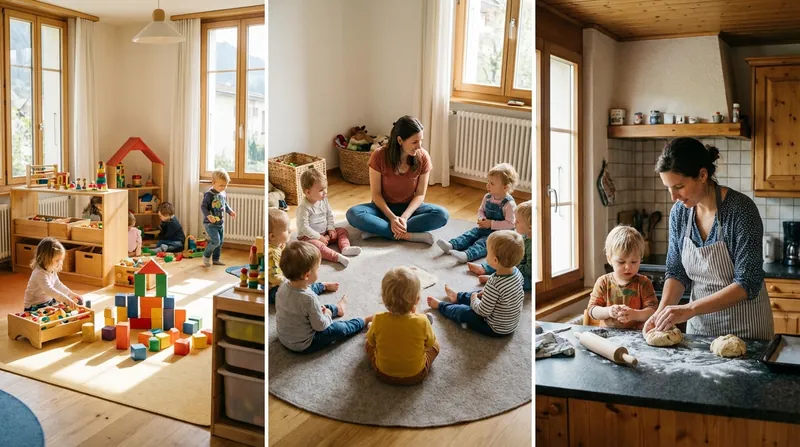
Daycare, Playgroup, or Childminder? The Complete Comparison
Which type of childcare is right for your family? Daycare, playgroup, and childminder compared side by side: age, costs,...
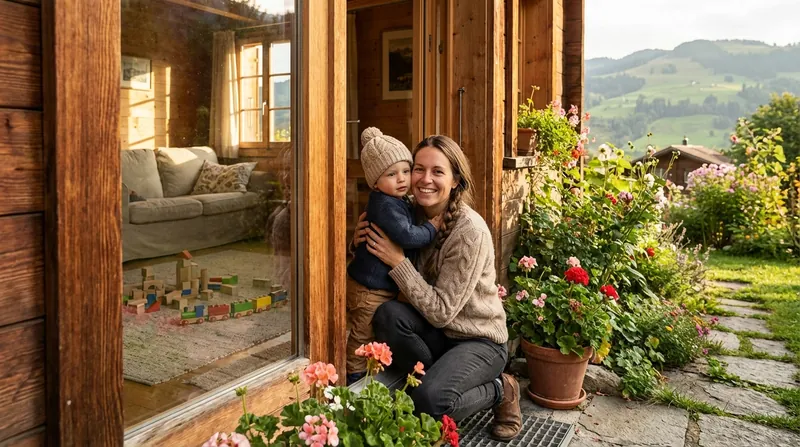
Finding a Childminder: The Complete Guide
How to find the right childminder. About associations, costs, contracts, and what you should look for....
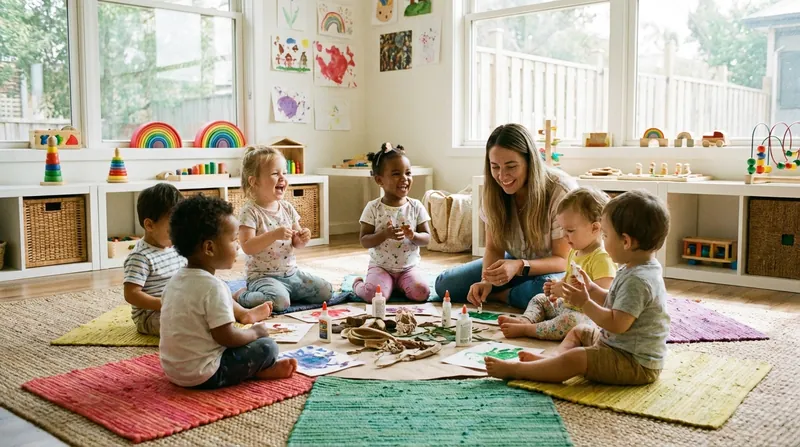
Playgroup: Everything Parents Need to Know
Playgroup from what age? Costs, types, and why playgroups are so important for kindergarten preparation....
Au Pair in Switzerland: Requirements & Costs
Au pair costs, legal rules, and the difference from a nanny: everything Swiss host families need to know....
Good Daycare: 10 Quality Criteria for Parents
How to recognise a good daycare? 10 evidence-based quality criteria, warning signs, and a printable checklist for parent...
Hiring a Nanny in Switzerland: Cost & Contract
Want to hire a nanny? Everything about wages, social insurance, contracts, nanny-sharing, and tax deductions as a privat...