At a glance: Your most important rights
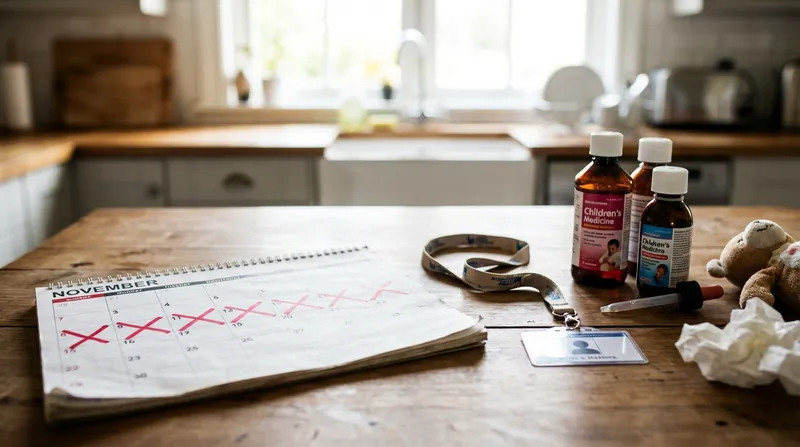
It's Monday morning, 6:30 am. Your child wakes up with a fever, a cough and glassy eyes. Daycare or school is out of the question. At the same time, an important meeting awaits at the office. What now? Can you simply stay at home? Will your salary continue to be paid? And what happens if your child is ill for longer?
Almost all working parents in Switzerland know this situation. The good news: Swiss law protects you in this situation — however, the legal position is more complex than many think. In this comprehensive guide, you'll learn everything about your rights regarding child sick days, the relevant legal articles, continued pay, collective agreements and practical tips for everyday life.
At a glance: Your most important rights
Before we go into detail, here's a brief overview:
| Situation | Legal basis | Duration | Salary |
|---|---|---|---|
| Child short-term ill | Art. 36 para. 3 ArG | Max. 3 days per illness | Yes (Art. 324a OR) |
| Care of family members | Art. 329h OR | Max. 3 days per case, 10 days/year | Yes |
| Seriously ill child (under 18) | Art. 329i OR + EO | Max. 14 weeks | 80% via EO |
Art. 36 ArG: The basis — up to 3 days per illness
What does the law say?
Art. 36 para. 3 of the Employment Act (ArG) is the central provision for working parents with sick children. It states: employees with family responsibilities are entitled to the time necessary for caring for sick children — up to a maximum of 3 working days per illness.
This means concretely:
- Per illness you are entitled to up to 3 free days — not per year.
- If your child has the flu in January and a stomach bug in March, you can take up to 3 days off for each illness.
- The 3 days are an upper limit. If your child recovers on the second day, you must in good faith return to work on the third day.
Who is entitled?
- Employees with own children up to 15 years of age
- It doesn't matter whether you are the father or mother
- Stepparents and foster parents can also invoke family responsibilities
- The entitlement applies regardless of whether you work full-time or part-time
What conditions apply?
- Medical certificate: You need a medical certificate confirming that your child is ill and needs care. Tip: ask the paediatrician for a medical certificate at the first visit — even if it's "only" a cold.
- No other care available: The care must be necessary. This means you must plausibly demonstrate that no other person (partner, grandparents, neighbours) can step in.
- Duty to notify: Inform your employer as early as possible — ideally before the start of work.
Important: Art. 36 ArG does not apply to everyone
The Employment Act (ArG) does not apply to all employees. Exempted are, among others:
- Senior employees within the meaning of Art. 3 lit. d ArG
- Public administrations (federal, cantonal, municipal — these have their own regulations)
- Agricultural businesses
- Domestic helpers in private households
If you work in one of these areas, more generous or more restrictive rules may apply according to your employment contract or the applicable personnel law.
Art. 329h OR: Care leave — additional protection since 2021
Since 1 January 2021, Art. 329h of the Code of Obligations (OR) provides another important legal basis. This article grants employees paid short leave for the care of family members with health impairments.
What does Art. 329h OR add?
- Up to 3 days per event, maximum 10 days per year
- Applies not only to children, but also to partners, parents, siblings and parents-in-law
- The term "health impairment" is broadly defined: illness, accident and disability are covered
Special provision for children
For the care of sick children, an important exception applies: the annual cap of 10 days does not apply to children. This means that in the case of multiple illnesses of your child in the same year, you can claim more than 10 days — up to 3 days per illness.
This is a significant difference from Art. 36 ArG and considerably strengthens the position of parents.
Art. 36 ArG and Art. 329h OR — what applies in parallel?
Both provisions apply side by side. You can invoke whichever regulation is more favourable for you depending on the situation. In practice, this means:
- For a sick child: Both articles applicable, no annual maximum of 10 days
- For a sick partner/mother/father-in-law: Only Art. 329h OR, with 10-day annual cap
Continued pay: Will your salary continue to be paid?
The question that concerns all parents the most: will my salary continue to be paid if I stay at home because of my sick child?
The legal position in detail
Continued pay for child sick days is based on Art. 324a OR. This article regulates continued pay in the case of involuntary prevention from working. Such prevention exists when:
- You yourself are ill, or
- A family member is ill for whom a legal duty of support exists (e.g. your child)
The Federal Supreme Court has confirmed that caring for a sick child falls under Art. 324a OR.
How long is salary paid?
The duration of continued pay follows the same rules as for your own illness:
| Year of service | Bern scale | Zurich scale | Basel scale |
|---|---|---|---|
| 1st year of service | 3 weeks | 3 weeks | 3 weeks |
| 2nd year of service | 1 month | 8 weeks | 2 months |
| 3rd–4th year of service | 2 months | 9 weeks | 3 months |
| 5th–9th year of service | 3 months | — | — |
Note: Absences due to your sick child are counted together with your own sick days. If you have already been ill yourself for 2 weeks in this service year, the remaining entitlement to continued pay for child sick days is reduced accordingly.
Daily sickness benefit insurance
Many employers have taken out daily sickness benefit insurance (KTG). This often replaces the statutory continued pay with a more generous solution:
- Typical: 80% of salary for 720 days within 900 consecutive days
- Check your employment contract or personnel regulations to see if KTG exists
- Important: Not all KTG solutions also cover absences due to sick children — ask the HR department if in doubt
Collective agreements (GAV): Often more generous regulations
The statutory minimum standards (3 days per case, continued pay according to scale) are exactly that: minimum standards. Many industries offer significantly better conditions through collective agreements (GAV).
What a GAV can change
- More free days: Some GAV grant 5 or more paid days per illness
- Higher continued pay: Full salary instead of only according to scale
- No medical certificate from day 1: Some GAV only require a certificate from the 3rd day
- Additional care days: Beyond the statutory entitlements
Examples from practice
| Industry / GAV | Child sick day regulation |
|---|---|
| Public service (many cantons) | 5–10 paid days per year for childcare |
| Healthcare (various GAV) | Up to 5 days per illness |
| Banking (bank personnel regulations) | 3–5 days paid, partly without medical certificate on day 1 |
| Retail (Coop, Migros) | 3 days per case, generous KTG arrangement |
| Tech / Startups (often individual contractual arrangements) | Often flexible home office solutions |
How to find out if a GAV applies to you
- Check your employment contract — it usually states which GAV is applicable
- Ask your HR department
- Search on gavservice.ch for your industry
- Contact your trade union (e.g. Unia, Syna, Angestellte Schweiz)
Long-term sick child: Care compensation via the EO
What happens if your child doesn't just have a week of flu but is seriously ill — for example with cancer, a chronic illness or after a severe accident? For these cases, Switzerland introduced care leave under Art. 329i OR on 1 July 2021, financed through the Income Compensation Scheme (EO).
Requirements for care compensation
Care compensation applies in the case of a serious health impairment of the child. This exists when:
- A significant change in physical or psychological condition has occurred
- The course or outcome is difficult to foresee, or
- A lasting or increasing impairment or death is to be expected
The child must be under 18 years of age.
Duration and amount
- Maximum 14 weeks (98 days) of care leave
- The leave must be taken within a framework period of 18 months
- The compensation amounts to 80% of average AHV-liable income
- Maximum CHF 220 per day (as of 2026)
- Both parents can divide the 14 weeks between them
How to apply for care compensation
- Obtain a medical certificate confirming the serious health impairment
- Register with the responsible compensation fund (that of your employer)
- The form can be found on ahv-iv.ch under "Care compensation"
- The compensation fund reviews the entitlement and pays out the daily allowances
Protection against dismissal during care leave
During care leave, you enjoy protection against dismissal for 6 months (Art. 336c para. 1 lit. c^bis OR). A dismissal by the employer during this period is void.
Your child is ill: Step-by-step guide
So that you don't have to think long in an emergency, here is the optimal procedure:
Step 1: Inform your employer immediately
- Call or send a message before the start of work
- State the expected duration ("my child has a high fever, I'm staying home today and will update you tomorrow")
- Offer — if possible — to handle urgent tasks from home
Step 2: Obtain a medical certificate
- Take your child to the paediatrician
- Ask for a medical certificate confirming the need for care
- For milder illnesses: some employers only accept the medical certificate from the 2nd or 3rd day — check your personnel regulations
Step 3: Organise care
- Consider whether your partner can take over the next day — take turns
- Check whether grandparents, godparents or neighbours can step in
- Contact emergency care services (see section below)
Step 4: Documentation
- Keep the medical certificate
- Note the absence days (for your own overview and in case of queries)
Practical tips: Organising emergency care
The statutory 3 days per illness sound good in theory. In practice, every parent knows: children are sometimes ill for a week or longer. What to do?
Emergency care services
Several organisations in Switzerland offer emergency care for sick children:
- SRC home childcare: The Swiss Red Cross offers care by trained carers in many regions — also for sick children. Cost: approx. CHF 9–15/hour depending on the canton.
- Care4Kids / Family Service: Professional emergency care, sometimes funded by employers.
- Neighbourhood help: Neighbourhood associations, church communities and parent networks often organise informal care help.
Build a network — before the emergency happens
- Talk early on with grandparents, neighbours and friends about who could step in in an emergency
- Exchange ideas in the daycare or playgroup parent group — perhaps there are parents in a similar situation who can support each other
- Ask your employer whether a family service or emergency care solution is offered
- Create an emergency contact list with 2–3 people who would be available at short notice
Home office as a pragmatic solution
Some employers offer the option of working from home when a child is ill. This is not a statutory entitlement, but is common practice in many companies — especially since the pandemic.
Tip: Clarify with your manager in advance how such situations are handled. If home office is fundamentally possible, agree on an arrangement: e.g. "For milder illnesses I can work from home, for serious illness I take child sick days."
Employer communication: How to proceed professionally
The topic of "child ill" can lead to tensions in the workplace — especially if it happens frequently. With the right communication, you can prevent conflicts.
Dos
- Inform early: The earlier your employer knows, the better they can plan.
- Proactively offer solutions: "I can answer the urgent emails from home" or "Colleague Meier is briefed and can take over the client presentation."
- Be transparent: You don't have to give details about the illness, but the basic information ("child ill, doctor's visit needed") is appropriate.
- Offer to catch up: Show willingness to make up for missed work.
Don'ts
- Don't justify yourself: You have a statutory right to these free days. You don't need to apologise.
- Don't lie: Don't say you yourself are ill. This can have employment law consequences.
- Don't have to be constantly available: If you take child sick days, you are not obliged to be constantly reachable — even if it's collegial to be available for urgent questions.
Special case: Single parents
As a single parent, you face a particular challenge: there is no partner who can step in. The statutory rights apply to you just the same as to parents in partnerships, but in practice you need an even stronger network.
Our tips for single parents:
- Build a reliable care network (at least 2–3 people)
- Check whether you are entitled to higher subsidies for emergency care
- Speak openly with your employer about your situation — many show understanding and offer flexible solutions
- Learn about your rights as a single parent in our guide Single parent: How to find the right care
Difference: Child sick days vs. daycare rules for sick children
This article focuses on your rights as an employee towards your employer. This is distinct from the rules of the daycare or playgroup regarding when your child may attend the facility.
The key differences:
| Topic | Child sick days (employment law) | Daycare rules |
|---|---|---|
| Regulated by | ArG, OR, GAV | Daycare contract, operating regulations |
| Concerns | Your relationship with your employer | Your relationship with the daycare |
| Key question | May I stay at home? | May my child attend the daycare? |
| Medical certificate | For the employer | For readmission to the daycare |
Everything about the question of when your child may return to daycare after an illness, reporting obligations and exclusion periods can be found in our article Child ill: When can they go to daycare?.
Special situations
Both parents work full-time
If both parents work, each parent has their own entitlement to child sick days from their respective employer. So you can take turns: on Monday the mother stays home, on Tuesday the father.
Patchwork families
In patchwork families, the legal position is less clear. Fundamentally, Art. 36 ArG applies to own children. For stepchildren living in the same household, a family duty may also exist — but this must be assessed on a case-by-case basis.
Chronically ill child
For chronically ill children who frequently need care, the model of 3 days per case reaches its limits. Here we recommend:
- Check whether EO care compensation applies (in the case of serious impairment)
- Speak with your employer about flexible working models (part-time, home office, flexitime)
- Enquire with the IV (disability insurance) whether entitlements to helplessness allowance or assistance contributions exist
Multiple children ill at the same time
If two or three children become ill at the same time (e.g. a stomach bug spreads through the family), this counts as one illness. You are entitled to up to 3 days — not 3 days per child.
If the children become ill one after another (child 1 on Monday, child 2 on Thursday), these are two separate illnesses with up to 3 days' entitlement each.
Your rights summarised: Overview of legal articles
| Law | Article | Content |
|---|---|---|
| Employment Act (ArG) | Art. 36 para. 3 | Up to 3 days off per illness of the child (with medical certificate) |
| Code of Obligations (OR) | Art. 324a | Continued pay for involuntary prevention (incl. sick child) |
| Code of Obligations (OR) | Art. 329h | Paid short leave for care of family members; no annual max. for children |
| Code of Obligations (OR) | Art. 329i | Care leave for seriously ill child (max. 14 weeks, EO-financed) |
| Code of Obligations (OR) | Art. 336c para. 1 lit. c^bis | Protection against dismissal during care leave (6 months) |
| EO / EOG | Art. 16n ff. | Care compensation: 80% salary, max. CHF 220/day |
Frequently asked questions (FAQ)
How many child sick days do I have per year?
There is no fixed annual maximum for child sick days in Switzerland. Per illness, you are entitled to up to 3 days (Art. 36 para. 3 ArG). With multiple illnesses in a year, the days add up. The 10-day annual limit from Art. 329h OR does not apply to children.
Do I have to provide a medical certificate?
Yes, Art. 36 para. 3 ArG requires a medical certificate. In practice, many employers only require the certificate from the 2nd or 3rd day. Check your personnel regulations or GAV. Our tip: when in doubt, always get a medical certificate — it protects you from discussions.
Can my employer dismiss me because I'm often absent due to my sick child?
Fundamentally no, as long as you exercise your rights correctly. Frequent absences can become an issue in the long term, but a dismissal solely for exercising statutory child sick days would be in bad faith. During care leave under Art. 329i OR, there is also explicit protection against dismissal for 6 months.
Are child sick days deducted from my holiday entitlement?
No. Child sick days are not holiday usage. They are legally protected absences. Your employer may not deduct the days from your holiday entitlement.
What applies for part-time work?
The same rights. If you work 60%, you have the same entitlement to 3 days per illness. Naturally only on days when you would normally work. If the illness falls on a day off, you don't need a child sick day.
Can I take child sick days when my child has a doctor's appointment?
A regular doctor's appointment (check-up, vaccination) is not an illness. For such appointments, you can request short leave depending on your employment contract or GAV, or arrange flexible working hours.
What happens if my child is ill for longer than 3 days?
After the statutory 3 days per case, there are various options:
- Your partner takes over (own entitlement)
- You take holiday days or unpaid leave
- You work from home (if possible and agreed)
- In the case of serious illness: care leave under Art. 329i OR (up to 14 weeks via EO)
Does the entitlement also apply to adopted children?
Yes. Adopted children are legally equal to biological children. All entitlements from Art. 36 ArG, Art. 329h and 329i OR apply equally.
Comparison with other countries
How does Switzerland compare internationally?
| Country | Child sick days per year | Continued pay |
|---|---|---|
| 🇨🇭 Switzerland | 3 days per illness (no annual max.) | Yes, according to OR scale |
| 🇩🇪 Germany | 15 days/child/parent (2024), 30 days for single parents | 90% net salary (health insurance) |
| 🇦🇹 Austria | 2 weeks per year (care leave) | Full salary |
| 🇫🇷 France | 3 days/year (child <16) | Unpaid (by law) |
| 🇸🇪 Sweden | 120 days/year (child <12) | ~80% (social insurance) |
Switzerland lies in the middle with its system. The absence of an annual cap is an advantage, while the relatively short duration per individual case is a disadvantage compared to countries like Germany or Sweden.
Returning to work and work-life balance
Child sick days are one building block in the larger puzzle of work-life balance. If you are currently in the phase of returning to working life after the birth of your child, we recommend our guide Returning to work after maternity leave. There you'll learn how to plan the transition and what models are available.
The choice of the right form of care also plays a role when it comes to flexibility on sick days. A well-managed settling-in gives you more security — and your child too.
Conclusion: Know your rights — and be prepared
Child sick days are not a luxury but a legally enshrined right. As an employee in Switzerland, you are entitled to at least 3 days per illness when your child is sick — with continued pay. For seriously ill children, the EO care compensation provides up to 14 weeks.
Our three most important recommendations:
- Find out about your GAV: Many industries offer significantly more than the statutory minimum.
- Build a care network: Grandparents, neighbours, emergency care — plan for the emergency before it happens.
- Communicate openly with your employer: Proactive, transparent communication prevents conflicts and strengthens trust.
Your child won't be less ill just because you work. But you can be well prepared.
On kizi.ch you'll find daycares, playgroups, day-care families and nannies near you — including those with flexible care hours for emergencies.
Sources: Swiss Employment Act (ArG), Art. 36; Code of Obligations (OR), Art. 324a, 329h, 329i, 336c; Income Compensation Act (EOG), Art. 16n ff.; AHV/IV Information Centre (ahv-iv.ch); Swiss Employers' Association (arbeitgeber.ch); SECO — Guide to the Employment Act.
More articles

Daycare Contract: What to Watch Out For
Notice periods, hidden costs, and liability: the most important clauses in a daycare contract — no nasty surprises....

Accident Insurance: When Something Happens
Your child gets hurt at daycare — who pays? Everything about accident insurance, liability, reporting duties, and dental...

Daycare Costs Switzerland 2026: Real Prices
How much does a daycare place cost in Switzerland? Current prices by canton, subsidies, tax deductions, and practical mo...
Daycare, Playgroup, or Childminder? The Complete Comparison
Which type of childcare is right for your family? Daycare, playgroup, and childminder compared side by side: age, costs,...
Daycare Tour: The Ultimate Checklist
What to look for during a daycare tour? The most important questions about organization, education, rooms, and costs....
Finding a Childminder: The Complete Guide
How to find the right childminder. About associations, costs, contracts, and what you should look for....