
The Current Legal Situation: No Right at Federal Level
This content is being fact-checked
We are currently reconciling this guide with up-to-date official sources. Until the review is complete, please use the linked authority information for important decisions.
Open official sourceYou are looking for a daycare place and wondering whether you as a parent in Switzerland are actually entitled to a childcare place? The short answer: No, there is no general legal right to a daycare place in Switzerland. Unlike in Germany or Scandinavia, supplementary childcare in this country is neither a fundamental right nor legally guaranteed.
Yet the topic is more politically current than ever. With the daycare initiative "Affordable Daycare for All" and the daycare law adopted by parliament as an indirect counter-proposal, a great deal is happening. In this guide, you will learn what the current legal situation looks like, what is happening politically, and how you can still find the right childcare place for your child.
The Current Legal Situation: No Right at Federal Level
Switzerland has no right to a daycare place at the federal level. Supplementary childcare is not enshrined as a fundamental right in the Federal Constitution. Instead, the principle of subsidiarity applies in Switzerland: the care of children is primarily a family matter and is regulated differently by cantons and municipalities.
In concrete terms, this means:
- No legal right: Neither you nor your child has an enforceable right to a childcare place.
- Cantons and municipalities decide: Whether and how many daycare places are available depends heavily on where you live.
- Supply and demand: In many regions, demand significantly exceeds supply — waiting lists are the rule, not the exception.
- Costs are the parents' responsibility: Without subsidies, parents bear the majority of the childcare costs themselves.
This situation fundamentally distinguishes Switzerland from most European neighbours, where the state takes a more active role in childcare.
Why Is There No Legal Right?
The reasons have grown historically and politically. In Switzerland, supplementary childcare has traditionally held a lower status than in other countries. For a long time, the single-earner family model was considered the norm. Out-of-home care was regarded as a private matter rather than a state responsibility.
Additionally, federalism means that childcare is a cantonal and municipal matter. A nationwide regulation has so far failed due to political majorities and resistance to stronger federal powers.
It is only since the 2000s that a shift in thinking has become apparent. The Federal Act on Financial Aid for Supplementary Childcare (stimulus programme) of 2003 was a first step. This seed-funding programme has been extended several times — most recently until the end of 2026 — and has contributed to the creation of tens of thousands of new childcare places.
The Daycare Initiative: "Affordable Daycare for All"
The popular initiative "For Good and Affordable Supplementary Childcare for All" — the daycare initiative for short — aims to fundamentally change the situation. It was launched by the SP and supported by a broad committee with representatives from the GLP, Centre Party and EVP. In 2024, over 102,000 valid signatures were submitted.
What the Initiative Demands
The daycare initiative calls for an amendment to the Federal Constitution with the following key points:
- Legal right to a childcare place: Every child should be entitled to supplementary childcare — from the end of maternity leave to the end of compulsory schooling.
- Cost cap of 10%: Childcare costs for parents should amount to a maximum of 10 per cent of income.
- Needs-based provision: The Confederation and cantons must ensure a sufficient, high-quality and geographically accessible childcare offering.
- Better working conditions: The wages and working conditions of childcare staff should be improved.
What Happens Next?
The Federal Council has recommended rejecting the initiative. At the same time, parliament has developed an indirect counter-proposal. The exact date for the vote on the daycare initiative has not yet been definitively set but is expected to take place in the second half of 2026. First, it must be clarified whether the initiative committee will withdraw the initiative in favour of the counter-proposal or whether both will go before the people.
The Counter-Proposal: The New Daycare Law
On 20 December 2025, parliament adopted the indirect counter-proposal to the daycare initiative — the Federal Act on Support for Supplementary Childcare (daycare law). It was adopted in the National Council with 115 to 81 votes and in the Council of States with 27 to 17 votes.
The Key Points
Childcare allowance for working parents:
- At least CHF 100 per month per child for one day of care per week in an institution.
- CHF 50 extra for each additional half day of care.
- Practical example: A family with two children, each cared for three days per week in a daycare, receives around CHF 600 per month.
- The allowance applies to children up to the age of eight.
Requirements:
- Both parents must be employed or undertaking training.
- The children must be resident in Switzerland.
Funding:
- The cantons regulate the funding and may involve employers, employees and self-employed persons through contributions — similar to the family allowance system.
- Estimated additional costs: around CHF 710 million annually.
- Additionally, the Confederation will provide a maximum of CHF 100 million in the first four years after entry into force to close gaps in provision and create childcare places for children with disabilities.
No legal right — but more financial support:
It is important to understand: The daycare law does not create a legal right to a childcare place. Instead, it focuses on financial relief for parents and incentives to expand provision. This is a significant difference from the initiative.
Referendum and Timeline
After adoption, the daycare law must be published in the Federal Gazette, which triggers the 100-day referendum period. In early January 2026, the law was accidentally published too early and withdrawn. The official publication is still pending. As of February 2026, no referendum has been launched.
What Applies at Cantonal Level?
Even though there is no legal right at the federal level, some cantons and cities are approaching one. The differences are substantial:
Canton of Basel-Stadt: Mandatory German Language Support as a Special Case
Basel-Stadt holds a special position. Since 2013, mandatory German language support has been in place for pre-school children. In the year before kindergarten entry, children who speak little or no German must attend a German-speaking playgroup, daycare or childminder for at least three half-days per week.
18 months before kindergarten entry, all families receive a questionnaire from the Education Department (available in 14 languages). Based on the responses, it is determined whether a child must participate in German language support.
While this is not a general legal right to a daycare place, it is an obligation to participate in a form of care — and the canton thus comes very close to providing a de facto entitlement for affected families. The canton covers the costs for three half-days per week.
Canton of Bern: Childcare Vouchers
The Canton of Bern relies on a system of childcare vouchers. Many municipalities in the canton grant families with low and middle incomes vouchers that go directly to the daycare. The amount depends on income, assets and family size.
The city of Bern was a pioneer with this model, which led to a veritable daycare boom. However, a challenge has also emerged: costs have risen sharply, and funding is being discussed politically. This is not a legal right, but an important financial relief. More on this in our guide on childcare vouchers.
Canton of Zurich: Municipal Diversity
In the Canton of Zurich, supplementary childcare is primarily a municipal matter. The canton has so far opposed cantonal co-funding. This means: depending on the municipality, there are more or fewer daycare places and more or less financial support. The city of Zurich offers more generous subsidies than many rural municipalities.
Canton of Lucerne: New Childcare Law
A recent example shows how the situation is changing: On 30 November 2025, the Canton of Lucerne adopted a counter-proposal to the cantonal initiative "Affordable Daycare for All" (57.25% Yes). This gives Lucerne a childcare law as the last canton. The canton and municipalities now share responsibility and costs of around CHF 45 million annually. Families with low and middle incomes are specifically relieved.
Other Cantons
Many other cantons have adjusted their systems in recent years. Some rely on childcare vouchers, others on direct subsidies to daycare centres. Overall, the development is moving towards more public co-funding — but Switzerland is still far from a comprehensive legal right.
International Comparison
A look across the border shows how differently other countries regulate childcare — and where Switzerland stands in an international comparison.
Germany: Legal Right from the First Birthday
Since August 2013, children in Germany have had a legal right to a childcare place from their first birthday in a daycare or with a childminder. This right is enshrined in the Eighth Social Code (SGB VIII, § 24).
What does this mean in practice?
- Parents can enforce the right in court if the municipality does not provide a place.
- Municipalities that cannot offer a place may have to pay compensation.
- Despite the legal right, there is a shortage of places in many regions — especially in large cities. The right guarantees a place, but not necessarily in the preferred daycare or location.
The German model shows: a legal right is a powerful instrument that has accelerated expansion. At the same time, it does not automatically solve all problems — the shortage of qualified staff in the childcare sector remains a major challenge.
France: High Coverage Without a Formal Legal Right
France has no formal legal right to a childcare place for children under three. Nevertheless, the coverage rate is among the highest in Europe. This is due to the comprehensive state system:
- Crèches (state nurseries) and assistantes maternelles (registered childminders) provide a broad offering.
- From the age of three, practically all children attend the école maternelle (pre-school), which is free and has been compulsory since 2019.
- The state contributes substantially to costs — parents pay on an income-dependent basis.
The French model shows that high coverage is possible even without a formal legal right — if the state invests sufficiently.
Scandinavia: Pioneers in Childcare
The Scandinavian countries are considered role models:
- Sweden guarantees every child a childcare place from the age of one. Parental contributions are capped by law (max. 3% of income for the first child). The childcare rate is over 80%.
- Norway introduced a legal right from the first birthday in 2009. Costs for parents are also moderate here.
- Denmark guarantees a place from the 26th week of life. Parents bear a maximum of 25% of the costs.
What Switzerland Can Learn
| Country | Legal Right | From What Age | Max. Parental Costs |
|---|---|---|---|
| Switzerland | No | – | Market price (with cantonal subsidies) |
| Germany | Yes | 1 year | Varies by federal state |
| France | No (but high coverage) | 3 years (compulsory) | Income-dependent |
| Sweden | Yes | 1 year | Max. 3% of income |
| Norway | Yes | 1 year | Capped by law |
| Denmark | Yes | 26 weeks | Max. 25% of operating costs |
Switzerland is clearly behind in international comparison. The new daycare law and the possible adoption of the daycare initiative could initiate a change.
What Does This Mean for You as a Parent?
Even without a legal right, there are ways to find a daycare place and keep costs under control:
1. Search Early
Register your child with daycare centres as early as possible — ideally during pregnancy. Waiting lists in cities like Zurich, Bern or Basel can be several months long. On kizi.ch you can find available places near you.
2. Use Financial Support
Check which subsidies are available in your municipality. Many municipalities offer income-dependent contributions or childcare vouchers. The differences are substantial: in some municipalities, up to 80% of costs are covered, while in others there is little to no support.
3. Consider Different Forms of Care
A daycare is not the only option. Depending on your situation, childminders, playgroups or a mix of different care arrangements may also make sense. Find out about the various childcare costs and compare.
4. Use Tax Deductions
The costs of supplementary childcare are tax-deductible in Switzerland. At the federal level, you can deduct up to CHF 25,500 per child per year as third-party childcare costs. The cantons also grant deductions — the amount varies.
5. Keep an Eye on the New Childcare Allowance
Once the new daycare law comes into force, you can apply for a childcare allowance as a working parent. Stay informed about the current status and keep up to date via kizi.ch.
FAQ: Frequently Asked Questions
Do I have a right to a daycare place in Switzerland?
No. There is no legal right to a daycare place in Switzerland — neither at federal nor at cantonal level. You therefore cannot take legal action if your municipality does not provide a place.
What is the daycare initiative?
The popular initiative "For Good and Affordable Supplementary Childcare for All" calls for a constitutional right to a childcare place and a cost cap of a maximum of 10% of parental income. It was launched by the SP and broadly supported.
When will the vote on the daycare initiative take place?
The exact date of the vote has not yet been definitively set (as of February 2026). It is expected that the vote will take place in the second half of 2026. First, it must be clarified whether the initiative will be withdrawn in favour of the counter-proposal.
What does the new daycare law provide?
The daycare law adopted by parliament in December 2025 provides for a childcare allowance of at least CHF 100 per month per child (for one day of care per week). However, it does not create a legal right to a place. Funding is provided through the cantons and can be secured through employer and employee contributions.
How high are daycare costs in Switzerland?
Costs vary greatly by region and care model. In larger cities, you should expect CHF 100 to 150 per day. Detailed information can be found in our guide to daycare costs.
What is the mandatory German language support in Basel-Stadt?
In Basel-Stadt, children with little or no German language skills must attend German-speaking care (playgroup, daycare or childminder) for at least three half-days per week in the year before kindergarten entry. The canton covers the costs. This is not a general daycare entitlement but an obligation for affected families.
Can I apply for childcare vouchers?
This depends on your canton and municipality. Cantons such as Bern or Lucerne use childcare vouchers, while others have different subsidy models. On kizi.ch we explain how to submit your application.
How do I find an available daycare place?
On kizi.ch you can search for daycare centres, playgroups and childminders in your region. Register early and use different channels in parallel.
Conclusion: Much in Flux
Switzerland has no legal right to a daycare place — but more movement in the area of supplementary childcare than ever before. The new daycare law introduces a national childcare allowance for the first time, and the daycare initiative could, if adopted, create a genuine legal right.
Until then, you as a parent remain challenged: search early, check subsidies, compare different forms of care. On kizi.ch we support you in finding the right childcare place — quickly, easily and across Switzerland.
Sources: Federal Assembly (parlament.ch), SRF News, Tages-Anzeiger, Canton of Basel-Stadt (bs.ch), Canton of Bern (bern.ch), NZZ, Swissinfo, German Education Server, kibesuisse. As of: February 2026.
More articles

Child Sick Days: Your Rights as a Parent
Child sick and you have to work? Learn how many days off you are entitled to, what the law says, and how to protect your...

Daycare Contract: What to Watch Out For
Notice periods, hidden costs, and liability: the most important clauses in a daycare contract — no nasty surprises....

Accident Insurance: When Something Happens
Your child gets hurt at daycare — who pays? Everything about accident insurance, liability, reporting duties, and dental...

Daycare Costs Switzerland 2026: Real Prices
How much does a daycare place cost in Switzerland? Current prices by canton, subsidies, tax deductions, and practical mo...
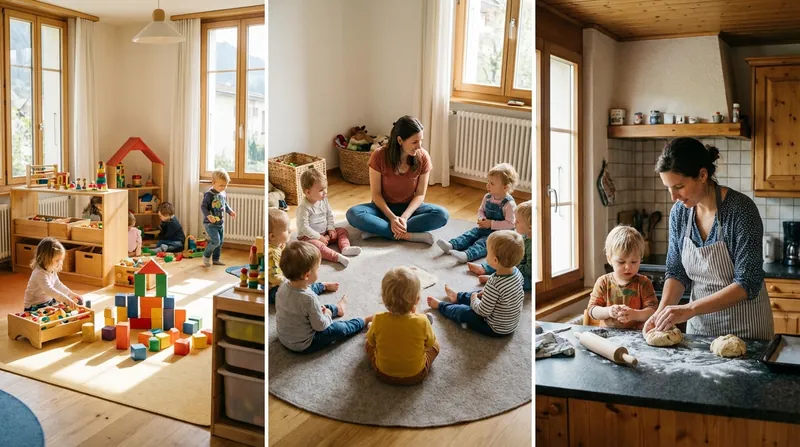
Daycare, Playgroup, or Childminder? The Complete Comparison
Which type of childcare is right for your family? Daycare, playgroup, and childminder compared side by side: age, costs,...

Daycare Tour: The Ultimate Checklist
What to look for during a daycare tour? The most important questions about organization, education, rooms, and costs....