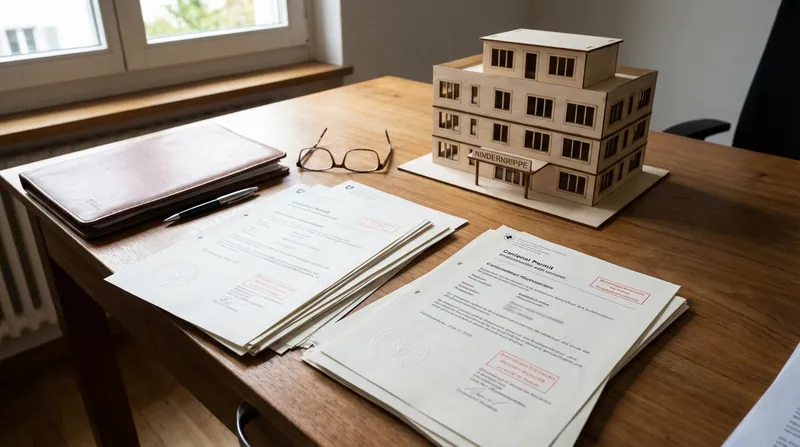
Overview: Who Needs a Licence?
You want to open a daycare, start a playgroup, or work as a childminder — and you're wondering whether you need an official licence for it? The answer sounds simple but is in practice one of the most confusing aspects of Swiss childcare: it depends. It depends on what type of care you offer, how many children you look after, how often the care takes place — and in which canton you operate.
This guide brings order to the chaos. It explains the legal foundations at the federal level (PAVO), shows the cantonal differences, and guides you step by step through the licensing process — including all the documents you need to prepare.
Why is this important? Without the necessary licence, you risk not just fines but also the immediate closure of your operation. And: parents and municipalities trust licensed facilities far more. The licence is therefore not a bureaucratic hurdle but a quality marker.
Overview: Who Needs a Licence?
The following table gives you a quick overview of the licensing requirements by type of care. You'll find the details for each type further below.
| Type of care | Licence needed? | Threshold | Responsible authority | Cost |
|---|---|---|---|---|
| Daycare / Kita | Yes, always | 6+ children under 12, regularly during the day | Canton | CHF 0–500 |
| Playgroup | Usually no | Exceptions: Valais, Fribourg and some cantons | Canton | — |
| Childminder / Day-care family | Under conditions | >5 children OR >2.5 days/week OR >3 months | Canton | CHF 0–200 |
| Nanny | No | Private employment relationship in the parents' household | — | — |
| Au pair | No (but work permit required) | Special rules for non-EU/EFTA | Canton / SECO | Varies |
Note: The table shows the federal minimum requirements under PAVO. Individual cantons may have stricter rules — and frequently do. Always check the regulations in your canton.
The Legal Foundation: PAVO
The Ordinance on the Placement of Children in Foster Care (PAVO) is the federal law governing the licensing obligation for non-family childcare. It forms the framework within which the cantons establish their own regulations.
Art. 13 PAVO: Licensing Obligation for Daycares
Under Art. 13 PAVO, a licence is required by anyone who regularly cares for children under 12 during the day in a facility. This applies to classic daycare centres (Kitas), nurseries, and after-school clubs. The licence is issued by the relevant cantonal authority and is tied to specific conditions — including staff qualifications, premises, and the care concept.
Art. 12 PAVO: Reporting Obligation for Day Care
Anyone who regularly cares for children for payment in their own household as a childminder is subject to a reporting obligation. Beyond certain thresholds (typically: more than 5 children, or care on more than 2.5 days per week over a period of more than 3 months), the reporting obligation becomes a licensing obligation.
Cantons May Be Stricter
A key point of PAVO: it sets minimum standards. Cantons can and do establish stricter rules. For example, some cantons already require reporting for the care of a single child, while PAVO only applies at several children. That's why it's essential to always check with your cantonal authority.
Starting a Daycare: What Goes into the Licence Application?
If you want to start a daycare, the licensing process is the most extensive. The cantonal authority thoroughly reviews your application before you're allowed to begin operations. You typically need to submit the following documents:
1. Operating Concept
The operating concept is the centrepiece of your application. It comprises two parts:
Pedagogical concept:
- What pedagogical philosophy do you follow?
- How do you structure the daily routine?
- What are your focus areas (language support, nature pedagogy, integration)?
- How do you handle the settling-in of new children?
- How do you support child development in the areas of language, motor skills, and social competence?
Organisational concept:
- Opening hours and company holidays
- Admission criteria and target group (age, number of places)
- Daily structure and meal concept
- Parent collaboration and communication
- Quality assurance and continuing education
2. Room Concept with Floor Plans
The premises must meet certain minimum requirements:
- Minimum area: In most cantons, 5–6 m² of usable space per childcare place applies (excluding ancillary rooms)
- Indoor areas: Group rooms, rest rooms, changing/sanitary areas, kitchen, office
- Outdoor area: Direct access to an outdoor play area is mandatory in many cantons
- Safety: Child-safe windows, stairs, and sockets; no toxic plants
You must submit to-scale floor plans showing all rooms and their intended use.
3. Fire Safety Certificate
A fire safety expert must inspect the premises and prepare a fire safety concept. This includes escape routes, fire extinguishers, fire detectors, and emergency plans. In many cantons, you need an official fire safety approval from the building insurance authority.
4. Hygiene Concept
The hygiene concept describes:
- Cleaning schedule for all rooms
- Handling of illnesses and exclusion rules
- Kitchen hygiene and food safety (HACCP concept if you have your own kitchen)
- Changing and sanitary hygiene
- Measures in case of pandemics or epidemics
5. Staffing Plan with Qualification Certificates
You must submit a detailed staffing plan showing:
- Number of carers per group and age class
- Qualifications of all planned staff (diplomas, certificates)
- Substitution arrangements for absences
- Training and continuing education concept
6. Criminal Record Extract
For all persons who have regular contact with the children in care, a current special private extract from the criminal record must be submitted. This applies to care staff, kitchen staff, cleaning staff, and also to the management.
7. Financial Plan
The financial plan must demonstrate that the operation is financially viable. This includes:
- Investment costs (renovation, furnishing, initial equipment)
- Ongoing operating costs (salaries, rent, insurance, materials)
- Revenue planning (parental contributions, subsidies)
- Liquidity planning for the first 12–24 months
More on insurance for childcare facilities
Personnel Requirements
The quality of childcare stands or falls with the staff. Requirements are regulated at both federal and cantonal level.
Daycare Manager
To manage a daycare, you typically need:
- Professional training: Childcare Specialist (FaBe) EFZ, qualified Early Childhood Educator HF, or an equivalent diploma
- Leadership skills: Additional continuing education in business management or team leadership (e.g. Team Leadership in Social Institutions, CAS Leadership)
- Professional experience: At least 2–3 years of experience in childcare
Staff-to-Child Ratio by Age
The staff-to-child ratio sets out how many children one professional may care for at the same time. The following values are kibesuisse recommendations and are considered the industry standard. Individual cantons may prescribe different ratios.
| Age of children | Staff-to-child ratio (recommendation) |
|---|---|
| 0–18 months | 1:4 |
| 18 months – 3 years | 1:6 |
| 3–6 years | 1:8 |
| School children (after-school) | 1:11 |
What does this mean in practice? If you open a daycare with 12 places for children between 18 months and 3 years, you need at least 2 carers present at the same time. Plus substitutes, management, and any support staff.
Team Qualification Requirements
Not all staff need to have a full professional qualification. Most cantons require the following breakdown:
- At least 50–60% of care staff must hold a recognised professional qualification (FaBe EFZ, HF, university/UAS)
- Up to 40–50% may be assistants, apprentices, or interns
- At least one qualified professional must be present at all times
Playgroup: Do I Need a Licence?
The short answer: In most cantons, no. Playgroups typically don't fall under the PAVO licensing obligation because they only take place on a few half-days per week and don't offer full-day care.
But be careful: There are exceptions.
- Canton of Valais: Playgroups are subject to the cantonal licensing requirement
- Canton of Fribourg: Similar regulations as for daycares when certain thresholds are exceeded
- Individual municipalities may have additional reporting requirements
Even without a licensing obligation, as a playgroup founder you generally need to comply with applicable fire safety, hygiene, and safety regulations. Always check the requirements of your municipality and canton.
Childminder: When Is a Licence Needed?
As a childminder, you work in your own household. The licensing obligation depends on several factors:
Reporting obligation exists in most cantons as soon as you regularly care for at least one child for payment. You must register with the responsible authority (municipality or canton).
Licensing obligation applies when one or more of these factors are met:
- You care for more than 5 children simultaneously
- Care takes place on more than 2.5 days per week
- Care lasts longer than 3 months
- You care for children under 3 (stricter rules in some cantons)
Tip: If you work through a day-care family association (e.g. kibesuisse member), the association typically handles the reporting and guides you through the licensing process. This is a great relief, especially at the beginning.
Nanny and Au Pair: No Licence Needed
- Nanny: Since a nanny works in the parents' household and a private employment relationship exists, no childcare licence is required. However, the normal rules of employment law apply (employment contract, social insurance, accident insurance).
- Au pair: Au pairs also don't need a childcare licence. However, au pairs from non-EU/EFTA states need a work permit. The rules vary by canton and country of origin. The cantonal labour market authority in coordination with SECO is responsible.
Cantonal Differences: What Applies Where?
Switzerland has 26 cantons — and thus 26 slightly different sets of regulations. Here are the key contact points for the largest cantons:
Canton of Zurich
- Responsible: Office for Youth and Career Counselling (AJB) of the Canton of Zurich
- Platform: Licence applications run through the Sirona platform (digital application process)
- Specifics: The City of Zurich has additional rules and quality standards that go beyond cantonal requirements. Pay attention to whether you're opening in the city or a rural municipality
- Processing time: Approx. 6–8 weeks
All information on the Canton of Zurich
Canton of Bern
- Responsible: Cantonal Youth Office, Division of Child and Youth Services (Health, Social and Integration Directorate)
- Specifics: Bern has a detailed fact sheet for new daycares and day-care family organisations. The requirements for the pedagogical concept are comparatively high
- Processing time: Approx. 4–6 weeks
All information on the Canton of Bern
Canton of Basel-Stadt
- Responsible: Department of Education, Division of Youth, Family and Sport
- Specifics: Basel-Stadt has strict room requirements and mandates compulsory German language support. Licence fees are at the upper end
- Processing time: Approx. 6–8 weeks
All information on the Canton of Basel-Stadt
Canton of Lucerne
- Responsible: Department of Social Affairs and Society (DISG), Division of Child and Adult Protection
- Specifics: Lucerne is working on a new Childcare Act (KiBeG) intended to standardise the licensing process. Currently, the existing PAVO-based rules apply
- Processing time: Approx. 4–6 weeks
All information on the Canton of Lucerne
Canton of St. Gallen
- Responsible: Office for Social Affairs, Division of Children and Young People
- Specifics: St. Gallen has a good online portal for licence applications and provides comprehensive fact sheets
All information on the Canton of St. Gallen
Canton of Aargau
- Responsible: Department of Health and Social Affairs, Division of Special Education, Homes and Workshops
- Specifics: Aargau requires a particularly detailed safety concept as part of the licence application
All information on the Canton of Aargau
Other Cantons
For all other cantons: contact the relevant office for non-family childcare. Depending on the canton, this may be the social services office, youth office, or education department. You'll find direct links on our canton pages.
Processing Time and Planning
The licensing process takes time. Plan generously:
| Phase | Duration |
|---|---|
| Preparation of documents | 4–8 weeks |
| Submission and official review | 4–8 weeks |
| Any necessary revisions | 2–4 weeks |
| Total duration (typical) | 3–5 months |
Recommendation: Submit your licence application at least 3 months before the planned opening date. For larger facilities or complex construction projects, rather 6 months. Bear in mind that fire safety approval and building permits run separately and may require additional time.
Tips for Speeding Things Up
- Preliminary meeting: Arrange a meeting with the responsible authority early on. Many cantons offer a free initial consultation where you can clarify open questions and avoid common mistakes.
- Complete documents: The most common reason for delays is incomplete applications. Use your canton's checklist and submit everything at once.
- Professional help: For the fire safety concept, floor plans, and financial plan, it's worth engaging professionals.
Ongoing Supervision After Licensing
The licence is not a one-off stamp. After opening, you'll be regularly inspected:
Inspections
- Frequency: In most cantons, inspections take place annually or every two years. New facilities are often visited once or twice in the first year of operation.
- Process: The responsible authority visits unannounced or with prior notice and checks staffing ratios, premises, documentation, safety, and hygiene.
- Outcome: You receive an inspection report with any conditions and deadlines for improvements.
Reporting Obligations
Even after licensing, you must report certain changes to the authority:
- Change of daycare management
- Significant changes to the operating concept
- Renovations or change of location
- Increase in the number of places
- Special incidents (accidents, child protection cases)
Licence Renewal
In some cantons, the licence is time-limited (e.g. 5 years) and must be renewed. Other cantons issue open-ended licences that can, however, be revoked at any time if the conditions are no longer met.
What Happens Without a Licence?
Anyone who operates a facility requiring a licence without a valid one must expect serious consequences:
- Immediate closure: The authorities can order the immediate closure of the facility
- Fines: Depending on the canton, fines of several hundred to several thousand francs may apply
- Criminal consequences: In case of serious violations (e.g. endangering children's welfare), criminal proceedings may follow
- Reputational damage: An unlicensed facility permanently loses the trust of parents and the municipality
- No subsidies: Without a licence, you have no entitlement to cantonal or municipal subsidies — a significant financial disadvantage
- Liability risks: In case of an accident at an unlicensed facility, the liability consequences are severe, and the insurance may refuse coverage
Conclusion: The licence is not an optional formality. It is a legal obligation that protects you, the children, and the parents. Take the process seriously and invest the necessary time.
Frequently Asked Questions (FAQ)
Can I apply for the licence before I have the premises?
No, generally not. The licence is tied to specific premises. You need a lease agreement or binding commitment and must submit floor plans. However, you can: arrange a preliminary meeting with the authority to have your concept reviewed in advance and clarify basic feasibility questions.
I only look after 2 children as a childminder — do I still need a licence?
A licence generally not, but a reporting obligation exists in many cantons from the very first child you regularly care for. Check the rules in your canton. In the Canton of Zurich, for example, you must register as soon as you regularly care for a single child for payment.
How much does the licence cost?
Fees vary by canton and type of care. For daycares, they typically range between CHF 0 and 500, for childminders between CHF 0 and 200. Some cantons charge no fees for the initial licence. The real costs, however, lie in preparation: fire safety assessments, floor plans, and any consulting fees can together amount to CHF 2,000–5,000.
Is my licence from Canton X recognised in Canton Y?
No. Licences only apply to the canton and specific location for which they were issued. If you move to another canton or open a second location, you must submit a new licence application. However, you can use your existing documentation (concepts, qualifications) as a basis.
Further Reading
This article is part of our comprehensive guide series for childcare providers in Switzerland:
- Starting a Daycare in Switzerland: The Complete Guide
- Starting a Playgroup: Step by Step
- Becoming a Childminder: How to Get Started
- Insurance for Childcare: What You Need
- Daycare, Playgroup, or Childminder? The Big Comparison
Want to list your offering on kizi.ch and gain visibility? Register as a provider and become part of Switzerland's largest childcare platform.
Sources: PAVO (SR 211.222.338), kibesuisse, cantonal childcare authorities. Last updated: February 2026.
More articles

Business Plan for a Daycare: Template & Tips
How to write a convincing business plan for your daycare: market analysis, financial plan, 3-year forecast, and common m...

Starting a Daycare in Switzerland: Full Guide
Starting a daycare in Switzerland: licensing, costs, legal form, staff ratios, and checklist — everything in one guide f...

PAVO: Foster Care Ordinance for Providers
The PAVO regulates licences for daycares and day families in Switzerland. Learn when you need a licence and what gets as...

The Right Legal Form for Your Childcare
Which legal form suits daycare, playgroup, or childminder? LLC, association, sole proprietorship, AG and foundation comp...
Starting a Playgroup: Easier Than You Think
Starting a playgroup in Switzerland: step-by-step guide without licensing. Costs, training, concepts, and tips for getti...
Becoming a Childminder: 10 Steps to Start
Becoming a childminder in Switzerland: training, licensing, insurance, rates, and income. The complete 10-step plan for ...