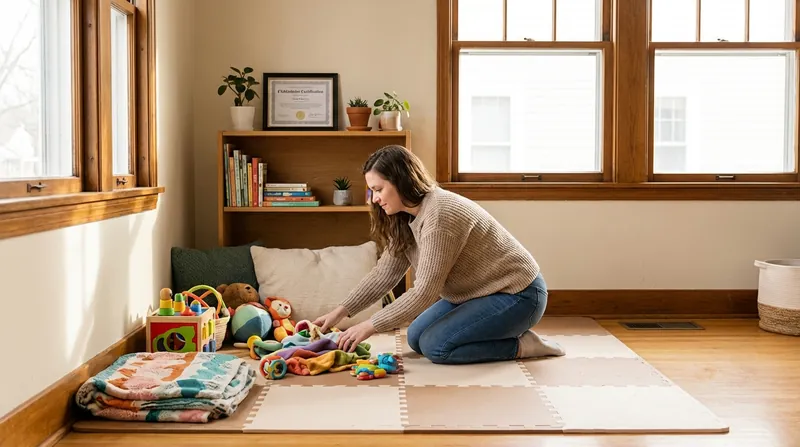
Step 1: Self-Check — Is Working as a Childminder Right for Me?
You are thinking about becoming a childminder? A wonderful idea — and one that makes everyday life easier for many Swiss families. Childminder families are an indispensable part of the Swiss childcare landscape: they offer family-like, flexible and personal care that no daycare can replace. But how do you get started? What do you really need? And what do you earn at the end of the day?
This guide takes you through 10 concrete steps from the first idea to your first child in care. Whether you want to work through an organisation or become self-employed — here you will find everything you need to know.
Step 1: Self-Check — Is Working as a Childminder Right for Me?
Before you dive into the organisational details, take a moment for honest self-reflection. Being a childminder is a fulfilling but also demanding profession. It requires more than just enjoying children.
Question Your Motivation
Ask yourself:
- Why do I want to become a childminder? Ideal is a combination of passion for childcare and the desire to combine your own children with work. Less ideal: "I just need some kind of job I can do from home."
- Can I imagine doing this work for years? Children and parents build relationships with you. Frequent changes are stressful for everyone.
- Am I willing to share my home? Your living room becomes a playroom. Your kitchen becomes a children's kitchen. Your garden becomes a playground.
Resilience and Stress Tolerance
Caring for toddlers means:
- Noise, chaos and multitasking — every day, all day
- Emotional situations — crying children, worried parents, difficult settling-in periods
- Physical demands — carrying, bending, sitting on the floor, constantly being on the move
- Responsibility — you bear sole responsibility for the wellbeing of the children in your care
Honest question to yourself: How do you react when three children are crying at once, lunch is burning and a parent calls? If this scenario motivates you more than it frightens you, you are on the right track.
Your Own Family Situation
- Partner: Does your family support the decision? The children in your care will become part of your family life.
- Own children: Your own children are not an obstacle — on the contrary, they often benefit from playmates. But consider: your own children will have to learn to share — toys, attention, mum or dad.
- Daily rhythm: Are you prepared to commit to fixed care times? Spontaneous doctor's appointments or shopping trips become more difficult.
Suitable Premises
Your home must be child-friendly — or be able to become so:
- Enough space: At least one room that serves as a play and living area
- Sleeping facilities: A quiet area for afternoon naps
- Outdoor area: A garden or playground nearby is a big plus
- Safety: No open staircases, no poisonous plants, no dangerous corners (more on this in Step 5)
Checklist: Are You Ready?
- I enjoy working with toddlers — even on difficult days
- My family supports the plan
- My home offers enough space
- I can set up fixed care times
- I am willing to undertake further training
- I can handle stress and the unexpected
If you can answer most points with yes, read on. If not — that is perfectly fine too. Perhaps a different form of childcare suits you better.
Step 2: Understanding the Licence Requirement
One of the most common misconceptions: "As a childminder I definitely need a licence." That is not quite right. The regulation is more nuanced — and that is good news.
When Do You NOT Need a Licence?
According to the Federal Ordinance on Foster Care (PAVO), you do not need a licence if all three of the following conditions are met simultaneously:
- You care for a maximum of 5 children at the same time (own children under 12 counted if present)
- The care takes place on no more than 2.5 days per week (calculated per child)
- The care relationship lasts less than 3 months
When Do You Need a Licence?
As soon as you exceed one of these thresholds, you need a licence:
| Criterion | Threshold | Exceeded? |
|---|---|---|
| Number of children simultaneously | > 5 children | -> Licence required |
| Care days per week | > 2.5 days per child | -> Licence required |
| Duration of relationship | > 3 months | -> Licence required |
In practice, this means: most childminders who care regularly and long-term need a licence. This is not a disadvantage — on the contrary: a licence signals quality and trustworthiness.
Licensing Process
The process is regulated at cantonal level. It typically includes:
- Submitting an application to the cantonal supervisory authority (often the youth welfare office or social services)
- Criminal record extract (private and special private extract)
- Proof of training (kibesuisse basic course, see Step 3)
- Home visit by the authority — they check your premises, safety and care concept
- Interview about your motivation, experience and care philosophy
Tip: If you work through a childminder family organisation (Step 4), it often handles most of the licensing process for you.
Detailed information on cantonal differences can be found in our guide Licensing Requirements in Childcare.
Step 3: Complete the kibesuisse Basic Course
The basic course from kibesuisse (formerly the Swiss Childcare Association) is the standard in childminder family care. While it is not legally required in every canton, it is effectively the entry ticket to the profession.
What Do You Learn in the Basic Course?
The course comprises 5 course days (approx. 40 lessons) and covers the following topics:
- Developmental psychology: How do children develop in the first years of life? What do they need at which age?
- Nutrition: Age-appropriate, healthy nutrition. Allergies and intolerances. Menu planning.
- Safety and prevention: Accident prevention at home and outdoors. Poisonous plants, sources of danger.
- First aid for children: What to do when a child chokes, falls, has a febrile seizure? (Often explored in more depth in a separate first aid course)
- Legal foundations: PAVO, licensing requirements, duty of supervision, liability
- Pedagogical foundations: Play as learning, daily structure, settling in, attachment
- Communication with parents: Educational partnership, difficult conversations, cultural differences
Where and How?
- Regional: Various locations across Switzerland (Zurich, Bern, Lucerne, Basel, St. Gallen, etc.)
- Online: Since the pandemic, some organisations also offer online or hybrid courses
- Language: German, French, Italian — depending on the region
- Providers: kibesuisse itself, regional childminder family organisations, educational institutions
Costs and Duration
| Detail | Information |
|---|---|
| Duration | 5 course days (spread over several weeks) |
| Costs | CHF 600–900 (depending on provider and region) |
| Certificate | kibesuisse certificate upon successful completion |
| Prerequisites | No formal prerequisites, minimum age 18 years |
Cost tip: Some childminder family organisations cover the course costs in full or in part if you subsequently register with them as a childminder. Ask before enrolling.
Additional Recommended Courses
- First aid course specifically for children: CHF 150–250, 1 day. Strongly recommended, even if not always compulsory.
- Further training courses: kibesuisse regularly offers advanced courses (e.g. dealing with challenging behaviour, language support, cultural diversity)
Step 4: Organisation or Self-Employed? The Big Decision
This is one of the most important junctions on your path. Both models have clear advantages and disadvantages. Take your time with this decision.
What Is a Childminder Family Organisation?
A childminder family organisation (TFO) is an association or specialist agency that acts as an intermediary between childminders and parents. The TFO handles administration, quality assurance and often payroll processing. In Switzerland there are around 200 such organisations, most of which are members of kibesuisse.
Detailed Comparison
| Criterion | Through an Organisation | Self-Employed |
|---|---|---|
| Administration | Organisation handles contracts, payroll, taxes, social insurance | You do everything yourself: bookkeeping, invoices, tax returns |
| Insurance | Usually covered through the organisation (liability, accident) | You must arrange liability and accident insurance yourself |
| Contracts | Organisation provides template contracts and handles the agreement with parents | You create your own care contract |
| Client acquisition | Organisation matches you with families — you do not need to search yourself | You must find clients yourself (adverts, profile, network) |
| Income | Typically CHF 5–8/hr net (after deduction of organisation share of 20–35%) | CHF 8–12/hr gross, but you bear all costs yourself |
| Flexibility | Care times and rates are co-determined by the organisation | You set your own rates, times and conditions |
| Quality assurance | Regular home visits, continuing education requirements, exchange with professionals | You are responsible for your own quality |
| Professional support | Expert advice in difficult situations, exchange meetings with other childminders | No institutional network — you must find exchange yourself |
| Start | Often faster, as the organisation guides the licensing process | More effort at the start, but more independence long-term |
| Social insurance | You are mostly employed (pay slip, AHV/IV/EO deducted) | You are self-employed and must register with the social insurance office |
Who Suits What?
Organisation is ideal if you:
- Are working as a childminder for the first time and value support
- Do not want to deal with bookkeeping and administration
- Seek exchange with other childminders
- Do not want to search for families yourself
Self-employment is ideal if you:
- Bring experience in childcare
- Think entrepreneurially and want to do your own thing
- Aim for a higher hourly rate
- Want to set your own rates, times and conditions
Good to know: Many childminders start with an organisation and become self-employed after a few years, once they have built experience and a network. Also read our guide Working as a Self-Employed Nanny for further insights into self-employment in childcare.
Step 5: Prepare Your Premises
Your home becomes your workplace — and must be child-safe accordingly. This does not mean you need to rebuild your entire flat. But a thorough safety check is essential.
Safety Check: The Key Points
Electrical outlets:
- All outlets at child height (below 1.50 m) fitted with child safety covers
- No loose cables that children could pull
Stairs:
- Install stair gates at the top and bottom (in homes with stairs)
- Railings must be close enough together that no child's head can fit through
Poisonous plants:
- Remove all poisonous houseplants (ivy, poinsettia, oleander, dieffenbachia, philodendron)
- Also in the garden: yew, monkshood, autumn crocus, deadly nightshade
Cleaning products and chemicals:
- Store all cleaning products, medicines and chemicals in lockable cupboards
- Also store dishwasher tabs, laundry detergent and nail polish remover out of reach
Windows:
- Install window locks (tilt protection is not enough!)
- No furniture in front of windows that children could climb on
Kitchen:
- Install a stove guard
- Keep knives, scissors and graters out of reach
- Never leave hot drinks at the edge of the table
Setting Up Areas
Sleeping area:
- A quiet, darkened room or a quiet corner
- Cots, mattresses or travel cots — depending on the children's age
- Individual sleeping places (not all in one bed)
- Correct temperature (18–20 degrees)
Play area:
- Age-appropriate toys (no small parts for children under 3)
- Craft materials, books, building blocks, dolls, vehicles
- Enough room to move, play and build
- Creative corner with washable floor or painting mat
Nappy changing area:
- Changing mat in a safe place (changing table with raised edges or on the floor)
- Nappies, wet wipes, spare clothes within reach
- Bin with lid
Outdoor area (if available):
- Fence the garden or ensure children cannot run onto the road
- No poisonous plants, no open water features (also secure rain barrels!)
- Cover the sandpit (cats!)
- Regularly check play equipment for stability
Step 6: Arrange Insurance
Insurance is not the most exciting topic — but one of the most important. As a childminder you bear great responsibility, and an accident or damage claim without proper cover can be existentially threatening.
Private Liability Insurance
What it covers: Damage that you or the children in your care cause to third parties. Example: a child in your care throws a ball through the neighbour's window.
Important: Check whether your existing private liability insurance covers your professional activity as a childminder. Many standard policies exclude professional activities. You then need either:
- An addition to your existing policy (approx. CHF 50–100/year more)
- Or a separate professional liability insurance (approx. CHF 200–400/year)
With an organisation: Liability insurance is usually arranged through the organisation. However, check what exactly is covered.
Accident Insurance (UVG)
If you are self-employed: You are not mandatorily UVG-insured. However, you can register voluntarily with Suva or a private insurer. This is strongly recommended — a work accident (e.g. falling while carrying a child) can put you out of action for weeks.
If you are employed through an organisation: The organisation must insure you under UVG. This is compulsory from the first working day.
Household Insurance
Check your household insurance: are damages caused by children in your care covered? A child that spills paint on your sofa or knocks a plate off the table causes property damage in your own household — this is not a liability case but a household insurance case.
Insurance Overview
| Insurance | Compulsory? | Approx. cost/year | Recommendation |
|---|---|---|---|
| Private liability (with professional cover) | Strongly recommended | CHF 200–400 | Definitely arrange |
| Accident insurance (UVG voluntary) | Voluntary for self-employed | CHF 300–600 | Highly recommended |
| Household insurance (check) | Recommended | Depending on policy | Have policy checked |
| Legal protection insurance | Optional | CHF 200–400 | Advisable if self-employed |
A detailed overview can be found in our guide Insurance for Childcare Providers.
Step 7: Create a Care Contract
A clear, written care contract protects you and the parents. It sets out expectations and prevents conflicts. Even if you work through an organisation (which often has its own template contracts), you should understand what belongs in a good contract.
The Most Important Contract Clauses
Care times:
- Weekdays and times (e.g. Monday and Wednesday, 7:30–17:30)
- Arrangements for early or late care
- When does overtime apply and what does it cost?
Rates and payment terms:
- Hourly rate or flat rate per day/month
- Meals included or extra?
- Payment deadline (e.g. monthly in advance by the 25th)
- Price increases: how and when are they announced?
Meals:
- Who provides the food — you or the parents?
- Cost of meals (typical: CHF 5–10/day for lunch and snacks)
- Handling of allergies and special diets (vegetarian, halal, intolerances)
Illness policy:
- When does the child stay at home? (Fever above 38°C, vomiting, contagious diseases)
- Must payment continue when the child is absent? (Usual: yes, as you have held the place)
- What happens when YOU are ill? (Cover? Cancellation? Refund?)
Holidays and public holidays:
- Your holiday days (usual: 4–5 weeks per year, similar to the family)
- Must your holidays and the parents' holidays be coordinated?
- Payment during holidays?
Notice period:
- Usual: 1–2 months' notice
- Extraordinary termination for gross misconduct (both sides)
Settling in:
- Duration and process of settling in (1–2 weeks recommended)
- Costs during settling in (often reduced or free)
- Is the settling-in period a probation period?
Probation period:
- Typical: 1–3 months probation with shortened notice period (e.g. 2 weeks)
Tip: kibesuisse offers a template care contract that you can use as a basis and adapt. Many childminder family organisations also provide their childminders with contract templates.
Step 8: Set Your Rates
The question "What do I earn as a childminder?" is complex — because the answer depends on many factors. Here are the key reference points.
What Does kibesuisse Recommend?
kibesuisse recommends a gross guideline rate of approx. CHF 8 per hour per child. This rate includes:
- Your wage
- Social insurance contributions (AHV/IV/EO)
- Meals (if you cook)
- Share for craft materials, outings, wear and tear
What Do Parents Actually Pay?
This depends heavily on whether the family receives subsidies:
| Situation | Parents pay per hour |
|---|---|
| Without subsidies (full payers) | CHF 6–10 |
| With childcare vouchers (low entitlement) | CHF 4–6 |
| With childcare vouchers (high entitlement) | CHF 1–3 |
| Through childminder organisation with subsidy agreement | CHF 0.50–5 |
Important: If you work through an organisation, the organisation sets the parental rate and charges you a share (typically 20–35% of your gross wage) for administration, placement and insurance.
Do Not Forget Additional Costs
In addition to the hourly wage, the following costs arise that you should include in your calculation:
- Meals: CHF 5–10 per child per day (morning snack, lunch, afternoon snack)
- Craft materials: CHF 20–50 per month
- Toy replacement and wear: CHF 30–50 per month
- Higher utility costs: Water, electricity, heating — estimated CHF 50–100 per month more
- Insurance: CHF 50–100 per month (if self-employed)
What Does a Childminder Really Earn? An Honest Calculation
Let us make a realistic calculation. We assume two scenarios:
Scenario A: Through an Organisation (employed)
| Item | Amount |
|---|---|
| 3 children, each 2 days/week, 9 hours/day | 54 hours/week |
| Gross rate per hour | CHF 8.00 |
| Gross per week | CHF 432 |
| Gross per month (4.33 weeks) | CHF 1,871 |
| Deduction organisation (approx. 25%) | – CHF 468 |
| Gross after organisation deduction | CHF 1,403 |
| Deduction social insurance (approx. 7%) | – CHF 98 |
| Net per month | approx. CHF 1,305 |
Scenario B: Self-Employed
| Item | Amount |
|---|---|
| 3 children, each 2 days/week, 9 hours/day | 54 hours/week |
| Gross rate per hour | CHF 9.00 |
| Gross per week | CHF 486 |
| Gross per month (4.33 weeks) | CHF 2,104 |
| Deduction social insurance AHV/IV/EO (approx. 10%) | – CHF 210 |
| Deduction insurance (liability, UVG) | – CHF 60 |
| Deduction meal costs (approx. CHF 150) | – CHF 150 |
| Deduction materials/wear | – CHF 50 |
| Net per month | approx. CHF 1,634 |
Conclusion: Being a childminder will not make you rich. With a net income of CHF 1,300–1,650 per month (depending on model and workload), it is a supplementary income that pays off especially if you have your own children and are looking to combine family and work. The advantage: you work from home, save commuting time and are with your own children.
Tax Aspects
- Employed (organisation): You receive a pay slip. The tax return is straightforward.
- Self-employed: You declare your income as self-employed earnings. You can deduct professional costs (share of rent, meals, materials, insurance). We recommend engaging a trustee — at least in the first year.
For more information on legal forms, read our guide Legal Forms for Childcare Providers.
Step 9: Register with the Social Insurance Office
If you work self-employed as a childminder, you must register with the Social Insurance Office (SVA) of your canton as self-employed. This is compulsory — not optional.
What You Must Register
- AHV (Old-age and survivors' insurance)
- IV (Disability insurance)
- EO (Loss of earnings compensation — covers maternity compensation)
- ALV (Unemployment insurance — voluntary for self-employed)
How Do You Register?
- Contact the SVA of your canton of residence (e.g. SVA Zurich, AK Bern, SVA Lucerne)
- Register as self-employed — you need proof of your activity (care contracts, invoices, bookkeeping)
- The SVA checks whether you actually qualify as self-employed — or whether an employment relationship exists
- You receive an AHV number (if you do not already have one) and are registered in the system
- Contributions: As a self-employed person, you pay approx. 10% of your net income to AHV/IV/EO (employer AND employee shares combined)
Caution: Self-Employed or Employed?
The SVA examines your working relationship. You only qualify as self-employed if you:
- Have multiple clients (families)
- Bear your own entrepreneurial risk
- Use your own infrastructure (your home)
- Are not subject to instructions
If you work for only one family, the SVA may determine an employment relationship — then the parents would need to register you as an employer and pay AHV contributions.
If you work through an organisation: The organisation registers you and deducts the social insurance contributions. You do not need to register with the SVA yourself.
Step 10: Become Visible and Find Your First Families
Everything is prepared — now all that is missing are the children. How do you find families looking for a childminder?
Create a Profile on kizi.ch
Create a free profile on kizi.ch. There you will be found by families in your region who are looking for a childminder. A good profile includes:
- Personal description: Who are you? What is your motivation? What makes you special?
- Qualifications: kibesuisse course, first aid course, professional experience, own children
- Care offering: Age of children, care times, available places
- Photos: Your play area, the garden, the surroundings (no photos of children in your care without consent!)
- Rates: Transparent pricing creates trust
- Location: Your postcode, so families can find you in searches
Build a Local Network
- Playgrounds and neighbourhood associations: Make yourself known in your neighbourhood
- Paediatric practices: Ask if you can hang up a flyer
- Parent advisory centres: Often a contact point for parents seeking care
- Parish offices and municipal administration: Notice boards, municipal newsletters
- Social media: Local Facebook groups, neighbourhood chats, neighbourhood apps
Notices and Flyers
A simple, appealing flyer works wonders. It should include:
- Your name and a friendly photo
- Your offering (ages, days, times)
- Your qualifications (kibesuisse certified)
- Contact information (phone, email or kizi.ch profile)
- Your address or neighbourhood
Display it at: retailers (Migros, Coop — ask at the info desk), libraries, municipal offices, paediatricians, parent advisory centres, neighbourhood shops.
Canton-Specific Information
Licensing practices and structures differ from canton to canton. Here are the most important features:
Canton of Zurich
In Zurich, the Verein Tagesfamilien Kanton Zürich serves as the umbrella organisation. It coordinates around 40 local childminder family associations. Features:
- Many municipalities in Zurich have subsidy agreements with childminder family organisations
- The City of Zurich works with the Zurich childcare voucher model, which also applies to childminder families
- Licensing authority: Office for Youth and Career Guidance (AJB)
More information: Childcare in the Canton of Zurich
Canton of Bern
Bern relies strongly on the childminder family model. The Verein Tagesfamilien Kanton Bern is well established. Features:
- Childcare vouchers in many municipalities also valid for childminder families
- The City of Bern offers subsidised childminder family places
- Licensing authority: Cantonal Youth Welfare Office
More information: Childcare in the Canton of Bern
Canton of Fribourg
In Fribourg there is a special licence for childminder parents that is more strictly regulated than in many other cantons:
- A licence may already be required when caring for one child for more than 20 hours per week
- The requirements for premises and training are above average
- Close contact with the youth welfare office throughout the entire licensing process
More information: Childcare in the Canton of Fribourg
Cantons of Vaud and Geneva
In Western Switzerland, the childminder family system is organised through the Accueillantes en milieu familial (AMF). The association is the Réseau d'accueil extrafamilial. The training requirements and licensing procedures differ from German-speaking Switzerland.
Canton of Lucerne
- Well-established childminder family network through the Verein Tagesfamilien Kanton Luzern
- The City of Lucerne also offers childcare vouchers for childminder families
- Licensing authority: Social and Community Services (DISG)
More information: Childcare in the Canton of Lucerne
Frequently Asked Questions (FAQ)
Can I work as a childminder if I do not have my own children?
Yes, absolutely. Own children are not a prerequisite. The kibesuisse basic course and any licence are open to everyone over 18 who has the necessary aptitude. Many people without their own children are excellent childminders.
How many children may I care for at the same time?
This depends on your canton and your licence. As a rule: a maximum of 5 children simultaneously (including your own children under 12). With more than 5 children, you always need a licence and possibly a second carer. Make sure you do not take on more children than you can care for well.
What do I do when I am ill?
This is one of the biggest challenges as a childminder. Plan ahead:
- With an organisation: The TFO usually organises a replacement
- Self-employed: Build a cover network (other childminders, family members). Include this option in the care contract
- With longer illness: Check whether your daily sickness allowance insurance also applies when self-employed. If you do not have one: arrange one urgently!
Do I need to speak German as my mother tongue?
No, that is not a requirement. Good knowledge of German (or the language of your region) is important, however, as you need to communicate with parents, understand contracts and follow the course. Many childminder family organisations actually greatly value multilingualism — bilingual care is a big plus for some families.
Can I also work as a male childminder?
Of course. The term "childminder" is historically gendered, but male childminders are equally welcome. The training, licence and all framework conditions are identical. In practice, the proportion of men is still low but growing — and many parents welcome male attachment figures for their children.
Summary: Your 10-Step Roadmap
| Step | What | Time Required |
|---|---|---|
| 1 | Self-check: is it right for me? | 1–2 weeks reflection |
| 2 | Clarify licensing requirement | 1 day research |
| 3 | Complete kibesuisse basic course | 5 course days (spread over weeks) |
| 4 | Decide on organisation or self-employment | 1–2 weeks |
| 5 | Prepare premises | 1–4 weeks |
| 6 | Arrange and conclude insurance | 1–2 weeks |
| 7 | Create care contract | 1–3 days |
| 8 | Calculate and set rates | 1–2 days |
| 9 | SVA registration (if self-employed) | 1 day + processing time |
| 10 | Become visible and find families | ongoing |
Realistic timeframe from decision to first child in care: 2–4 months.
Ready to Start?
You want to become a childminder and are looking for families near you? Create your free profile on kizi.ch now and become visible to parents who are looking for exactly you.
And if you want to know more:
- Licensing Requirements in Childcare — all cantonal details
- Insurance for Childcare Providers — what you need and what it costs
- Working as a Self-Employed Nanny — alternative paths into childcare
- Legal Forms for Childcare Providers — Ltd, association or sole proprietorship?
More articles

Licensing: Daycare, Playgroup & More
When do you need a licence for childcare in Switzerland? PAVO rules, cantonal differences, and the application process a...

Business Plan for a Daycare: Template & Tips
How to write a convincing business plan for your daycare: market analysis, financial plan, 3-year forecast, and common m...

Starting a Daycare in Switzerland: Full Guide
Starting a daycare in Switzerland: licensing, costs, legal form, staff ratios, and checklist — everything in one guide f...

PAVO: Foster Care Ordinance for Providers
The PAVO regulates licences for daycares and day families in Switzerland. Learn when you need a licence and what gets as...

The Right Legal Form for Your Childcare
Which legal form suits daycare, playgroup, or childminder? LLC, association, sole proprietorship, AG and foundation comp...
Starting a Playgroup: Easier Than You Think
Starting a playgroup in Switzerland: step-by-step guide without licensing. Costs, training, concepts, and tips for getti...