
Parent Communication in Daycare: Best Practices
Parent Communication in Daycare: Best Practices
Parent communication is far more than the brief doorstep chat at pick-up time. It is the foundation for a trusting partnership between daycare and family — and thus a central quality factor of your facility. Good communication reassures parents, strengthens the educational partnership, and helps you defuse conflicts early.
This guide shows you tried-and-tested strategies, formats, and tools for professional parent communication — from the daily handover through parent evenings to dealing with complaints and using digital communication tools.
Why Parent Communication Is So Important
Parents entrust you with the most precious thing they have: their child. This trust must be built anew every day — through transparency, respect, and open communication.
The Most Common Communication Problems in Daycares
| Problem | Consequence |
|---|---|
| Parents feel uninformed | Mistrust, frequent enquiries, dissatisfaction |
| Conflicts are not addressed | Escalation, complaints to management or authorities |
| Cultural misunderstandings | Parents feel unwelcome |
| Information overload without prioritisation | Important information gets lost |
| Different communication styles within the team | Contradictory messages |
Good parent communication prevents these problems and creates an atmosphere in which parents feel welcome and well informed.
The Daily Handover: Professionalising Doorstep Chats
The handover in the morning and evening is the most frequent point of contact between daycare and parents. At the same time, it is often hectic, unstructured, and prone to error.
Morning Handover: What You Need to Know
When parents drop off their child, the team needs the following information:
- How did the child sleep?
- Have they had breakfast?
- Are there any health issues (slight cold, teething, medication)?
- Are other people authorised to collect the child today?
- Is there anything special (birthday, new sibling, divorce)?
Evening Handover: What Parents Want to Know
At pick-up, parents want to know:
- How was the day? (brief summary)
- What did the child eat?
- How did they sleep?
- Were there any notable events (injury, conflict, milestone)?
Tips for Better Handovers
- Use a handover log: A simple form per child that the carer briefly fills in during the day helps at the evening handover
- Prioritise: Not every detail needs to be communicated — focus on what's important
- Be positive and honest: Start with something positive, then the important information
- Respect time: Keep the handover to 2 to 3 minutes — arrange a separate appointment for longer conversations
Parent Evenings and Parent Meetings
Parent Evenings: Format and Frequency
Parent evenings are the classic format for group information. Two to three parent evenings per year are recommended:
| Occasion | Timing | Content |
|---|---|---|
| Start of year | August/September | Team introduction, annual programme, organisational matters |
| Topic evening | January/February | Pedagogical topic (e.g. settling in, media, nutrition) |
| Year-end | June/July | Review, outlook, farewells |
Tips for Successful Parent Evenings
- Start and finish on time (90 minutes maximum)
- Create a welcoming atmosphere (drinks, name tags)
- Mix information with interaction (workshops, group discussions)
- Offer translation support for non-native-speaking parents
- Send the key information in writing to those who couldn't attend
Individual Parent Meetings
At least once a year, you should hold a structured development meeting with every family. Preparation is key:
- Collect observations: Record targeted observations of the child 2 to 4 weeks before the meeting
- Use a meeting guide: Strengths, developmental areas, social behaviour, next steps
- Involve parents: Ask about their observations at home
- Document: Record the key points and agreements in writing
- Maintain confidentiality: The meeting remains between the participants
Digital Communication Tools
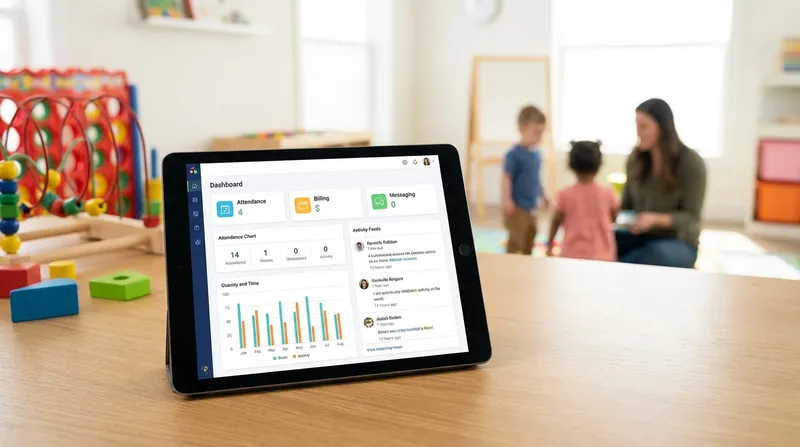
Digitalisation has also changed parent communication. More and more daycares are using digital tools for exchanging information with parents.
Daycare Apps at a Glance
Modern daycare apps offer numerous features:
- Daily reports and photos
- Absence notifications
- Calendar and event information
- Push notifications for urgent information
- Digital signatures for forms
A detailed comparison of common daycare software can be found in the guide Digitalisation in Daycare: Tools & Software.
Data Protection in Digital Communication
When using digital communication tools, you must observe data protection:
- Obtain parental consent for photos and reports
- Use DSG-compliant tools (server location Switzerland or EU preferred)
- Never send children's photos via WhatsApp or unencrypted channels
- Delete data regularly (define retention periods)
- Revoke access rights immediately when a child leaves
WhatsApp, Signal & Co.: Dos and Don'ts
| Channel | Recommendation | Reasoning |
|---|---|---|
| Dedicated daycare app | Best choice | DSG-compliant, professional, all features |
| Good for formal communication | Traceable, archivable | |
| WhatsApp group | Only conditionally recommended | Data protection critical, mixing private/professional |
| Signal/Threema | Better alternative to WhatsApp | Encrypted, but not professional |
| Phone call | For urgent matters | Direct contact, no written documentation |
Dealing with Complaints and Conflicts
Complaints are an opportunity. They show you where you can improve — and they offer the chance to build trust through professional handling.
The 5-Step Complaint Management
Step 1: Listen Let the parents finish speaking. Show understanding for their perspective. Don't interrupt and don't become defensive.
Step 2: Summarise Repeat the concern in your own words: "If I understand you correctly, it's about..."
Step 3: Thank them Thank them for the feedback. This may sound counterintuitive, but it shows character and professionalism.
Step 4: Seek a solution Offer a concrete solution or agree on a timeframe by which you'll get back to them. If you can't answer immediately, say: "I'll discuss this with the team and get back to you by Friday."
Step 5: Follow up Get back to them by the agreed deadline — even if the problem isn't fully resolved yet. Show that you're staying on it.
Typical Conflict Situations in Daycare
- Injuries: "My child always comes home with bruises"
- Biting behaviour: "Why does my child get bitten? Who is the other child?"
- Nutrition: "My child should not eat pork / sweets"
- Sleep: "My child should not sleep for more than 30 minutes"
- Pedagogical differences: "Why are the children allowed to play in the rain?"
Ground rule: Never share information about other children or families. In biting incidents, you must not reveal which child bit. This protects the personal rights of all children.
Multicultural Communication
In many Swiss daycares, parents speak different languages and come from different cultures. This requires particular sensitivity.
Overcoming Language Barriers
- Translate important documents into the most common languages (or have them translated)
- Use simple language (short sentences, no jargon)
- Use visual aids (pictograms for the daily routine, photos for meals)
- Use interpreter services for parent meetings (municipalities often offer free intercultural mediators)
- Don't use older siblings as interpreters
Respecting Cultural Differences
Different cultures have different ideas about child-rearing, nutrition, clothing, and gender roles. Approach these differences with openness and curiosity — without abandoning your pedagogical principles.
Parent Surveys: Systematically Collecting Feedback
Don't wait until dissatisfaction builds up. Collect feedback regularly and systematically.
Format and Frequency
- Annual parent survey: Comprehensive questionnaire on satisfaction, communication, quality
- Short pulse checks: 3 to 5 questions quarterly (also possible digitally)
- Feedback box: Anonymous feedback option in the entrance area
Topics for the Parent Survey
| Area | Example questions |
|---|---|
| Overall satisfaction | How satisfied are you overall with our daycare? (1–10) |
| Communication | Do you feel well informed about daycare life? |
| Care quality | How do you rate the support for your child's development? |
| Organisation | Are the opening hours suitable for your needs? |
| Improvement | What can we do better? (Free text) |
Communicating Results
Share the survey results with parents — including the measures you derive from them. This shows that you take their feedback seriously.
More on systematic quality development in the guide QualiKita Certification.
Documentation: Transparent and Traceable
Good communication needs good documentation. Record the most important communication processes:
- Parent meetings: Date, participants, topics discussed, agreements
- Complaints: Date, content, measures, outcome
- Special incidents: Accidents, conflicts, behavioural concerns
- Consent: Photos, outings, medication administration
Storage and Data Protection
Keep documentation during the care period and 1 to 2 years beyond. After that, personal data should be deleted. Ensure that only authorised persons have access to the files.
Communication Concept: How to Create One
A written communication concept ensures that all team members maintain the same standards.
Contents of a Communication Concept
- Core attitude: How do we communicate? (respectful, transparent, solution-oriented)
- Communication channels: Which channels do we use for what?
- Formats: Parent evenings, parent meetings, daily reports — frequency and process
- Responsibilities: Who communicates what?
- Complaint management: How do we handle complaints?
- Data protection: Which rules apply?
- Multilingualism: How do we deal with language barriers?
Common Mistakes in Parent Communication
- Only communicating when there are problems: Share positive news too — it strengthens the relationship
- Using jargon: Not all parents understand terms like "resilience" or "gross motor development"
- Comparing children: Every child develops individually — never compare with other children
- Information overload: Focus on what matters
- Criticism on the doorstep: Sensitive topics need a protected setting — arrange an appointment
Conclusion: Communication as a Quality Marker
Professional parent communication distinguishes a good daycare from an average one. It requires time, structure, and a clear attitude within the team. The effort pays off: satisfied parents recommend you, stay longer, and are willing to cooperate constructively even in difficult situations.
The key points:
- Structure the daily handover — short, positive, informative
- Use digital tools — but in compliance with data protection
- Hold regular parent meetings — at least once a year
- Take complaints seriously — they are an opportunity
- Create a communication concept — so that everyone on the team maintains the same standards
Make your daycare visible and show parents how professionally you communicate: Create your provider profile on kizi.ch now and present your childcare offering.
Sources: kibesuisse — Swiss Childcare Association, Netzwerk Kinderbetreuung Schweiz, QualiKita — Quality Label for Daycare Centres, Marie Meierhofer Institut for the Child, cantonal guidelines for non-family childcare. As of: February 2026.
More articles

Employment Law in Daycare: CLA, Wages & More
Employment law in childcare: CLA guidelines, minimum wages, working hours, and dismissal protection for daycare staff in...
Digitalisation in Daycare: Tools & Software
Daycare software compared: parent apps, admin tools, billing systems, and data protection tips for childcare facilities ...

Writing a Pedagogical Concept: Guide & Template
How to write a pedagogical concept for your daycare or playgroup: structure, required content, cantonal requirements, an...

QualiKita: The Path to the Quality Label
QualiKita is the national quality label for daycares in Switzerland. Learn about the certification process, costs, benef...

Daycare Costs Switzerland 2026: Real Prices
How much does a daycare place cost in Switzerland? Current prices by canton, subsidies, tax deductions, and practical mo...

Daycare, Playgroup, or Childminder? The Complete Comparison
Which type of childcare is right for your family? Daycare, playgroup, and childminder compared side by side: age, costs,...