Understanding a daycare's cost structure
You run a daycare or are about to open one — and you're wondering: what do I need to charge per care day to make the operation viable? The answer is not simply a gut feeling or a glance at the competition. Behind a sound daycare rate lies a solid calculation that takes into account your cost structure, your occupancy and the local conditions.
This guide takes you step by step through rate calculation. You'll learn how to calculate your full costs per place, how subsidies affect your rates, and at what occupancy level your daycare becomes profitable. The article is aimed at daycare operators, founders in the planning phase and anyone who wants to review their existing rates.
Tip: This article is part of our guide series for providers. You'll find further in-depth articles on topics such as Founding a daycare, Choosing a legal form and Insurance.
Understanding a daycare's cost structure
Before you set a rate, you need to know what your operation actually costs. Many daycare operators underestimate individual cost blocks — and set the rate too low. This comes back to bite at the latest after the first year of operation.
Staff costs: The largest item (70–80%)
Staff is by far the largest cost factor in any daycare. In Switzerland, staff costs typically make up 70 to 80 percent of total operating costs. This includes:
- Gross salaries of all care staff (qualified childcare workers, apprentices, interns)
- Daycare manager's salary (often proportional, if the manager also provides care)
- Social insurance contributions (AHV/IV/EO/ALV: approx. 6.4% employer share)
- BVG contributions (pension fund: 5–10% of insured salary, depending on the plan)
- UVG (accident insurance: 0.5–2% for non-occupational accidents)
- Daily sickness benefit insurance (optional but strongly recommended: approx. 1–2% of payroll)
- Continuing education budget (at least CHF 500–1,000 per qualified staff member per year)
- Substitute costs (for holidays, illness, continuing education)
Salary bands in Switzerland (indicative figures 2026):
| Role | Gross salary/month (100%) | Typical range |
|---|---|---|
| Qualified childcare worker (FaBe EFZ) | CHF 4,800–5,800 | Depending on canton and experience |
| Qualified childcare worker HF (Childhood Education HF) | CHF 5,500–6,800 | Higher with management function |
| Daycare manager | CHF 6,500–8,500 | Depending on size and governance |
| FaBe apprentice (3rd year) | CHF 1,200–1,500 | Varies by canton |
| Intern | CHF 800–1,200 | Pre-training |
Important: These salaries are indicative. In Zurich and Geneva, salaries tend to be higher; in rural areas, somewhat lower. Check the recommendations from kibesuisse and any cantonal GAV guidelines.
Rent costs (10–15%)
Rent is the second largest item. It depends heavily on location:
- Urban (Zurich, Geneva, Basel): CHF 250–400 per m² per year
- Agglomeration: CHF 180–280 per m² per year
- Rural: CHF 120–200 per m² per year
For a daycare with 24 places, you need at least 150–200 m² of usable space (excluding outdoor area). This results in an annual rent of CHF 27,000 to CHF 80,000 — depending on location.
Food costs (3–6%)
Whether you run your own kitchen or use catering makes a big difference:
- Own kitchen (incl. cook's salary): CHF 8–14 per child per day
- Catering/delivery service: CHF 10–16 per child per day
- Afternoon snack and snacks: CHF 2–4 per child per day
Materials and consumables (2–4%)
Craft and play materials, cleaning supplies, nappies (if included), office supplies, printing costs, software licences (daycare management, accounting), pedagogical support materials.
Insurance (1–3%)
In addition to the social insurance already mentioned, you need:
- Business liability insurance: CHF 800–2,500 per year
- Property insurance (inventory): CHF 500–1,500 per year
- Legal expenses insurance: CHF 400–1,000 per year
More on this in our article Insurance for childcare providers.
Other operating costs (2–5%)
Energy, water, telephone/internet, accounting and fiduciary, advertising and marketing, maintenance and minor repairs, outings and excursions.
Cost overview in percentages
| Cost type | Share of total costs | Typical range/year (24 places) |
|---|---|---|
| Staff | 70–80% | CHF 560,000–800,000 |
| Rent | 10–15% | CHF 40,000–80,000 |
| Food | 3–6% | CHF 25,000–55,000 |
| Materials | 2–4% | CHF 15,000–30,000 |
| Insurance | 1–3% | CHF 8,000–25,000 |
| Other | 2–5% | CHF 15,000–40,000 |
| Total | 100% | CHF 663,000–1,030,000 |
Calculating full costs per place
The full costs per place are the foundation of any rate calculation. This tells you what a care place actually costs you — regardless of what the parents pay.
The formula
Full costs per place per year = Total operating costs / Number of licensed places

Full costs per place per day = Full costs per place per year / Operating days per year
Calculation example: Daycare with 24 places
Let's take a medium-sized daycare in a Swiss agglomeration municipality:
Assumptions:
- 24 licensed places
- 240 operating days per year (52 weeks minus 5 weeks operating holidays minus public holidays)
- Average occupancy: 90%
Annual operating costs:
| Cost item | Amount/year |
|---|---|
| Staff (7 qualified staff, 2 apprentices, 1 manager 50%) | CHF 620,000 |
| Rent (180 m² at CHF 220/m²) | CHF 39,600 |
| Food (catering at CHF 12/child/day) | CHF 37,800 |
| Materials and consumables | CHF 18,000 |
| Insurance (operations) | CHF 12,000 |
| Energy, telephone, internet | CHF 8,400 |
| Accounting / fiduciary | CHF 6,000 |
| Advertising / marketing | CHF 3,000 |
| Maintenance / miscellaneous | CHF 5,200 |
| Total operating costs | CHF 750,000 |
Calculation:
| Metric | Calculation | Result |
|---|---|---|
| Full costs per place/year | CHF 750,000 / 24 | CHF 31,250 |
| Full costs per place/day | CHF 31,250 / 240 | CHF 130.20 |
| Effective costs at 90% occupancy | CHF 130.20 / 0.90 | CHF 144.70 |
Important: The effective costs per occupied place are higher than the theoretical full costs, because you never achieve 100% occupancy. Always plan with a realistic occupancy rate of 85–92%.
Why occupancy decides everything
Occupancy is the decisive factor for your profitability. Because the majority of your costs are fixed — staff and rent are incurred regardless of whether 20 or 24 children are present.
| Occupancy | Effective costs/place/day | Difference to 100% |
|---|---|---|
| 100% | CHF 130.20 | — |
| 95% | CHF 137.05 | + CHF 6.85 |
| 90% | CHF 144.70 | + CHF 14.50 |
| 85% | CHF 153.18 | + CHF 22.98 |
| 80% | CHF 162.75 | + CHF 32.55 |
| 75% | CHF 173.60 | + CHF 43.40 |
As you can see: a drop from 90% to 80% occupancy alone increases your effective costs by CHF 18 per place per day. For 24 places, that's over CHF 100,000 in lost revenue per year.
Setting parent rates
Now comes the step that is visible to parents: what appears on the invoice? There are fundamentally two models.
Model 1: Flat rate (same price for everyone)
With a flat rate, all parents pay the same amount. This is easy to communicate and administratively simple.
Advantages:
- Transparent and understandable
- Low administrative effort
- No income verification needed
- Clear calculation
Disadvantages:
- Often unaffordable for lower-income families
- No access to subsidies that require income-dependent rates
- Potentially smaller target group
Typical flat rates in Switzerland (full day):
| Region | Rate range per day |
|---|---|
| Zurich city | CHF 120–160 |
| Bern city | CHF 110–140 |
| Basel city | CHF 115–150 |
| Agglomeration | CHF 100–135 |
| Rural | CHF 90–120 |
Model 2: Income-dependent rate
With an income-dependent rate, parents pay a contribution based on their income (and often assets). The difference between the actual rate and the full costs is covered by subsidies from the municipality.
Advantages:
- Access to a broader range of parents
- Municipal subsidies cover part of the costs
- Socially fairer
- Often higher occupancy (more families can afford the place)
Disadvantages:
- Higher administrative effort (income verification, accounting)
- Dependence on municipal subsidies
- Rate adjustments are politically tied
- Service agreement with the municipality required
Example of an income-dependent rate:
| Qualifying income | Parent contribution/day | Subsidy/day |
|---|---|---|
| Up to CHF 45,000 | CHF 12 | CHF 118 |
| CHF 45,001–65,000 | CHF 40 | CHF 90 |
| CHF 65,001–85,000 | CHF 70 | CHF 60 |
| CHF 85,001–105,000 | CHF 100 | CHF 30 |
| CHF 105,001–125,000 | CHF 120 | CHF 10 |
| Over CHF 125,000 | CHF 130 (full rate) | CHF 0 |
Note: The specific income thresholds and rates vary considerably from municipality to municipality. This table serves as an illustration. Check with your municipality for the applicable rate model.
Which model suits you?
The choice depends on your situation:
- You're founding privately without a service agreement: A flat rate is often the simpler start. You retain full control over your prices.
- You're working with a municipality: Income-dependent rates are usually a prerequisite for subsidies. In return, you have more stable financing.
- You want both: Some daycares offer subsidised and private places in parallel. This is more administratively complex but diversifies your risk.
Subsidy models: How they affect your rates
Subsidies are a central element in Swiss childcare. They largely determine how you can structure your rates — and how much parents ultimately pay.
Object-based financing
The municipality pays a fixed amount per place or per operating day directly to the daycare. This is the classic model.
- Your advantage: Predictable income, independent of parent income
- Your disadvantage: You must fulfil a service agreement (opening hours, staff-to-child ratio, rate requirements)
Subject-based financing (childcare vouchers)
Parents receive a voucher from the municipality that they redeem at the daycare. The value depends on the family's income.
- Your advantage: Market mechanism — good daycares are in greater demand
- Your disadvantage: Less planning security, as demand can fluctuate. Administration of voucher accounting.
Mixed models
Many municipalities combine object and subject-based financing or have developed their own systems. The cantons of Bern, Lucerne and Graubuenden rely more on childcare vouchers, while Zurich and Basel-Stadt more frequently work with object-based financing and standard costs.
More on the various subsidy models can be found in our detailed article Subsidies for childcare in Switzerland.
What does this mean for your calculation?
The key point is: your full costs remain the same regardless of which subsidy model applies. What changes is the composition of income:
| Without subsidies | With subsidies |
|---|---|
| Income = 100% parent contributions | Income = parent contributions + subsidies |
| Rate must cover full costs | Rate can be lower because the municipality contributes |
| Target group: medium to high incomes | Target group: all income levels |
Social rates: What you need to know as a provider
Social rates are reduced parent rates for families with low income. In many municipalities, they are a prerequisite for a service agreement.
How social rates work
- The municipality defines a rate schedule with income levels
- Parents prove their income (tax return, tax assessment)
- You as the daycare operator invoice the reduced rate
- The difference to the full rate is covered by the municipality (or canton)
What you need to consider
- Your full costs are covered. Social rates don't mean you receive less money. The income per place remains the same — only the composition (parent share + municipal share) changes.
- Accounting effort. You must prepare subsidy accounts correctly and submit them on time. Invest in good daycare software.
- Place allocation. Some municipalities require that a certain proportion of your places are reserved for subsidised families.
- Rate adjustments. If the municipality changes the rate schedule, you are bound by it. Negotiate clear rules for rate adjustments and inflation compensation in the service agreement.
Additional costs: What's included, what's extra?
The question of which additional costs are included in the rate is a common point of contention — and an important differentiator.
Overview: What is usual?
| Service | Usually included | Often separate | Comment |
|---|---|---|---|
| Care | Yes | — | Core rate |
| Lunch | Varies | CHF 8–15/day | Big difference depending on daycare |
| Morning/afternoon snack | Often yes | Rarely separate | If lunch is included, usually snacks too |
| Nappies | About 50/50 | CHF 2–4/day | Trend: rather included |
| Outings | Smaller ones yes | Larger ones separate | Zoo visits etc. often CHF 5–20 extra |
| Sunscreen / hygiene | Yes | — | Standard |
| Settling-in | Yes | — | Part of the care concept |
| Additional days (outside regular plan) | — | CHF 100–160/day | Depending on availability |
| Holiday care (operating holidays) | — | — | Daycare closed — no rate |
Pricing psychology: All-inclusive vs. base rate + extras
There are two strategies:
All-inclusive rate: Everything is included in the price. The daily rate is higher, but parents know exactly what they pay. No surprises at the end of the month.
Base rate + additional costs: The advertised daily rate is lower, but costs for food, nappies and extras are added. This can lead to dissatisfaction if parents underestimate the total costs.
Our recommendation: In Switzerland, most parents prefer a transparent all-inclusive model. It also simplifies your accounting. If you charge food separately, communicate this clearly from the start — ideally before settling-in.
Benchmark: What do other daycares in Switzerland charge?
A look at the market helps you position your rates. But be careful: a benchmark is not a price dictate. Your rate must cover your costs — not the competition's.
Indicative figures for full-day care (2026)
| Canton / Region | Private (without subsidy) | Subsidised (parent contribution) |
|---|---|---|
| Zurich city | CHF 120–160/day | CHF 10–130/day |
| Zurich agglomeration | CHF 110–145/day | CHF 15–120/day |
| Bern city | CHF 110–140/day | CHF 10–110/day |
| Basel-Stadt | CHF 115–150/day | CHF 0–100/day |
| Lucerne city | CHF 110–140/day | CHF 15–110/day |
| St. Gallen | CHF 100–130/day | CHF 10–100/day |
| Aargau | CHF 100–130/day | CHF 15–110/day |
| Rural areas | CHF 90–120/day | CHF 10–90/day |
How to use the benchmark data
- Research the rates of 5–10 daycares in your area. Check their websites, call or ask directly.
- Compare like with like. A rate of CHF 120 including food is not the same as CHF 100 plus CHF 15 for food.
- Position yourself deliberately. You can be cheaper (higher occupancy, lower margins) or more expensive (premium positioning, smaller groups, organic food). Both are legitimate — but it must match the calculation.
- Consider the subsidy situation. If the municipality subsidises generously, parent rates can be lower without your income declining.
Calculating the break-even: When are you profitable?
The break-even is the point at which your income exactly covers your costs. Everything above is profit — everything below is a loss.
The break-even formula for daycares
Break-even (in occupied places) = Fixed costs / (Revenue per place/day - Variable costs per place/day)
In practice, almost all costs in a daycare are fixed or quasi-fixed (staff, rent). Variable costs (food, nappies, materials) make up only 5–10%. Therefore the formula simplifies to:
Break-even occupancy = Total costs per year / (Revenue per place/day x Places x Operating days)
Calculation example
Let's take our example daycare with 24 places:
Assumptions:
- Total costs: CHF 750,000/year
- Daily rate (parent contribution + subsidy): CHF 130/day
- 24 places, 240 operating days
Calculation:
| Step | Calculation | Result |
|---|---|---|
| Maximum annual revenue (100% occupancy) | 24 x CHF 130 x 240 | CHF 748,800 |
| Break-even occupancy | CHF 750,000 / CHF 748,800 | 100.2% |
The result shows: at a rate of CHF 130/day, it just barely doesn't work. You have two options:
Option A: Increase the rate
| Rate/day | Maximum annual revenue | Break-even occupancy |
|---|---|---|
| CHF 130 | CHF 748,800 | 100.2% (not achievable) |
| CHF 135 | CHF 777,600 | 96.5% |
| CHF 140 | CHF 806,400 | 93.0% |
| CHF 145 | CHF 835,200 | 89.8% |
| CHF 150 | CHF 864,000 | 86.8% |
Option B: Reduce costs
| Annual costs | Break-even at CHF 130/day |
|---|---|
| CHF 750,000 | 100.2% |
| CHF 720,000 | 96.2% |
| CHF 700,000 | 93.5% |
| CHF 680,000 | 90.8% |
| CHF 650,000 | 86.8% |
Rule of thumb: Set your rate so that you reach break-even at 85–90% occupancy. Then you have a healthy buffer for fluctuations — for example in summer, when families are on holiday.
What a realistic profit margin looks like
Daycares are not a high-margin business. A net margin of 3–8% is considered good in the industry. For a daycare with CHF 750,000 in costs and a 5% margin, that's CHF 37,500 profit per year. Not much — but with multiple locations or higher occupancy, it scales.
Communicating rate changes: Best practices
Sooner or later you'll need to adjust your rates — whether due to rising wages, higher rent or changed subsidies. Communication determines whether parents accept the adjustment or leave.
Ground rules for rate increases
Communicate early. Inform parents at least 3 months before the adjustment, ideally 6 months. Many care contracts provide for a 3-month notice period — so parents need sufficient time.
Justify transparently. Explain why you're increasing the rate. Parents understand rising staff costs or higher energy prices. What they don't appreciate: unexplained increases without justification.
In writing and in person. Send an official letter (post or email) and additionally discuss the adjustment at a parents' evening or in a personal conversation.
Choose the right timing. The best time is the turn of the year or the start of a new school year (August). Mid-school year is unfavourable.
Increase in small steps. Better to increase by CHF 2–3 per day every year than CHF 10 all at once every three years. Small adjustments are more readily accepted.
Template for an information letter
Your letter should include the following points:
- Appreciation for the parents' trust
- Specific reasons for the adjustment (e.g. inflation compensation for staff)
- The new rate (old and new values side by side)
- From which date the new rate applies
- Contact option for questions
- Reference to subsidies or childcare vouchers for families who cannot bear the higher rate
Schedule regular rate reviews
Plan a rate review every year in October or November. Compare your actual costs with the budgeted ones, check the current year's occupancy and factor in inflation. This way you're never in the situation of suddenly having to make a large adjustment.
Practical checklist: Your rate calculation in 10 steps
- List all costs. Staff costs, rent, food, materials, insurance, additional costs — don't forget anything.
- Calculate total annual costs. Add all items.
- Determine full costs per place per day. Total costs divided by places and operating days.
- Factor in realistic occupancy. Plan with 85–90%, not 100%.
- Clarify the subsidy model. Is there a service agreement with the municipality? What rates does it prescribe?
- Choose a rate model. Flat rate or income-dependent?
- Settle additional costs. What's included, what's extra?
- Benchmark. What do other daycares in your area charge?
- Check the break-even. At what occupancy are you profitable?
- Set and communicate the rate. Transparently, in writing, in good time.
Frequently asked questions (FAQ)
How do I calculate the daily rate for my daycare?
Add up all annual operating costs (staff, rent, food, insurance, materials, additional costs). Divide the total by the number of licensed places and by the operating days per year. Add a surcharge for a realistic occupancy of 85–90%. Example: CHF 750,000 annual costs / 24 places / 240 days = CHF 130/day at 100% occupancy, or CHF 145/day at 90% occupancy.
Do I have to include meals in the rate?
No, there is no legal obligation. You can offer meals as included or separate. Most parents prefer an all-inclusive model. If you charge food separately, this must be clearly regulated in the care contract.
How often may I increase rates?
Legally there is no restriction, as long as you observe the contractual notice period and communicate the adjustment in good time. With a service agreement with the municipality, rate adjustments may be subject to conditions (e.g. maximum increase per year or approval by the municipality).
What happens if my costs are higher than the municipality's standard costs?
If the municipality sets standard costs and your actual costs are higher, you must bear the difference yourself — either through efficiency gains or through a higher parent contribution for full-paying families. Check whether you can optimise your cost structure before increasing the rate.
How do I handle discount requests from parents?
Individual discounts are problematic because they lead to unequal treatment. Instead, refer to the municipality's subsidy options. If a family is entitled to childcare vouchers, their parent contribution is automatically reduced. If no subsidies are available, you can offer a sibling discount model (e.g. 10% reduction from the second child).
From how many places is it worth having your own kitchen?
Generally from approx. 20–24 places. Under 20 places, catering is often cheaper because you save on the salary costs of a cook. From 24+ places, your own kitchen can be worthwhile — especially if it also improves quality and flexibility. Calculate both options and consider the investment costs for a kitchen.
Which software helps with rate calculation?
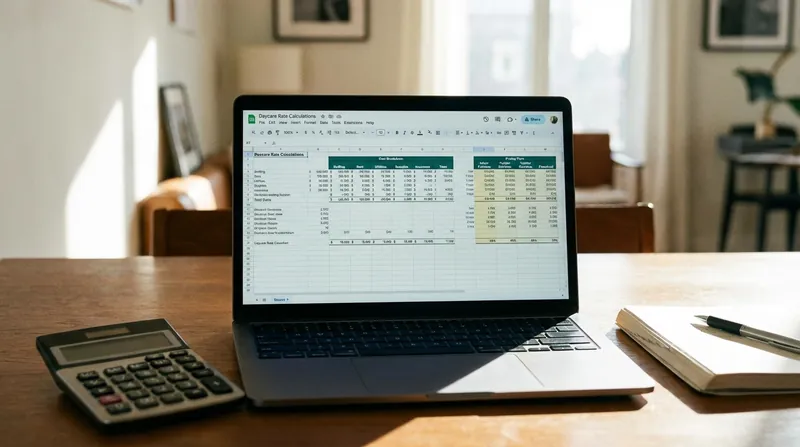
For the basic calculation, an Excel or Google Sheets template is sufficient. For ongoing management, many daycares use specialised software such as Kidis, Kidsfox, famly or MeKi. These programmes also help with subsidy accounting and invoicing parents.
Further guides
- Founding a daycare in Switzerland: The complete guide
- Daycare costs in Switzerland: What you really pay
- Subsidies for childcare: All models explained
- Insurance for childcare providers
- The right legal form for your childcare
Sources: kibesuisse, Federal Social Insurance Office (BSV), cantonal childcare offices, SECO, Swiss Association of Daycares. Last updated: February 2026.
More articles

Financing a Daycare: Sources & Strategies
Start-up capital for your daycare: equity, bank loans, foundations, municipal grants, and sample financing for a 24-plac...

Subsidies for Childcare Providers: How It Works
Learn how to obtain subsidies from your municipality, canton, and the federal government as a daycare, playgroup, or day...

Daycare Costs Switzerland 2026: Real Prices
How much does a daycare place cost in Switzerland? Current prices by canton, subsidies, tax deductions, and practical mo...
Daycare, Playgroup, or Childminder? The Complete Comparison
Which type of childcare is right for your family? Daycare, playgroup, and childminder compared side by side: age, costs,...

Daycare Tour: The Ultimate Checklist
What to look for during a daycare tour? The most important questions about organization, education, rooms, and costs....
Finding a Childminder: The Complete Guide
How to find the right childminder. About associations, costs, contracts, and what you should look for....