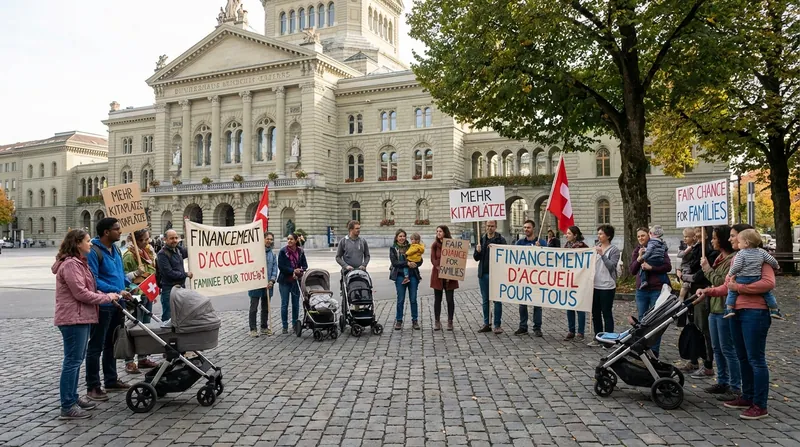
Daycare initiative 2026: What's ahead for families?
This content is being fact-checked
We are currently reconciling this guide with up-to-date official sources. Until the review is complete, please use the linked authority information for important decisions.
Open official sourceDaycare initiative 2026: What's ahead for families?
Childcare in Switzerland is expensive — too expensive, many families feel. A full-time daycare place costs CHF 2,000 to 3,000 per month privately. That's among the highest internationally. The popular initiative "Affordable daycares for all" aims to change this and cap parental contributions at a maximum of 10% of household income. At the same time, parliament has drafted its own counter-proposal. What's behind the two proposals, when will the vote take place, and what would concretely change for you as a mother or father? This guide summarises the current status.
The popular initiative "Affordable daycares for all"
What does the initiative demand?
The initiative was launched by a broad alliance of parties (SP, Greens, GLP, Centre Party), trade unions, women's and family organisations. The core demands:
- Capping parental contributions: Parents should pay a maximum of 10% of their household income for supplementary childcare.
- Federal funding: The federal government covers at least one third of the costs of supplementary childcare.
- Cantons and municipalities also bear a share — the exact allocation will be determined in the implementing legislation.
- Quality standards: Care quality shall be ensured through minimum standards (staff-to-child ratios, staff training).
- Employer participation: Employers should be able to contribute to costs (but are not required to).
What would this mean for an average family?
Let's take a family with a household income of CHF 10,000 per month (CHF 120,000/year) using a full-time daycare place:
| Today (private) | With initiative | |
|---|---|---|
| Daycare costs (full-time, 1 child) | CHF 2,400/mo. | max. CHF 1,000/mo. |
| Share of income | 24% | 10% |
| Annual saving | — | CHF 16,800 |
For families with lower incomes, the relief would be even greater. A family with CHF 6,000 monthly income would pay a maximum of CHF 600/month — instead of the current CHF 1,500–2,000.
The parliamentary counter-proposal
What does parliament propose?
Parliament has recognised that action is needed and has drafted an indirect counter-proposal. The key elements:
- Federal contribution to cantons: The federal government provides the cantons with approximately CHF 710 million annually to reduce parental contributions.
- Reduction of parental contributions: The cantons must reduce parental contributions by at least 20% compared to the status quo.
- Childcare allowance: A new childcare allowance supplements the existing child allowances. This is paid out via the family allowance funds.
- Quality measures: Federal funds for improving care quality and training initiatives.
- Time limit: The counter-proposal is initially limited to 5 years.
Comparison: Initiative vs. counter-proposal
| Criterion | Initiative | Counter-proposal |
|---|---|---|
| Parental contributions | Max. 10% of income | Min. 20% reduction |
| Federal contribution | Min. 1/3 of total costs | CHF 710 million/year |
| Legal entitlement | Yes (indirect) | No |
| Quality standards | Yes, minimum standards | Yes, support programmes |
| Employer participation | Optional | No |
| Time frame | Unlimited | Limited to 5 years |
| Estimated costs (federal) | CHF 2–3 billion/year | CHF 710 million/year |
Timeline: When will the vote take place?
The exact timeline depends on the parliamentary debate. As of February 2026:
- Initiative submitted: 2024 with over 100,000 valid signatures
- Parliamentary debate on counter-proposal: 2025/2026
- Expected popular vote: 2027 (likely in autumn)
- Entry into force (if accepted): Earliest 2028/2029
Should parliament adopt the counter-proposal and the initiative committee not withdraw the initiative, both proposals will likely come to a vote simultaneously — with a tie-breaking question.
What would change for families?
Scenario 1: Initiative is accepted
- Parental contributions are capped at maximum 10% of household income
- Massive relief especially for middle-income and lower-income families
- Likely more subsidised places, as demand increases
- Possibly waiting lists during the transition period until supply is expanded
- Care quality should improve through minimum standards
Scenario 2: Counter-proposal is accepted
- Parental contributions decrease by at least 20% compared to the current level
- New childcare allowance supplements child allowances
- More moderate relief than the initiative, but more realistically financeable
- Cantons have more flexibility in implementation
- Limited to 5 years — followed by evaluation and decision on continuation
Scenario 3: Both are rejected
- Status quo remains
- Continued large cantonal differences in subsidies and rates
- Families remain dependent on existing support: subsidies, childcare vouchers, tax deductions
What would change for providers?
The proposals would also have consequences for daycares, day-care families and playgroups:
- More demand: Lower prices lead to more registrations. Providers would need to expand capacity.
- Quality standards: Stricter requirements for staff-to-child ratios and staff qualifications.
- Funding security: Federal contributions would create a more stable financial basis.
- Administrative effort: New billing models and reporting obligations to cantons.
- Wage pressure: The quality standards could mean that higher salaries for care staff become necessary — which could exacerbate the skilled worker shortage but make the profession more attractive.
For more on current costs and subsidy models, see our guides Daycare costs in Switzerland and Subsidies for childcare.
Switzerland in international comparison
Switzerland spends significantly less on supplementary childcare in relation to GDP than other European countries.
| Country | Public spending (% GDP) | Max. parental contribution | Parental leave |
|---|---|---|---|
| Switzerland | 0.1% | No maximum | 14+2 weeks |
| Germany | 0.8% | Max. EUR 430/mo. (in many places free from age 3) | 14 months parental allowance |
| France | 1.3% | Income-dependent, free from age 3 | 16 weeks + parental leave |
| Sweden | 1.6% | Max. SEK 1,572/mo. (approx. CHF 140) | 480 days (!) |
| Denmark | 1.4% | Income-dependent, heavily subsidised | 52 weeks |
| Netherlands | 0.7% | 4–96% of costs (income-dependent) | 26 weeks |
The figures show: Switzerland lags far behind most European countries in public spending on childcare. Both proposals — the initiative and the counter-proposal — would bring Switzerland closer to the European average.
Current costs of childcare in Switzerland
According to the Federal Statistical Office (BFS) and kibesuisse, the average full costs of a daycare place in Switzerland amount to around CHF 130 per day or CHF 2,600 per month (full-time, 5 days). Costs vary by region:
| Region | Full costs/day (average) | Parental contribution private | Parental contribution subsidised |
|---|---|---|---|
| Major cities (ZH, BS, GE) | CHF 140–160 | CHF 100–150 | CHF 20–80 |
| Medium-sized cities | CHF 120–140 | CHF 90–130 | CHF 15–70 |
| Rural areas | CHF 100–120 | CHF 80–110 | CHF 10–60 |
For a detailed overview of costs by canton, see our guide Daycare costs in Switzerland.
What you can do right now
Regardless of how the vote turns out — you can already make use of existing support offerings today:
- Check subsidies: Many municipalities offer income-dependent subsidies. Details at Subsidies for childcare.
- Apply for childcare vouchers: In cantons like Bern and Lucerne, you can apply for childcare vouchers. All information in the article Applying for childcare vouchers.
- Use the tax deduction: Childcare costs are tax-deductible up to CHF 10,100 (federal tax). More at Deducting childcare from taxes.
- Search for a daycare place early: Regardless of political developments, good daycare places are scarce. Start your search on kizi.ch.
- Check legal entitlement: In some municipalities and cantons, there is already a (limited) entitlement to a care place. More in our guide Legal entitlement to a daycare place.
Frequently asked questions (FAQ)
Is there already a vote date?
No, a definitive date has not yet been set. The popular vote will likely take place in autumn 2027, depending on the progress of the parliamentary deliberations.
Would the initiative also affect day-care families and playgroups?
Yes. The initiative and the counter-proposal relate to all supplementary childcare — i.e. daycares, day-care families, after-school care and playgroups.
Who finances the additional costs?
For the initiative: federal government (min. 1/3), cantons, municipalities and potentially employers. For the counter-proposal: primarily the federal government with CHF 710 million/year, supplemented by cantonal funds and a new childcare allowance via the family allowance funds.
What happens with already subsidised places?
Families who already use subsidised places will likely benefit from even greater relief — particularly with the initiative, which provides for an absolute cap of 10% of income.
Conclusion
The daycare initiative and the parliamentary counter-proposal are the largest political efforts for affordable childcare in Switzerland's history. Regardless of which proposal is accepted — for families, the financial burden would be noticeably reduced. Until then, it is worth making optimal use of the existing support offerings.
Start your search for the right care place now on kizi.ch — and inform yourself about subsidies in your municipality.
Sources: Swiss Federal Chancellery — Popular initiative "Affordable daycares for all", Parliamentary Services — Curia Vista, Federal Statistical Office (BFS) — Families and Generations, kibesuisse — Swiss Childcare Association, OECD — Starting Strong Reports. As of: February 2026.
More articles
Staff Shortage in Daycares: Impact on Your Child
Thousands of qualified staff are missing in Swiss daycares. Learn what this means for care quality and what to look for ...

Daycare Costs Switzerland 2026: Real Prices
How much does a daycare place cost in Switzerland? Current prices by canton, subsidies, tax deductions, and practical mo...
Daycare, Playgroup, or Childminder? The Complete Comparison
Which type of childcare is right for your family? Daycare, playgroup, and childminder compared side by side: age, costs,...

Daycare Tour: The Ultimate Checklist
What to look for during a daycare tour? The most important questions about organization, education, rooms, and costs....
Finding a Childminder: The Complete Guide
How to find the right childminder. About associations, costs, contracts, and what you should look for....

Playgroup: Everything Parents Need to Know
Playgroup from what age? Costs, types, and why playgroups are so important for kindergarten preparation....